

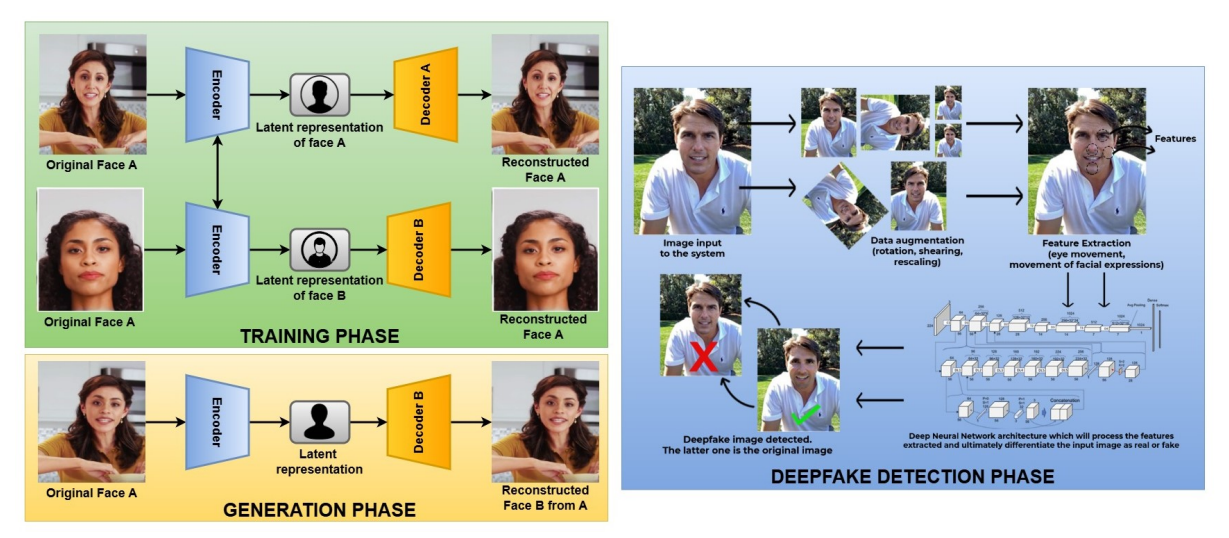
The proliferation of increasingly realistic deepfakes poses a significant threat to digital media integrity and public trust, prompting urgent research into effective detection and prevention strategies. Ayan Sar, Sampurna Roy, and Tanupriya Choudhury, from the University of Petroleum and Energy Studies, along with Ajith Abraham, investigate zero-shot deepfake detection, a promising approach that aims to identify manipulated content even when the specific forgery technique is previously unseen. Their work explores a range of advanced techniques, including self-supervised learning and generative model fingerprinting, and importantly, proposes proactive AI-driven prevention strategies that target the deepfake creation process itself. By combining these innovative detection methods with preventative measures like adversarial perturbations and blockchain-based verification, this research represents a crucial step towards building resilient defenses against the growing threat of deepfake attacks and safeguarding digital authenticity.
The study investigated self-supervised learning, transformer-based zero-shot classifiers, generative model fingerprinting, and meta-learning techniques to enhance adaptability against evolving deepfake threats. Researchers developed a framework leveraging these techniques to discern subtle inconsistencies indicative of synthetic media, moving beyond reliance on extensive labeled datasets. Proactive prevention strategies targeting the content generation pipeline itself were engineered, including adversarial perturbations to disrupt deepfake generator algorithms and digital watermarking to verify content authenticity. Real-time AI monitoring systems analyze content creation pipelines, flagging potentially manipulated content, while blockchain-based frameworks create immutable records of content origin and modifications. The research addresses limitations of current deepfake detection, such as poor generalization and the need for extensive labeled data, harnessing transformer-based classifiers and generative model fingerprinting for improved accuracy.
Autoencoders and SVMs Detect Novel Deepfakes
This research delivers advancements in zero-shot deepfake detection, focusing on methods that identify synthetic content without prior training on specific variations. Investigations reveal the power of autoencoders in detecting anomalies by combining reconstruction errors, feature extraction, and unsupervised learning, with convolutional autoencoders proving most effective for images and temporal autoencoders for videos. Trained autoencoders accurately reconstruct real images with low error, but introduce distortions when processing deepfakes, resulting in high reconstruction error. One-Class Support Vector Machines (One-Class SVMs) were analyzed as a powerful anomaly detection technique, classifying content falling outside learned boundaries as deepfakes, utilizing kernel functions to enhance pattern distinguishability.
Out-of-Distribution (OOD) detection plays a critical role in identifying unseen deepfake content by detecting feature distributions deviating from real-world data. Analysis of a video featuring Robert Downey Jr. deepfaked with Rowan Atkinson, across 657 frames, revealed inconsistencies, demonstrating the effectiveness of these methods.
👉 More information
🗞 Zero-Shot Visual Deepfake Detection: Can AI Predict and Prevent Fake Content Before It’s Created?
🧠 ArXiv: https://arxiv.org/abs/2509.18461




See today’s quantum computing news on Quantum Zeitgeist for the latest breakthroughs in qubits, hardware, algorithms, and industry deals.



