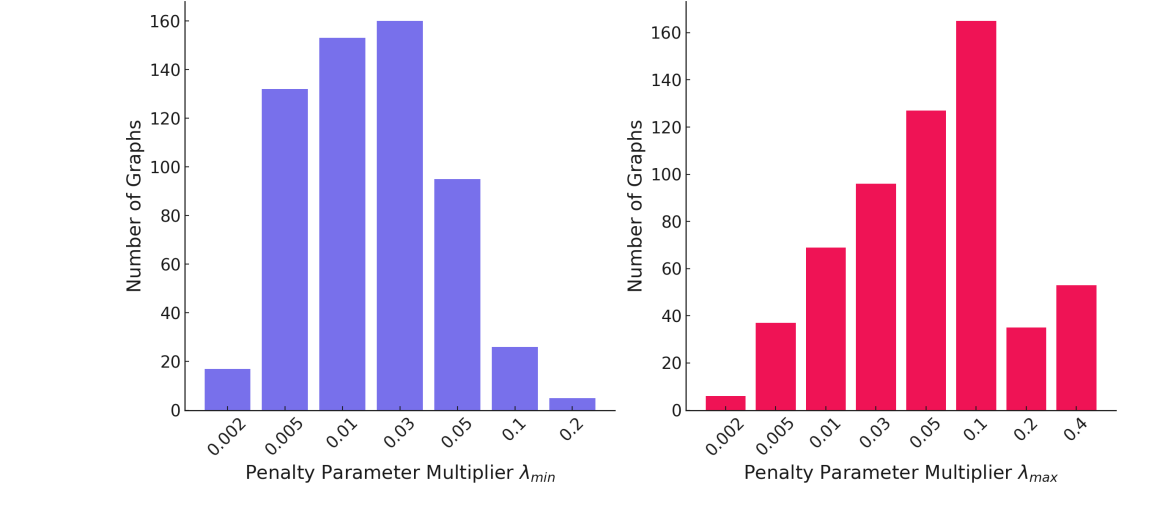
The Minimum Bisection Problem, a notoriously difficult challenge in combinatorial optimisation with applications ranging from computer engineering to network design, receives fresh attention from Renáta Rusnáková, Martin Chovanec, and Juraj Gazda. Their work investigates the use of quantum annealing, employing D-Wave Systems’ solvers, to tackle this problem, formulating it as a Quadratic Unconstrained Binary Optimisation model. A significant hurdle in this approach lies in selecting the optimal penalty parameter, which dictates solution quality and constraint satisfaction, and the researchers introduce a machine learning-based method to address this. By training a Gradient Boosting Regressor to predict suitable parameter values based on graph characteristics, they enable dynamic adjustment for each problem instance, enhancing the solver’s performance and consistently surpassing classical partitioning algorithms like Metis and Kernighan-Lin on large, randomly generated graphs with up to 4,000 nodes. This achievement demonstrates the potential of their approach as a viable alternative for solving complex graph partitioning problems.
Quantum Annealing for Graph Partitioning Problems
This research explores the application of Quantum Annealing, utilizing D-Wave systems, to solve graph partitioning problems, fundamental in areas like network optimization and security. The study reviews techniques, challenges, and considerations involved in employing quantum annealers for these complex tasks, including the principles of quantum annealing, the architecture of D-Wave systems, and the crucial technique of minor embedding. Researchers also address performance optimization strategies, such as parameter tuning and bias correction, to enhance the effectiveness of quantum annealing algorithms. The study highlights the potential of quantum annealing for applications in network optimization, cybersecurity, and mobility, while acknowledging challenges associated with limited qubit connectivity, noise, and the need for careful problem formulation. The research focuses on carefully selecting a penalty parameter to balance solution quality and constraint satisfaction, introducing a machine learning-based approach for adaptive tuning. By accurately forecasting the appropriate penalty parameter, the system significantly improves the solver’s ability to minimize the cut size while maintaining equally sized partitions. The team rigorously tested this approach using a large dataset of randomly generated graphs, scaling up to 4,000 nodes, and compared its performance against established classical partitioning algorithms, Metis and the Kernighan-Lin algorithm. This method dynamically adjusts the penalty parameter based on structural properties of the input graph, the number of nodes, and the graph’s density, enabling a better balance between solution quality and constraint satisfaction. Experiments conducted on a large dataset of randomly generated graphs, scaling up to 4,000 nodes, demonstrate a clear advantage over classical partitioning algorithms. The adaptive tuning strategy consistently outperformed both the Metis and Kernighan-Lin algorithms, indicating its potential as an alternative approach for graph partitioning. The team successfully demonstrated that by dynamically adjusting a key parameter, the penalty parameter, the performance of the quantum annealing solver can be significantly improved. The results demonstrate a clear advantage of this hybrid quantum-classical method over traditional partitioning algorithms, including Metis and the Kernighan-Lin algorithm, consistently outperforming them across a range of graph sizes up to 4,000 nodes. This improvement highlights the potential of quantum annealing, when combined with classical optimization techniques and machine learning, as a viable alternative for graph partitioning problems.
🗞 Quantum Annealing for Minimum Bisection Problem: A Machine Learning-based Approach for Penalty Parameter Tuning
🧠 ArXiv: https://arxiv.org/abs/2509.19005



See today’s quantum computing news on Quantum Zeitgeist for the latest breakthroughs in qubits, hardware, algorithms, and industry deals.