The pursuit of high-temperature superconductivity hinges on understanding how electrons interact within complex materials, and recent work sheds new light on these interactions in a key compound. Rishabh Mishra, Jonathan O. Tollerud, Paolo Franceschini, and colleagues demonstrate a method for directly observing the behaviour of electrons in different regions of a high-temperature superconductor, specifically underdoped Bi-2212. Their research utilises a sophisticated spectroscopic technique to measure coherent dynamics in areas where superconductivity is strongest and weakest, revealing a surprising link between electronic and vibrational energy. The team finds that these electron interactions persist for a remarkably long time in the superconducting state, suggesting a mechanism by which coherence is maintained and potentially contributing to the material’s ability to conduct electricity with no resistance. This achievement provides crucial insight into the fundamental processes governing high-temperature superconductivity and may guide the development of future superconducting materials.
Ultrafast Spectroscopy of Cuprate Superconductors
Scientists employ ultrafast spectroscopy, utilizing extremely short laser pulses, to investigate the dynamics of materials and observe processes occurring on incredibly short timescales. This powerful technique, particularly two-dimensional (2D) spectroscopy, correlates two frequency dimensions to provide detailed information about interactions between different excitations within a material, revealing dynamic processes previously hidden from view. This research focuses on understanding quantum coherence, the ability of quantum systems to exist in multiple states simultaneously, within cuprate superconductors, materials exhibiting superconductivity at relatively high temperatures. Investigations aim to understand the origin of this phenomenon, the nature of the pseudogap phase, and the roles of electron-phonon and electron-electron interactions.
Researchers also study collective excitations, such as phonons, magnons, and plasmons, which play a crucial role in determining a material’s properties, including its superconducting behavior. Scientists investigate spin fluctuations, the role of magnetic fluctuations in mediating electron interactions, and photoinduced phase transitions, where light induces changes in a material’s state. Measurements of coherence dynamics reveal how long quantum coherence lasts under different conditions, while studies of excitons, electron-hole pairs, and magnons, spin waves, provide insights into fundamental material properties. This research extends beyond cuprates to include semiconductors, photosynthetic systems, and layered materials, broadening the scope of investigation.
Key techniques employed include femtosecond laser spectroscopy and 2D electronic and Raman spectroscopy, which correlate electronic and vibrational frequency dimensions, respectively. Coherent Raman spectroscopy selectively excites vibrational modes, while heterodyne detection enhances signal sensitivity. Spectrally shaped pulses allow scientists to control excitation and probe the system with precision. This research suggests potential avenues for future exploration, including definitively determining the nature of the pseudogap, mapping interactions between different excitations, controlling quantum coherence, and developing new materials with promising properties.
Researchers also aim to explore non-equilibrium dynamics, studying materials far from equilibrium to reveal fundamental properties. Combining 2D spectroscopy with other experimental techniques, such as angle-resolved photoemission spectroscopy and scanning tunneling microscopy, promises a more complete understanding of material properties. Theoretical modeling plays a crucial role in interpreting experimental results and predicting new phenomena. Extending 2D spectroscopy to new dimensions, such as spatial resolution or time resolution, represents a promising frontier. This work represents a vibrant and evolving field where ultrafast spectroscopy serves as a powerful tool for probing the fundamental properties of materials and understanding complex phenomena like superconductivity.
Polarization-Resolved Spectroscopy of Superconducting Interactions
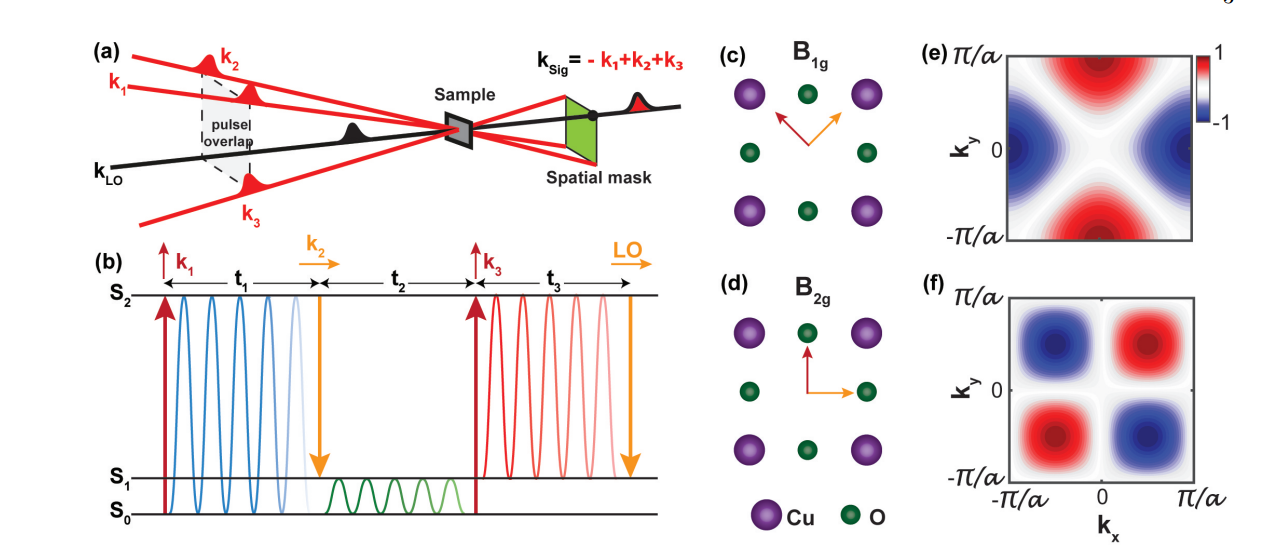
Scientists developed a sophisticated multidimensional coherent spectroscopy (MDCS) technique to investigate how electronic interactions occur within underdoped Bi-2212, a high-temperature superconductor. The technique directs three excitation beams onto the sample with distinct wavevectors, generating a measurable signal. By controlling the polarization of each pulse, researchers selectively excite Raman modes with either B1g or B2g symmetry, corresponding to different regions of the material’s electronic structure. Experiments utilize laser pulses centered at 770nm with a duration of approximately 22 femtoseconds to excite the sample and drive the nonlinear response.
By aligning the polarization of the first and third beams perpendicular to the second beam and local oscillator, scientists selectively excite Raman modes. The team records measurements as a function of the delay between the first two pulses, the delay between the second and third pulses, and the emission energy, resolving this energy directly with a spectrometer. A Fourier transform of the data yields a 2D spectrum correlating absorption and emission energies, while a further transform generates a 3D spectrum separating Raman coherences. The study reveals a strong anti-correlation between low-energy Raman excitations in the nodal region and electronic excitations at approximately 1.
6 electron volts within the superconducting state, with a surprisingly long coherence time exceeding 44 femtoseconds. In contrast, excitations at the antinode or above the critical temperature exhibit significantly faster decoherence and a weaker correlation. This difference in coherent dynamics suggests that nodal fluctuations are protected from dissipation and may be crucial for sustaining coherent behavior in high-temperature superconductivity.
Coherent Raman Excitations Reveal Superconductor Linkages
This research demonstrates a detailed connection between electronic and vibrational energy in a high-temperature superconductor, underdoped Bi-2212. Scientists employed polarization-resolved multidimensional coherent spectroscopy to selectively measure coherent Raman excitations in different regions of the material’s electronic structure, focusing on areas where superconductivity is either strongest or weakest. Their findings reveal a striking anti-correlation between the energy of Raman excitations in the nodal region and electronic excitations at 1. 6 eV, with both maintaining coherence for over 44 femtoseconds.
In contrast, excitations in the antinodal region exhibit significantly faster decoherence, measured at 18 femtoseconds, and no measurable correlation. This long-lived coherence in the superconducting state vanishes when the material enters the pseudogap or normal state. Measurements of the cross-diagonal width in 2D spectra reveal a narrow linewidth of 30 ±7 meV for the B2g configuration, corresponding to a decay constant of 44 ±8 fs. This narrow width indicates a strong correlation between low-energy Raman excitations and transitions to many-body Cu-O states. Conversely, the B1g configuration displays a broader cross-diagonal linewidth of 70 ±10 meV, with a corresponding decay constant of 18 ±3 fs, closely matching the instrument window function.
These results demonstrate that nodal fluctuations are protected from dissipation, potentially sustaining the coherent behavior crucial for high-temperature superconductivity. The team’s ability to measure coherence times exceeding the laser pulse duration highlights the strength of the correlation between the excited Raman mode and transitions to in-gap states. This work establishes a coherent link between the energy associated with the many-body Cu-O bands and the energy of electronic Raman modes mapping to the near-nodal superconducting gap, offering new insights into the mechanisms driving superconductivity.
Coherent Electron-Vibration Coupling in Superconductors
Researchers have demonstrated.
🗞 Direct measurement of coherent nodal and antinodal dynamics in underdoped Bi-2212
🧠 ArXiv: https://arxiv.org/abs/2509.18524




See today’s quantum computing news on Quantum Zeitgeist for the latest breakthroughs in qubits, hardware, algorithms, and industry deals.