The search for materials exhibiting exotic quantum states of matter has led researchers to explore the interplay between topological and correlated electron behaviour, and now, Zhongdong Han, Yiyu Xia, and colleagues at Cornell University, alongside Kenji Watanabe and Takashi Taniguchi from the National Institute for Materials Science, report a significant advance in this field. They demonstrate a pathway to oscillate between two distinct quantum states, quantum spin Hall insulators and excitonic insulators, within twisted bilayer tungsten diselenide. This achievement overcomes a major hurdle in materials science by creating a tunable system where these states can be repeatedly accessed and observed, revealing a novel topological transition and providing crucial insights into the fundamental electronic properties of this fascinating material. The team’s findings open new avenues for exploring and potentially harnessing these quantum states for future technologies.
Researchers have now demonstrated a pathway to transition between these states within twisted bilayer WSe2, a material exhibiting exceptional tunability. This achievement unlocks the potential to explore correlated and topological phenomena by precisely controlling electron-like and hole-like Landau levels, which emerge when a magnetic field is applied.
Twisted WSe2 Reveals Correlated Insulating States
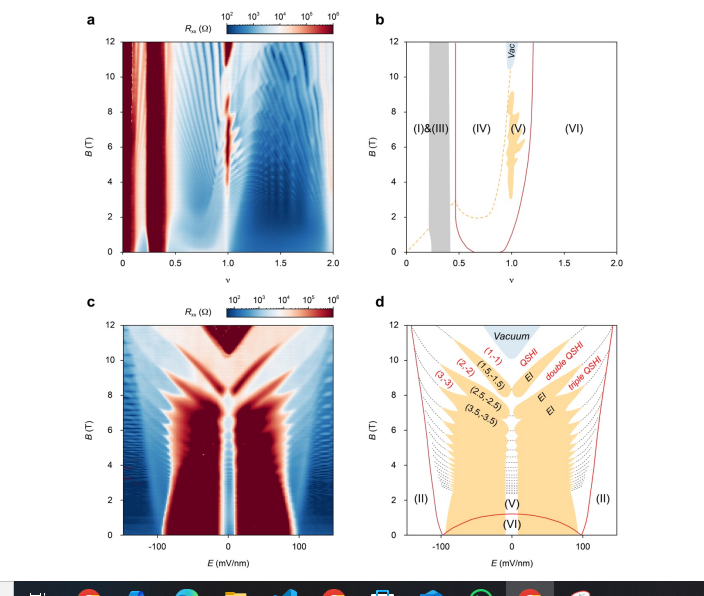
Scientists have successfully observed both quantum spin Hall insulator and excitonic insulator states within twisted bilayer WSe2 at specific conditions. These states arise from strong interactions between electrons and the material’s unique band structure. Fully filled Landau levels lead to quantum spin Hall states, characterized by quantized conductance and conducting edge channels, while half-filled Landau levels give rise to excitonic insulator states, where electrons and holes pair up, creating an insulating state. Nonlocal resistance measurements provide strong evidence for spin-polarized edge channels in the quantum spin Hall phase, confirming spin-momentum locking, and temperature measurements reveal a gap opening in the excitonic insulator phase, consistent with electron-hole pair formation. These observed insulating states are directly linked to the topology of the material’s electronic structure, which changes with applied fields.
Tunable Transitions Between Quantum Insulating States
Scientists have demonstrated a novel transition between quantum spin Hall and excitonic insulating states within twisted bilayer WSe2. This work realizes a topological phase transition by precisely controlling electron-like and hole-like Landau levels, allowing for exploration of correlated and topological states of matter. Experiments reveal periodic oscillations between these states at half-band-filling, corresponding to charge neutrality, due to the interplay between cyclotron energy and electron interactions. The team measured up to four pairs of helical edge states within the quantum spin Hall insulator phase, confirming the presence of spin-polarized conducting channels at the material’s edges, protected by spin-orbit coupling and characterized by a topological invariant.
Further analysis demonstrates that the stability of the excitonic insulator phase is influenced by the material’s Fermi surface, which can be tuned with an applied electric field. Measurements of electrical resistance as a function of filling factor and electric field agree with calculated electronic properties, alongside evidence of correlated insulating behaviour and superconductivity near a filling factor of one. These findings demonstrate a pathway to engineer and explore novel quantum states of matter, offering potential advancements in spintronics and low-dissipation electronics.
Tunable Oscillations Between Insulating States Observed
This research demonstrates a novel pathway to transition between quantum states of matter, specifically revealing oscillations between topological insulators and excitonic insulators within twisted bilayer WSe2. By carefully controlling the material’s electronic properties using a magnetic field, scientists observed periodic shifts between these distinct states at half-band-filling, a condition where electron and hole densities are balanced. The ability to tune between these states is enabled by the material’s unique characteristics, including a large valley g-factor and narrow bandwidth, which allow for precise control of electron-hole pair density. The findings provide a comprehensive understanding of the electronic behaviour within twisted bilayer WSe2, detailing how the interplay between cyclotron energy and electron interactions drives the observed transitions. Furthermore, manipulating the material’s Fermi surface with an electric field influences the stability of the excitonic insulator state. The results also lay the groundwork for exploring more exotic quantum states, such as fractional quantum spin Hall insulators, by leveraging the unique properties of conjugate electron and hole Landau levels.
🗞 Quantum oscillations between excitonic and quantum spin Hall insulators in moiré WSe2
🧠 ArXiv: https://arxiv.org/abs/2509.19287



See today’s quantum computing news on Quantum Zeitgeist for the latest breakthroughs in qubits, hardware, algorithms, and industry deals.