

Establishing long-distance entanglement is fundamental to building a future quantum internet, yet maintaining this fragile connection over significant distances presents a major challenge. Sudipta Mondal, Pritam Halder, Stav Haldar, and Aditi Sen(De) investigate efficient methods for formulating quantum networks under realistic noise conditions, specifically focusing on amplitude damping, a common source of error in quantum systems. Their research demonstrates that a network designed to account for this specific type of noise consistently outperforms a simplified approach that relies on a broader, ‘twirled’ noise model, achieving higher fidelity and greater average entanglement. This improvement is particularly significant in early quantum experiments where generating reliable links is difficult, and the team identifies specific conditions where the more nuanced approach proves essential for successful entanglement distribution, representing a crucial step towards practical quantum communication networks.
Optimised Quantum Networks Under Amplitude Damping
Establishing a large-scale quantum internet requires overcoming the challenges of signal loss and decoherence during long-distance quantum communication. Researchers are now developing efficient strategies for formulating quantum networks specifically under the influence of amplitude damping noise, a common source of error in photonic quantum systems. This work presents a novel approach to optimise network performance by carefully considering the characteristics of this noise and tailoring the quantum communication protocols accordingly. The team demonstrates that this optimised formulation yields significant benefits compared to utilising a simplified approach, particularly in terms of achievable entanglement fidelity and communication rates. This improvement stems from a more accurate representation of the noise and a corresponding refinement of the quantum error correction strategies employed within the network, contributing to the development of practical and robust quantum communication networks capable of supporting future quantum internet applications.
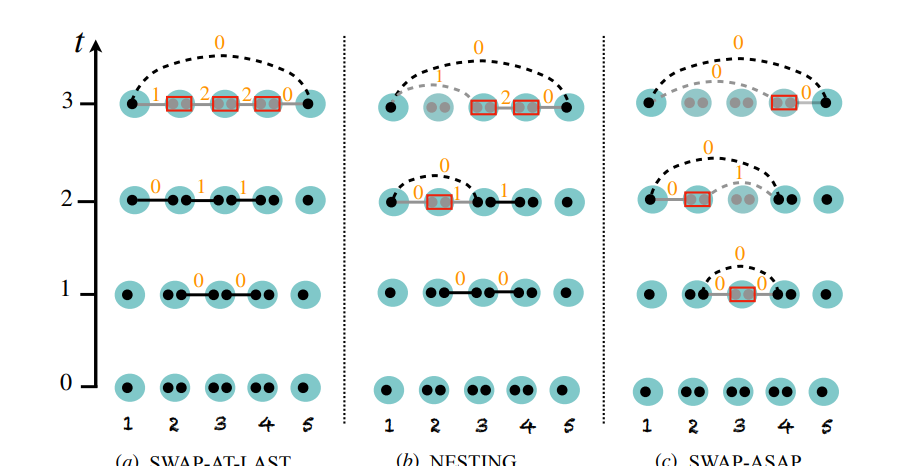
This research focuses on distributing end-to-end entanglement in a quantum network operating under realistic, non-simplified noise, specifically amplitude damping noise. The authors term this an amplitude damping-affected quantum network (AQN). Unlike a simplified counterpart, the AQN produces a state with a richer structure, described by four parameters. They develop a method for simulating the AQN, meticulously tracking these four parameters for each entangled link.
Quantum Repeaters, Entanglement, and Error Correction
Current research highlights a central focus on enabling long-distance quantum communication by overcoming signal loss and maintaining the integrity of quantum information. The work covers various aspects of quantum communication, including protocols and architectures for quantum repeaters, optimisation of entanglement distribution, and strategies for dealing with noise and imperfections. A significant trend within the research is the application of reinforcement learning to optimise resource allocation, control policies, and network design.
Researchers are exploring various quantum error correction codes and techniques, alongside advancements in building reliable quantum memories. The core of quantum communication, entanglement distribution and manipulation, is also extensively covered, with work detailing entanglement generation, swapping, distillation, and characterisation. Performance analysis and optimisation of quantum repeater schemes are central themes, alongside recent work on building and testing quantum repeater components and networks. Specific areas of investigation include optimising repeater chain parameters, using reinforcement learning for network control, developing robust quantum operations, and improving quantum memory performance.
Block-Diagonal States in Noisy Quantum Networks
This research establishes a comprehensive theoretical framework for understanding quantum repeater networks affected by amplitude damping noise, termed an amplitude damping-affected quantum network (AQN). Unlike previous studies simplifying noise through approximations, this work retains a full description of the quantum states, revealing a richer structure than previously understood. The team demonstrated that states in an AQN remain block-diagonal in the Bell basis, fully described by four parameters, even as noise accumulates and entanglement swapping occurs. This contrasts with simplified models where states become fully Bell-diagonal and characterised by a single parameter.
The results of this analysis show that AQN consistently outperforms its simplified counterpart in terms of both entanglement fidelity and average entanglement. This advantage is particularly significant in conditions relevant to near-term experiments, specifically when elementary link generation is infrequent and coherence times are limited. The team also identified specific scenarios where the simplified model fails to distribute entanglement successfully, while AQN maintains performance. While the study explored several entanglement distribution policies, finding one to be most effective, the researchers acknowledge that further improvements could be achieved through the implementation of distillation procedures, fidelity cut-offs, and optimised swapping strategies. Future work may focus on developing policies specifically tailored to address amplitude damping noise and further enhance network performance.
🗞 Efficient formulation of quantum network under amplitude damping noise: Highlighting benefits over its Pauli-twirled counterpart
🧠 ArXiv: https://arxiv.org/abs/2509.18064


See today’s quantum computing news on Quantum Zeitgeist for the latest breakthroughs in qubits, hardware, algorithms, and industry deals.



