Quantum computing promises revolutionary advances, but building reliable quantum computers requires overcoming the inherent fragility of quantum information, and researchers are increasingly exploring quantum error detection as a promising intermediate step towards full error correction. Ji Liu, Quinn Langfitt, and Mingyoung Jessica Jeng, alongside colleagues from Argonne National Laboratory, Grambling State University, and Tuskegee University, present QuantEM, a new compiler that automates the complex process of integrating quantum error detection codes into quantum programs. This achievement significantly reduces the burden on developers, allowing for faster exploration of error detection strategies and ensuring consistent implementation across different quantum computing architectures. QuantEM accepts a quantum circuit, a chosen detection code, and target hardware specifications, then automatically generates an optimised, executable circuit, and even selects appropriate detection codes based on circuit structure and resource estimates, representing a substantial step towards practical, fault-tolerant quantum computation.
Automated Quantum Error Detection Compiler Design
This research introduces QuantEM, a compiler designed to simplify the application of Quantum Error Detection (QED) techniques to quantum algorithms. The core problem it addresses is the complexity of integrating QED into existing quantum workflows, hindering developers from leveraging these error-reducing methods. QuantEM automates QED integration, optimizes circuits after code insertion to minimize overhead, and streamlines implementation for a wider range of users. The compiler specifically focuses on optimizing the Iceberg code as a QED technique within its framework, and is publicly available to encourage further research and development. QuantEM addresses the challenge of manually applying QED, which requires significant expertise and effort, limiting the potential for improving the reliability of quantum computations on near-term devices. In essence, QuantEM bridges the gap between theoretical QED techniques and their practical implementation in real-world quantum algorithms.
Automated Quantum Error Detection Code Integration
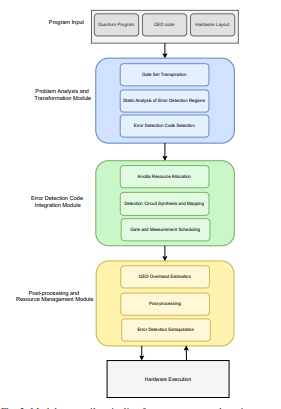
The research team engineered QuantEM, a modular compiler that automates the integration of Quantum Error Detection (QED) codes into arbitrary quantum circuits, moving beyond mitigation strategies towards more robust fault tolerance. The system accepts a high-level circuit description, a chosen detection code, and a target hardware topology, then delivers an optimized and executable circuit ready for implementation. A key innovation lies in the compiler’s ability to automatically select the most appropriate detection code, such as Pauli Check Sandwiching (PCS) or Iceberg codes, based on circuit structure and estimated resource requirements. The workflow begins with a Program Analysis and Transformation Module, which operates at the logical circuit level to identify suitable regions for error detection, transpiling the input circuit into a target gate set and performing static analysis to pinpoint circuit blocks ideal for protection.
Based on this analysis, the module selects the optimal detection code, favoring PCS for circuits rich in Clifford operations or Iceberg codes for those with numerous two-qubit Pauli rotations. Following analysis, the Error Detection Code Integration Module allocates ancilla qubits and synthesizes the corresponding error detection subcircuit, prioritizing mapping to minimize additional SWAP operations due to hardware connectivity constraints. The system distinguishes between original circuit gates and those introduced for error detection, a crucial distinction absent in standard compilers. Finally, the Postprocessing and Resource Management Module addresses QED-specific overhead and refines measurement results, employing techniques like Pauli check extrapolation to achieve resource-efficient estimation. The compiler’s modular structure enables flexible composition and customization of the compilation pipeline, allowing researchers to explore different QED strategies and hardware targets effectively.
QuantEM Compiler Automates Quantum Error Detection Integration
Scientists developed QuantEM, a compiler that automates the integration of quantum error detection (QED) codes into arbitrary quantum programs, representing a significant step towards fault-tolerant quantum computing. The work addresses a critical need for tools that can efficiently manage the complexities of applying QED, which identifies and discards faulty runs rather than attempting error correction. QuantEM accepts a high-level quantum circuit and a target hardware topology, then produces an optimized and executable circuit incorporating the chosen detection code. The compiler operates through three key modules: program analysis and transformation, detection code integration, and postprocessing and resource management.
The program analysis module examines circuits in a QED-aware context, introducing necessary checks and ancilla qubits. The team designed QuantEM to automatically select an appropriate detection code based on circuit structure and resource estimates, streamlining the development process. Currently, the compiler supports both Pauli check sandwiching and Iceberg codes, with a design that allows for future expansion to accommodate new QED schemes and hardware targets. Experiments demonstrate that QuantEM successfully automates the complex QED compilation flow, reducing developer burden and enabling rapid code exploration. By carefully distinguishing between the original computational circuit and the error detection subcircuits, QuantEM avoids interference with intended error propagation paths, ensuring correct and effective circuit operation. This approach delivers consistent application of detection primitives and facilitates the development of more reliable quantum algorithms.
Automated Quantum Error Detection Compiler Demonstrated
QuantEM, a new modular and extensible compiler, automates the integration of quantum error detection (QED) codes into quantum programs, significantly reducing complexity for developers. The compiler accepts a high-level quantum circuit and a specified hardware backend, then produces an optimized and executable circuit incorporating error detection. By automating this process, QuantEM enables more user-friendly application of QED techniques to quantum algorithms and facilitates rapid exploration of different code options. Currently, QuantEM supports Pauli check sandwiching and Iceberg codes, but its modular design allows for the incorporation of future QED schemes and adaptation to new hardware targets. The compiler is publicly available, allowing researchers to build upon and extend its functionality, fostering collaboration and accelerating progress in the development of robust and reliable quantum computations.
🗞 QuantEM: The quantum error management compiler
🧠 ArXiv: https://arxiv.org/abs/2509.15505