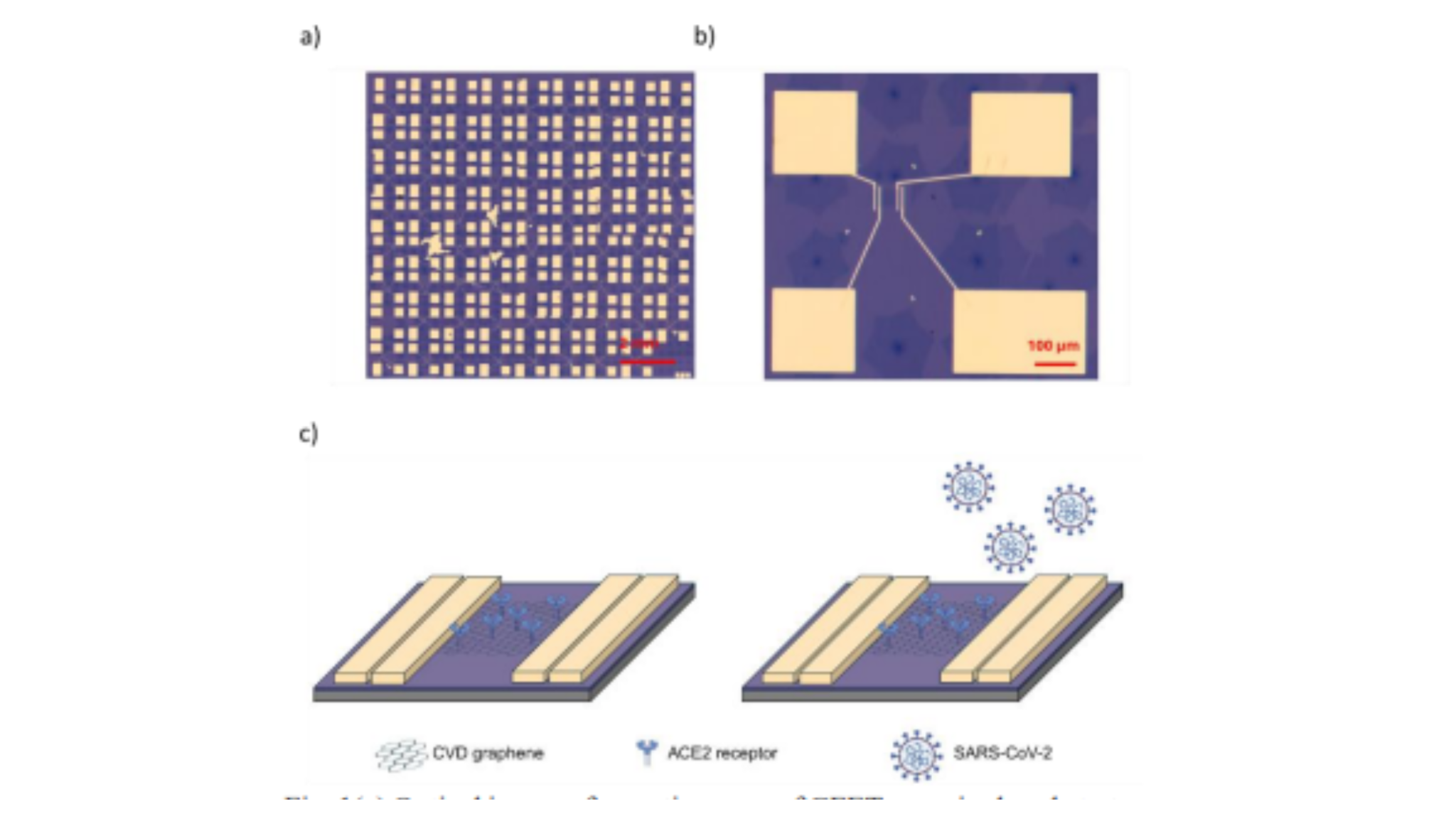
The urgent need for rapid and adaptable diagnostic tools became strikingly clear during the recent global spread of COVID-19, caused by the SARS-CoV-2 virus, and researchers are actively developing innovative sensing technologies to address this challenge. Leonardo Martini, Ylea Vlamidis, and Ileana Armando, working at the Istituto Italiano di Tecnologia, alongside colleagues including Vaidotas Mišeikis and Valerio Voliani, have created a scalable platform for detecting the SARS-CoV-2 spike protein using graphene field-effect transistors. This new sensor achieves remarkably sensitive detection, identifying the protein at concentrations as low as 1 fg/mL, and importantly, avoids the need for complex labelling procedures. By functionalising graphene with a key protein, ACE2-His, the team demonstrates a robust and reproducible system that offers a flexible foundation for detecting emerging viral variants and other pathogens, representing a significant step towards future-proof diagnostic technologies.
Graphene Biosensors Detect Coronavirus Spike Protein
Scientists are developing highly sensitive biosensors using graphene field-effect transistors to detect the SARS-CoV-2 spike protein, a crucial step in improving COVID-19 diagnostics. These sensors aim to identify even extremely low concentrations of the spike protein, offering the potential for early and accurate detection. The biosensors are built on large-area, high-quality graphene grown through chemical vapor deposition, allowing for scalable production and integration into diagnostic devices. Researchers are also focused on techniques to regenerate the sensors, enabling their repeated use and reducing costs.
The success of these biosensors relies heavily on the quality of the graphene itself. Scientists prioritize high electron mobility, large crystal size to minimize performance-hindering boundaries, and cleanliness to reduce defects. They also work to decouple the graphene from the underlying substrate, further enhancing its electrical properties. Graphene is grown on copper and then transferred to other materials, with sapphire sometimes used as a supporting layer. Researchers employ a variety of techniques to analyze the graphene and the biosensors.
Raman spectroscopy assesses graphene quality, identifies defects, and measures strain. Atomic force microscopy characterizes the surface morphology of the graphene. Electrical measurements determine the graphene’s electrical properties, while X-ray photoelectron spectroscopy analyzes its chemical composition. Challenges remain in minimizing defects and strain within the graphene, controlling substrate interactions, and achieving consistent sensor performance. This research has significant implications for point-of-care diagnostics, potentially leading to portable, rapid, and affordable devices for detecting COVID-19 and other diseases. The potential for creating arrays of sensors to detect multiple targets simultaneously further expands its versatility. By harnessing the unique properties of graphene, this work represents a significant step towards advanced biosensors with the potential to revolutionize disease diagnostics.
Graphene Transistors Detect SARS-CoV-2 Spike Protein
Scientists engineered a scalable matrix of graphene field-effect transistors to directly and rapidly detect the spike protein of SARS-CoV-2. This innovative approach utilizes high-quality, single-crystal graphene, leveraging its exceptional electrical properties and high surface-to-volume ratio for sensitive biomolecular detection. Researchers functionalized the graphene with the human ACE2 receptor, a protein the virus uses to enter cells, enabling specific binding of the spike protein and subsequent detection. This method achieves a limit of detection as low as 1 femtogram per milliliter, demonstrating exceptional sensitivity for detecting even trace amounts of the viral protein.
To ensure reliability, the team conducted measurements on approximately 70 individual devices for each analyte concentration, establishing robust statistical validation of the sensor’s performance. This enabled precise determination of the sensor’s response and minimized the impact of device-to-device variations. The study employed a non-covalent functionalization strategy, avoiding harsh chemical treatments that could degrade the graphene’s performance and ensuring biocompatibility for future applications. This label-free approach simplifies the detection process and reduces potential interference. The developed sensor offers a flexible platform adaptable for detecting emerging SARS-CoV-2 variants or other viral pathogens, offering a promising tool for future diagnostic applications and pandemic preparedness. By eliminating the need for fluorescent tags or other signal enhancers, the sensor streamlines the detection process and minimizes potential interference.
Graphene Biosensor Detects Spike Protein at Femtogram Levels
Scientists have developed a graphene-based biosensor capable of detecting the SARS-CoV-2 spike protein with a limit of detection as low as 1 femtogram per milliliter. The work centers on a scalable matrix of graphene field-effect transistors, functionalized with the ACE2 receptor to specifically bind the receptor binding domain of the virus’s spike protein. This innovative approach enables rapid and direct detection of the virus without the need for labeling or amplification, offering a significant advantage for point-of-care diagnostics. The biosensor utilizes high-quality, single-crystal graphene grown using chemical vapor deposition, ensuring exceptional sensitivity and scalability.
Researchers fabricated an array of 100 micro transistors, incorporating both functionalized devices and control groups, to enable robust statistical analysis and assess device variability. Measurements from approximately 70 devices per analyte concentration consistently demonstrated the reliability and reproducibility of the platform. This extensive sampling provides confidence in signal trends and accurately defines saturation effects. The biosensor’s exceptional sensitivity was confirmed in experiments, achieving a detectivity of 1 fg/mL in phosphate-buffered saline. The graphene transistors function as solution-gated devices, where ions in the electrolyte form an electrical double layer acting as the gate. This design allows for sensitive detection of biomolecules binding to the functionalized graphene surface, altering the transistor’s electrical characteristics. The ease of surface functionalization allows for adaptation to detect emerging SARS-CoV-2 variants and other viral pathogens, positioning the GFET platform as a versatile tool for future diagnostic challenges.
Graphene Sensor Detects Spike Protein at 1fg/mL
This research demonstrates the successful development of a highly sensitive electronic sensor for detecting the SARS-CoV-2 spike protein, utilizing large-area graphene field-effect transistors. The fabrication process, employing chemical vapor deposition and optical lithography, offers a cost-effective and scalable approach for industrial production of these sensors. Through non-covalent functionalization with ACE2, the graphene exhibits targeted chemical responsiveness while maintaining its exceptional electronic properties, ultimately achieving a remarkable detection limit of 1 fg/mL for the spike protein. The team validated the sensor’s performance through extensive statistical analysis, utilizing approximately 70 devices per analyte concentration, a significantly larger sample size than reported in many comparable studies.
This rigorous approach enhances the reliability and sensitivity of the biosensor, enabling consistent detection even at trace concentrations. The sensor’s response exhibits a sigmoidal binding behavior, consistent with established biomolecular interaction models, and shows potential for reusability following washing cycles. While the sensor demonstrates high sensitivity, the authors acknowledge that the response flattens at both very low and high concentrations, likely due to limitations in binding site availability or the graphene channel’s modulation capacity. Future work could focus on optimizing the functionalization process and sensor architecture to address these limitations and further enhance performance, potentially extending the platform’s applicability to detect a wider range of viruses and quantify viral loads.
🗞 Scalable CVD Graphene Field-Effect Transistor Platform for Viral Detection: Application to COVID-19
🧠 ArXiv: https://arxiv.org/abs/2509.15818




See today’s quantum computing news on Quantum Zeitgeist for the latest breakthroughs in qubits, hardware, algorithms, and industry deals.