The behaviour of magnetism in novel materials remains a central challenge in modern physics, and recent attention has focused on a class of compounds called altermagnets. Zhaobo Zhou from Charles University, Sangeeta Sharma from the Max-Born-Institute and Freie Universität Berlin, and Junjie He demonstrate how laser light can precisely control the magnetism in a specific altermagnet, chromium antimonide. Their research reveals that the direction of the laser beam dramatically alters the way the material responds, switching between maintaining zero magnetism and temporarily creating a measurable magnetic state. This control arises from the unique electronic structure of these materials, allowing light to directly transfer spin between atoms in an anisotropic manner, and provides a fundamental insight into manipulating magnetism with light, potentially paving the way for new technologies in data storage and processing.
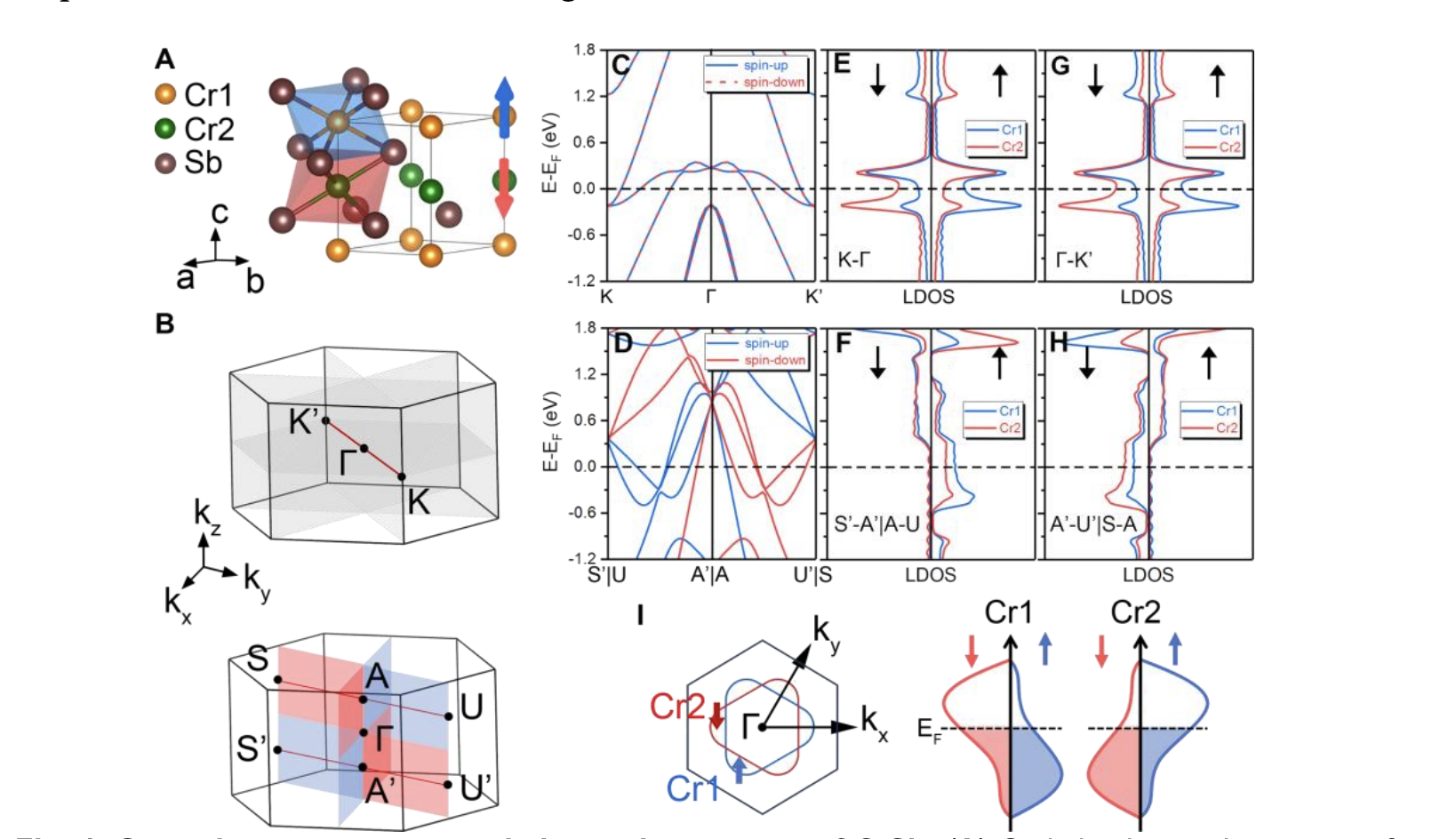
Researchers are gaining a clearer understanding of how laser light interacts with altermagnetic materials. Using advanced theoretical calculations, they reveal that laser-induced demagnetization dynamics in the g-wave antiferromagnet CrSb are strongly governed by the laser’s direction of incidence. When laser light strikes the material head-on, along its central axis, the two chromium sublattices demagnetize symmetrically, preserving the material’s overall zero magnetization, unlike the behavior observed in conventional antiferromagnets. However, when the laser light strikes at an angle, it induces asymmetric demagnetization between the sublattices, transiently driving the system into a ferrimagnetic-like state with a sizable net magnetization. This direction-dependent response arises from the characteristic nodal structures inherent to the g-wave antiferromagnetic order and the resulting symmetry-breaking upon oblique illumination.
Altermagnetic Spin Dynamics with Ultrafast Laser Pulses
This research significantly advances understanding of altermagnetism, a recently discovered magnetic state exhibiting properties distinct from conventional ferromagnetism and antiferromagnetism. Scientists have demonstrated that the response of the altermagnet CrSb to laser light is strongly dependent on the direction of incidence, revealing a complex interplay between light and spin. Through detailed theoretical calculations, the team showed that when laser light strikes the material along its axis, the two constituent chromium sublattices demagnetize symmetrically, preserving the overall zero magnetization. However, off-axis illumination induces asymmetric demagnetization, temporarily creating a ferrimagnetic-like state with a net magnetization.
This direction-dependent behavior arises from the unique nodal structures within the material’s electronic structure, which facilitate anisotropic optical intersite spin transfer, a process where spin information is transferred between atoms via light. By comparing CrSb with conventional antiferromagnets, the researchers propose that light-induced magnetization occurs when the laser polarization aligns with regions of uncompensated spin within the electronic structure, a characteristic that can be readily identified through analysis of the local spin density of states. While the calculations provide a fundamental understanding of ultrafast dynamics in altermagnets, the authors acknowledge that further investigation is needed to explore the effects of different laser parameters and material compositions. Future work could focus on extending these calculations to other altermagnetic materials and exploring the potential for controlling magnetization with light for technological applications.
Laser Light Controls Altermagnetism and Magnetization
This research significantly advances understanding of altermagnetism, a recently discovered magnetic state exhibiting properties distinct from conventional ferromagnetism and antiferromagnetism. Scientists have demonstrated that the response of the altermagnet CrSb to laser light is strongly dependent on the direction of incidence, revealing a complex interplay between light and spin. Through detailed theoretical calculations, the team showed that when laser light strikes the material along its axis, the two constituent chromium sublattices demagnetize symmetrically, preserving the overall zero magnetization. However, off-axis illumination induces asymmetric demagnetization, temporarily creating a ferrimagnetic-like state with a net magnetization. This direction-dependent behavior arises from the unique nodal structures within the material’s electronic structure, which facilitate anisotropic optical intersite spin transfer, a process where spin information is transferred between atoms via light.
🗞 Ultrafast controlling net magnetization in g-wave altermagnets via laser fields
🧠 ArXiv: https://arxiv.org/abs/2509.14991


See today’s quantum computing news on Quantum Zeitgeist for the latest breakthroughs in qubits, hardware, algorithms, and industry deals.