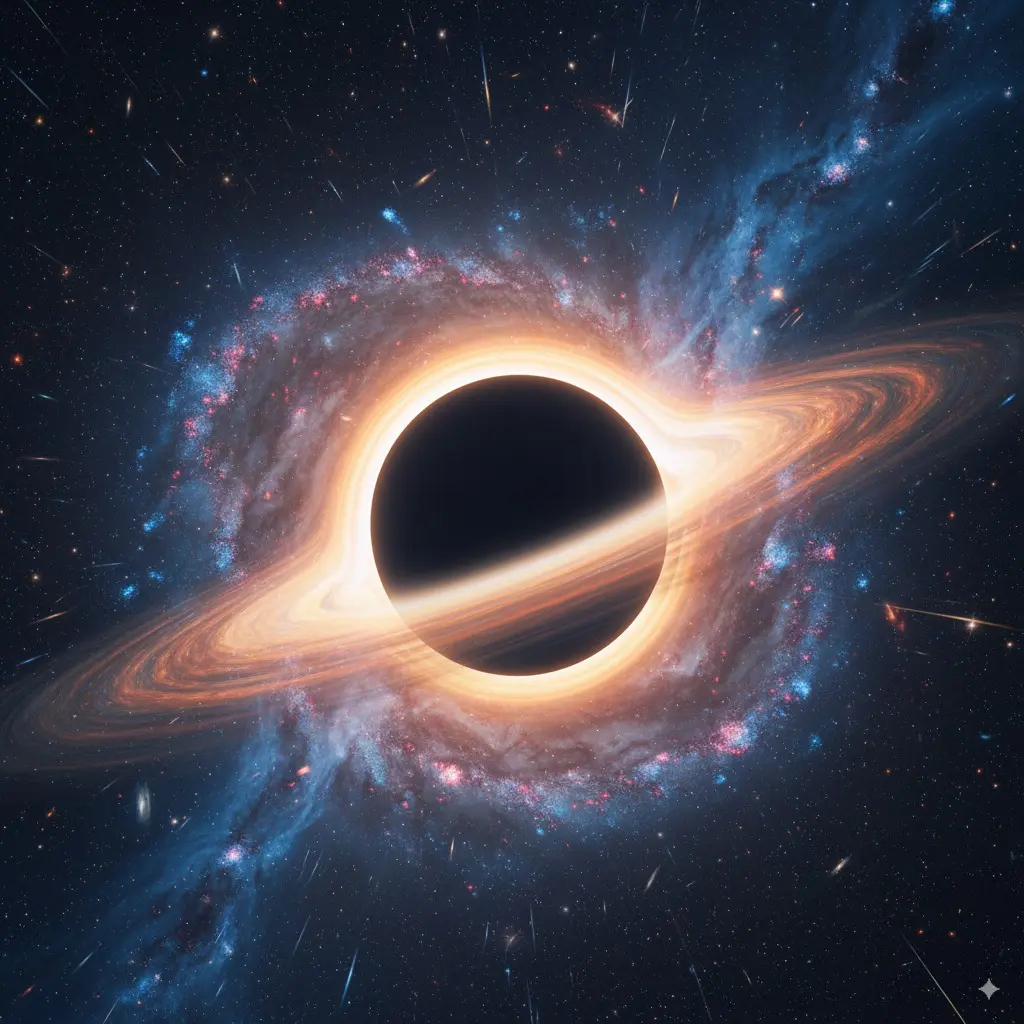
Black holes, enigmatic objects with immense gravitational pull, continue to challenge our understanding of the universe, and recent research delves into their behaviour within a modified theory of gravity. A. A. Araújo Filho from Universidade Federal de Campina Grande, N. Heidari, and Iarley P. Lobo from Federal University of Paraíba investigate gravitational phenomena around black holes as predicted by higher-order curvature-scalar gravity, a theory extending Einstein’s general relativity. This work meticulously examines the black hole’s structure, its response to various disturbances, and how it bends light, ultimately producing constraints on the theory itself using observations ranging from the Event Horizon Telescope data to the subtle movements within our own solar system. By exploring these effects, the team provides new insights into the nature of gravity and tests the boundaries of our current cosmological models, potentially revealing whether Einstein’s theory requires refinement to fully describe these extreme objects.
This work explores the gravitational consequences of a recently proposed black hole solution, extending beyond the standard predictions of general relativity. Researchers began by meticulously analyzing the black hole’s horizon structure, focusing on both the event horizon and the Cauchy horizon to understand the boundaries of spacetime around the object. These studies investigate how modifications to general relativity affect these shadows, examining photon orbits and the mass, charge, and spin of black holes. Wormholes, theoretical tunnels connecting different points in spacetime, are also a recurring topic, with investigations into their geometry, stability, and effects on particle dynamics and thermodynamics. Many papers explore extensions or modifications to general relativity, including Kalb-Ramond gravity, bumblebee gravity, non-commutative geometry, rainbow gravity, and f(R) gravity.
Researchers are also exploring quantum gravity phenomenology, attempting to connect theoretical quantum gravity ideas to observable phenomena. Studies of gravitational lensing, the bending of light by massive objects, are used to probe spacetime geometry and black hole properties. Researchers investigate how particles move and how thermodynamic properties are affected by the curvature of spacetime, including studies of particle creation, evaporation, and quantum gases. Observations, such as radio links with spacecraft and gravitational waves, are used to test the predictions of general relativity.
This research is organized into several key areas: black hole shadows and lensing, modified gravity theories, wormhole physics, particle dynamics and thermodynamics in curved spacetime, tests of general relativity, and quantum gravity phenomenology. The research demonstrates a strong focus on theoretical modeling, combining concepts from general relativity, quantum field theory, thermodynamics, and differential geometry. There is a growing interest in modified gravity as a way to address limitations of standard theory and explain dark matter and dark energy, with many papers attempting to connect theoretical predictions to observational data.
Black Hole Dynamics and Quasinormal Mode Analysis
The study then turned to the optical properties of the black hole, specifically investigating null geodesics, the paths of light, and the stability of the photon sphere surrounding it. Researchers precisely determined the black hole’s shadow, the dark region created by the extreme gravity bending light, providing a key observable for astronomical tests. Gravitational lensing was analyzed in both the weak-field and strong-deflection limits using established theoretical approaches. These constraints were derived from precise measurements of the precession of Mercury’s orbit, the bending of light, and the time delay of light, known as the Shapiro effect, within our solar system. The results demonstrate the ability to test modifications to general relativity using well-established solar system observations. The analysis provides a rigorous framework for understanding black hole physics beyond the standard model and opens new avenues for testing fundamental theories of gravity with astronomical observations.
Black Hole Shadows and Gravitational Lensing
The team comprehensively analyzed the black hole’s horizon structure and examined quasinormal modes across various types of perturbations, confirming the solution’s mathematical consistency and physical plausibility. Further investigation focused on the black hole’s optical properties, specifically the paths of light around it, and the resulting black hole shadow. By applying these observations, the researchers were able to place constraints on a parameter within the black hole solution, which arises from higher-order curvature terms in the gravitational theory.
Additionally, the team assessed the solution’s compatibility with Solar System measurements, including the precession of Mercury’s orbit and the time delay of light signals, providing further validation. The authors acknowledge that the current analysis relies on specific assumptions within the chosen theoretical framework and that further research is needed to explore the full range of possible solutions and their implications. Future work could focus on refining the constraints on the model parameters, investigating the behavior of matter in the vicinity of the black hole, and exploring the potential connections between this modified gravity theory and other areas of physics, such as cosmology and quantum gravity.
🗞 Black Hole Gravitational Phenomena in Higher-Order Curvature-Scalar Gravity
🧠 ArXiv: https://arxiv.org/abs/2509.11985