Calculating the electric dipole moment of molecules presents a significant challenge for quantum computers, yet understanding these properties is crucial for modelling chemical behaviour. Michael A. Jones, Harish J. Vallury, and colleagues from the University of Melbourne and CSIRO Data61 now demonstrate a new approach to this problem, utilising computed moments to estimate the dipole moment of the water molecule on a superconducting quantum device. Their method achieves a remarkable level of accuracy, reducing errors by over 50% compared to standard techniques, even in the presence of noise. This breakthrough establishes a pathway towards more reliable and efficient quantum computation of essential molecular properties, extending the capabilities of near-term quantum devices beyond simple energy calculations.
With rapid progress in quantum computing, researchers are increasingly exploring whether current and near-term devices can solve relevant problems, particularly in quantum chemistry. While many experimental demonstrations focus on ground-state electronic energy, other ground-state properties, such as the electric dipole moment, are also of significant interest.
Dipole Moment Calculations, Noise Mitigation Strategies
This document details a comprehensive analysis of methods for calculating dipole moments using quantum computation, with a strong focus on mitigating the effects of noise. The authors meticulously compare several approaches, identifying their strengths and weaknesses and explaining why certain methods perform better than others. The core problem involves accurately determining the dipole moment of a molecule using quantum computation, leveraging the Hellmann-Feynman theorem to relate the dipole moment to expectation values of operators. The team utilizes a moments-based approach, calculating moments of operators to approximate the dipole moment, while addressing the crucial challenge of noise inherent in quantum computers.
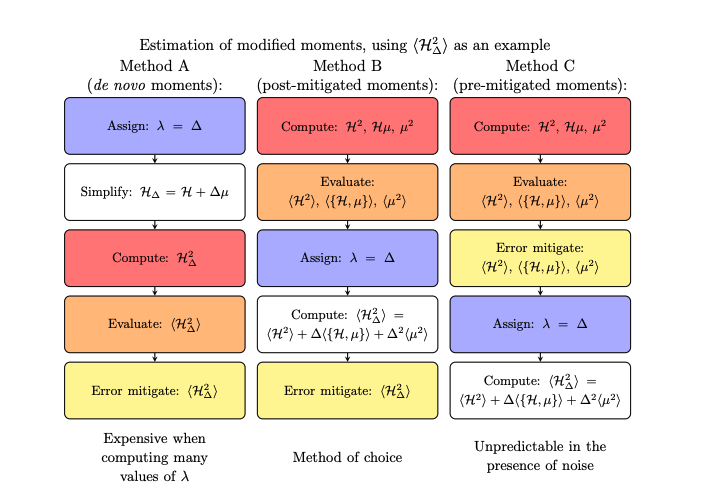
The analysis compares five methods, each with distinct characteristics. Methods utilizing truncation and error mitigation demonstrate improved accuracy and stability. Pre-mitigation with certain methods proves unreliable due to poor noise mitigation, particularly for higher-order terms. The effectiveness of error mitigation depends heavily on the accuracy of the noise model used.
Water Dipole Moment Computed with High Fidelity
Scientists have achieved a significant breakthrough in accurately computing molecular properties using quantum devices, demonstrating improved measurement of the electric dipole moment of the water molecule. The research team employed the quantum computed moments (QCM) method, a technique based on the Lanczos cluster expansion, to estimate this fundamental property on an IBM superconducting quantum device. Results demonstrate that the noise-mitigated QCM method achieves agreement with full configuration interaction (FCI) calculations to within 0. 03 ±0. 007 debye, representing a 2% ±0.
5% margin of error. This level of precision represents a substantial improvement over direct expectation value determination, which yielded errors on the order of 0. 07 debye, or 5%, even without added noise. The team’s approach leverages Hamiltonian moments and a Hellmann-Feynman approach to correct estimates without requiring additional quantum circuit depth, offering a practical advantage for complex calculations. The water molecule, represented in the STO-3G basis, served as a test case. Experiments reveal that the QCM method effectively adapts energy estimation techniques for the noise-robust evaluation of non-energetic ground-state properties, opening new avenues for quantum chemical simulations. The success of this method highlights the potential for improved accuracy in calculating molecular properties, even with the limitations of current quantum hardware, and paves the way for more sophisticated quantum simulations of chemical systems.
Water’s Dipole Moment Measured with Quantum Device
The research team successfully estimated the electric dipole moment of a water molecule using a superconducting quantum device, demonstrating a method for determining molecular properties beyond just ground-state energy. Employing a computed moments method, based on a Lanczos cluster expansion, the results achieved accuracy within 0. 03 debye (2%) of full configuration interaction calculations, a significant improvement over direct expectation value determination which exhibited errors of approximately 0. 07 debye (5%). This demonstrates the adaptability of moments-based energy estimation techniques to evaluate other ground-state properties, offering a pathway to more robust and accurate quantum simulations of chemical systems.
The study broadens the scope of potential applications for quantum devices in chemistry, moving beyond energy calculations to encompass a wider range of molecular properties. While the method proved effective, the authors acknowledge limitations related to error correction, suggesting that future work could explore refinements to further improve accuracy. This research establishes a promising approach for leveraging quantum computation to determine molecular characteristics, potentially offering advantages over classical computational methods in the field of chemistry.
🗞 Moments-based quantum computation of the electric dipole moment of molecular systems
🧠 ArXiv: https://arxiv.org/abs/2509.10758