The behaviour of correlated metals near points where their electronic properties change dramatically represents a significant challenge in condensed matter physics, often giving rise to novel states of matter. X. Boraley, A. D. Christianson, J. Lass, and colleagues at the PSI Center for Neutron and Muon Sciences, Switzerland, investigate these transitions in the material CeCuAg to understand the underlying physics driving them. Their work focuses on critical fluctuations, the microscopic changes that precede these transitions, and reveals a pronounced anisotropy in how these fluctuations respond to external magnetic fields. This anisotropy, coupled with observations of temperature dependence, suggests that the transitions in CeCuAg are driven by complex, three-dimensional fluctuations of the material’s spin density, offering new insight into the behaviour of strongly correlated metals and the emergence of novel quantum states.
Neutron Scattering Reveals Critical Fluctuations and Hertz-Millis-Moriya Support
This study details investigations into critical fluctuations within the material CeCu₅. ₈Ag₀. ₂, likely a magnetic compound, using neutron scattering techniques. Researchers meticulously measured these fluctuations and performed detailed data analysis to understand the material’s behavior near a critical point. By comparing experimental results with theoretical models, specifically the Hertz-Millis-Moriya (HMM) model, the team found stronger evidence supporting its predictions.
The analysis involved fitting data to extract key parameters, allowing for a precise characterization of the fluctuations. Detailed critical scaling analysis revealed the superior descriptive power of the HMM model. This supports the main findings, providing a robust foundation for understanding the material’s critical behavior.
Neutron Scattering Maps Magnetic Fluctuations in CeCuAg Alloy
Scientists investigated quantum critical phenomena in CeCu₅. ₈Ag₀. ₂ using inelastic neutron scattering to probe magnetic fluctuations. This technique allowed them to map the energy and momentum of scattered neutrons, revealing the characteristics of these fluctuations. By systematically varying the magnetic field orientation, the team observed a pronounced anisotropy in the suppression of critical fluctuations, meaning the fluctuations responded differently depending on the field’s direction.
Specifically, fluctuations diminished rapidly when the magnetic field aligned with one crystallographic axis, but remained robust up to 8 Tesla when aligned along another. Researchers determined that fluctuations at one location exhibited quantum criticality, and the temperature dependence of these fluctuations aligned with the predictions of the HMM model. These observations strongly suggest that the material undergoes a spin-density wave (SDW) quantum phase transition, reflecting the inherent spin anisotropy within its long-range ordered state.
Spin Anisotropy Drives Quantum Critical Fluctuations
Researchers have gained a detailed understanding of quantum critical fluctuations in CeCu₅. ₈Ag₀. ₂, revealing the underlying driving force behind its quantum phase transition. Experiments utilizing inelastic neutron scattering demonstrate a pronounced sensitivity of these fluctuations to magnetic fields applied along one crystallographic axis, but not along another, up to 8 Tesla. This anisotropy directly reflects the spin anisotropy inherent in the material’s long-range ordered ground state, confirming a spin-density wave (SDW) mechanism for the observed quantum criticality.
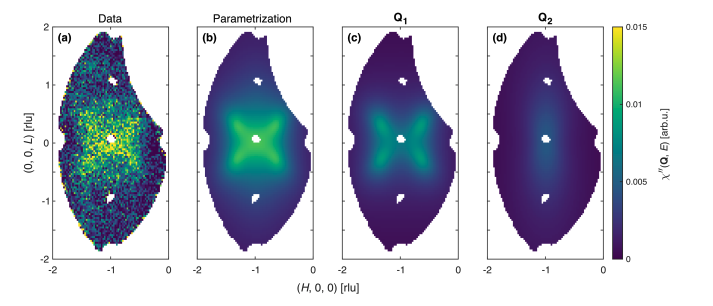
The team mapped large regions of reciprocal space using neutron spectrometers at extremely low temperatures. Measurements reveal that fluctuations at a specific point in reciprocal space are indeed quantum critical, while fluctuations at another location exhibit a small energy gap. The observed sensitivity to magnetic fields, coupled with the temperature dependence of the fluctuations, strongly suggests that the quantum phase transition in CeCu₅. ₈Ag₀. ₂ is driven by three-dimensional spin-density wave fluctuations. These findings build upon previous work and provide crucial insight into the microscopic origins of quantum criticality in rare-earth metals.
Anisotropic Suppression of Quantum Critical Fluctuations
This research provides new insight into the nature of quantum phase transitions in strongly correlated metals, specifically within the compound CeCu₅. ₈Ag₀. ₂. By employing inelastic neutron scattering, scientists investigated the critical fluctuations arising as the material’s electronic ground state is tuned, revealing a pronounced anisotropy in their suppression when exposed to magnetic fields. The team discovered that fluctuations are rapidly suppressed by fields aligned along one crystallographic axis, but remain robust along another, reflecting the underlying spin anisotropy of the material.
Importantly, the study identified that fluctuations at one particular point in reciprocal space exhibit characteristics consistent with a quantum critical point. These findings strongly suggest that the observed quantum phase transition in CeCu₅. ₈Ag₀. ₂ is driven by the formation of spin-density wave order.
🗞 Magnetic Field Dependence of Critical Fluctuations in CeCu Ag
🧠 ArXiv: https://arxiv.org/abs/2509.10285




See today’s quantum computing news on Quantum Zeitgeist for the latest breakthroughs in qubits, hardware, algorithms, and industry deals.