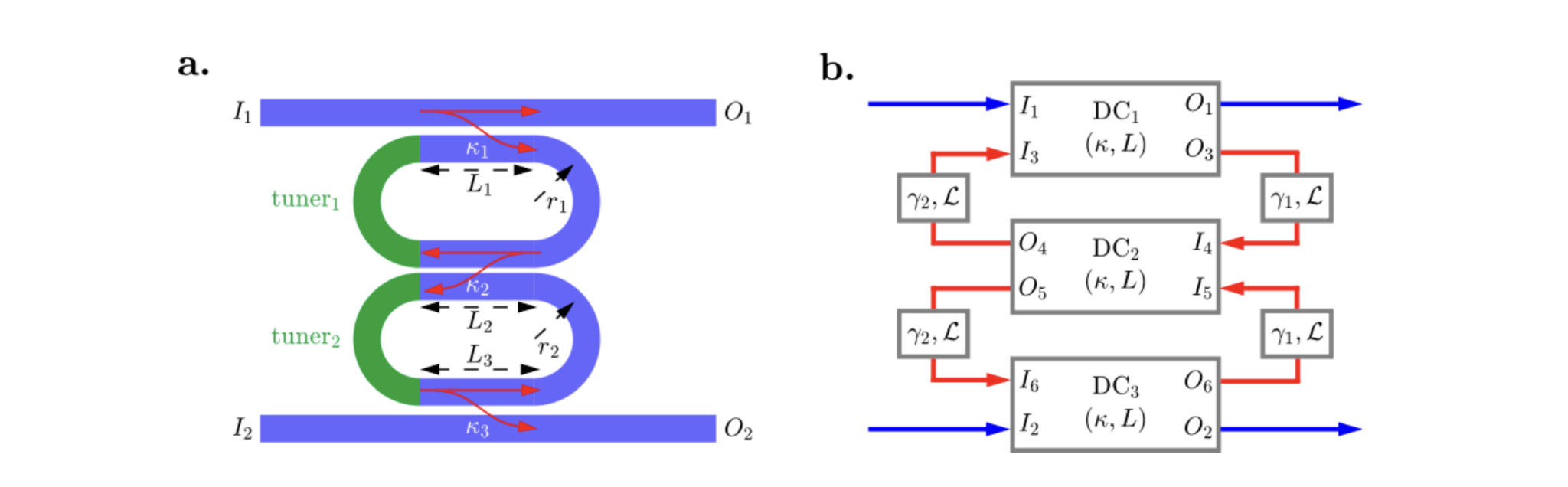
The demand for faster and more efficient computation drives research into photonic computing, and a team led by Hussein Talib, Phillip D. Sewell, and Ana Vukovic at the University of Nottingham now presents a new approach to building photonic matrix multipliers. Their work focuses on designing programmable photonic integrated circuits using double racetrack resonators as fundamental building blocks, offering a potentially versatile alternative to existing technologies like directional couplers and Mach-Zehnder interferometers. The researchers demonstrate that these resonators accurately replicate the functions of conventional components, enabling complex matrix calculations, and validate their design with detailed simulations. This innovative framework promises to enhance the fidelity and broaden the application of reconfigurable photonic circuits, particularly for high-speed signal processing in communication networks and within microwave photonics systems.
Reconfigurable Photonics for Complex Signal Processing
Research into programmable photonic integrated circuits aims to create flexible optical systems capable of performing complex signal processing, mirroring the functionality of electronic digital signal processing. This work explores various circuit designs and techniques to overcome challenges in building practical, robust, and scalable photonic processors, with a central focus on developing architectures that can be reconfigured to perform different tasks, offering versatility in optical signal manipulation. Scientists are investigating mesh-like networks of optical components, such as Mach-Zehnder Interferometers and ring resonators, to implement complex mathematical transformations. Different network arrangements, including diamond and braided meshes, are being tested for their resilience to imperfections in manufacturing and operation, alongside self-configuring circuits that automatically calibrate and compensate for errors, ensuring reliable performance.
Accurate modelling of component behaviour, including imperfections, is crucial, and tools like COMSOL Multiphysics are used for detailed simulations. A key application area is matrix multiplication, a fundamental operation in many signal processing tasks. Researchers are also exploring the potential of optical neural networks and reservoir computing for time-series analysis and pattern recognition. Error mitigation strategies, including redundant components and robust optimization techniques, are essential for building reliable systems, aiming to create photonic processors that can handle a wide range of signal processing applications, from communications to sensing.
Double Racetrack Resonators for Photonic Processing
Scientists have engineered a new building block for photonic integrated circuits using double racetrack resonators, offering a novel approach to programmable optical signal processing. This design mimics the behaviour of conventional components like directional couplers and Mach-Zehnder interferometers, making it suitable for complex matrix calculations, and has been validated through detailed 3D simulations. The team successfully implemented a 3-by-3 photonic processor using these resonators, demonstrating the feasibility of the design for practical applications. Scalability was further analysed using a combined simulation approach, blending the precision of detailed modelling with the efficiency of circuit analysis.
To showcase versatility, scientists also implemented an all-optical low-pass filter, confirming the resonator’s ability to handle diverse optical functions. The research confirms a strong agreement between simulated and analytical models, validating the double racetrack resonator as a viable component for reconfigurable photonic circuits. This method achieves a compact design with finer control over tuning parameters and improved spectral control compared to existing building blocks, demonstrating the potential to build a single, reprogrammable circuit capable of performing various optical tasks, enhancing flexibility and efficiency in applications like communication systems and microwave photonics.
Double Racetrack Resonators Enable Photonic Processors
Scientists have developed a new building block for photonic integrated circuits based on double racetrack resonators, demonstrating a pathway towards more flexible and reprogrammable optical systems. The research centers on designing a circuit element that can perform complex calculations with light, offering advantages over traditional approaches, and has been analytically derived and confirmed through detailed 3D simulations. A 3-by-3 photonic processor was implemented using these resonators, confirming the viability of the design. Further analysis investigated the scalability of the system, demonstrating its potential for larger, more complex circuits.
To showcase versatility, the team implemented an all-optical low-pass filter, highlighting the building block’s adaptability beyond simple matrix operations. Results confirm a strong agreement between simulated and analytical models, validating the double racetrack resonator as a viable component for reconfigurable photonic circuits. The design offers a compact layout, finer control over tuning parameters, and improved spectral control, making it well-suited for narrow-band applications such as reconfigurable optical filters, and demonstrates a pathway towards building a single circuit that can be reprogrammed for different tasks, enhancing flexibility and efficiency in various applications, including all-optical signal processing and microwave photonics for emerging telecommunications technologies.
Photonic Circuits Programmable with Double Resonators
This work introduces a new framework for designing programmable photonic integrated circuits, utilising double racetrack resonators as fundamental building blocks. Researchers demonstrated that these resonators possess a behaviour comparable to conventional components, such as directional couplers, establishing a solid basis for their use in complex, tunable circuits, and successfully mapped both unitary and non-unitary systems, including a practical implementation as an infinite impulse response filter. While the framework demonstrates potential for broader applications in optical signal processing and neuromorphic computing, the authors acknowledge that the scalability of circuits built with these resonators requires further optimisation for large-scale applications. Analysis indicates that the number of necessary signal elements increases more rapidly with circuit size compared to designs based on conventional components, and future research will likely focus on addressing these scalability challenges to enable the creation of high-density, reconfigurable photonic circuits demanding compactness, precision, and adaptability.
🗞 Photonic Matrix Multiplication Circuit Based on Double Racetrack Resonator Building Blocks
🧠 ArXiv: https://arxiv.org/abs/2509.09445
See today’s quantum computing news on Quantum Zeitgeist for the latest breakthroughs in qubits, hardware, algorithms, and industry deals.