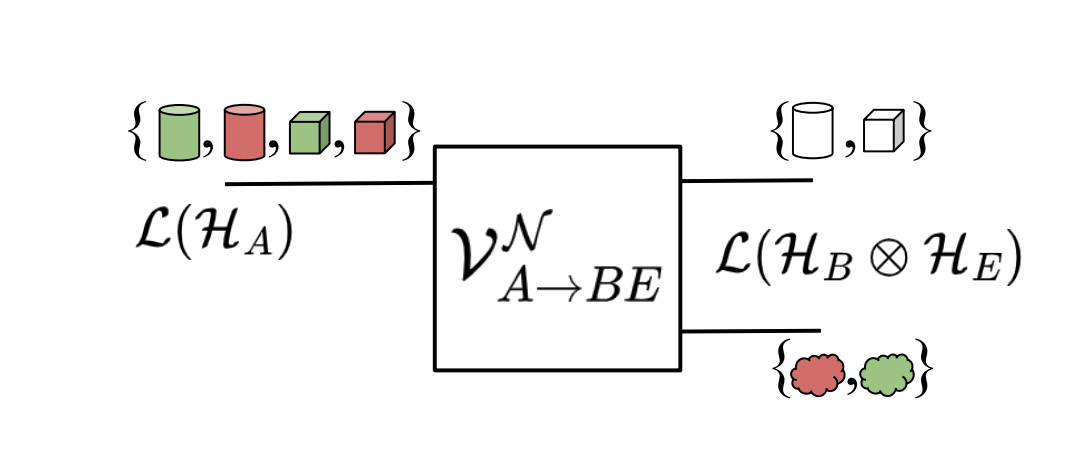
The fundamental limits of reliable communication face a surprising challenge when transmitting information through channels that reduce the number of possible signals, effectively causing information to leak into the surrounding environment. Snehasish Roy Chowdhury from the Indian Statistical Institute, Sutapa Saha from the Harish Chandra Research Institute, and Subhendu B. Ghosh from S. N. Bose National Centre for Basic Sciences, alongside Ranendu Adhikary and Tamal Guha, investigate whether this lost information can be recovered with only minimal interaction with the environment. Their work reveals that even a small amount of environmental assistance can fully restore a channel’s encoding capability, surpassing the limits achievable through complex correlations between sender and receiver. This research establishes a new framework for understanding communication limits and identifies a clear distinction between conventional environmental assistance and the true potential for unlocking a channel’s full encoding strength, offering insights into more efficient communication strategies.
Minimal Assistance and Quantum Channel Capacity
This research explores the fundamental limits of information transmission through quantum channels, particularly those where the output dimension is smaller than the input. The overarching goal is to understand how effectively information can be sent through these constrained channels and whether assistance from the environment can restore lost capacity. Researchers investigate the relationship between different types of quantum channels, focusing on those with limited assistance and their ability to transmit information, even if their standard capacity appears suboptimal. The work aims to demonstrate that certain channels can achieve a specific level of performance, establishing a lower bound on their capacity.
Key concepts include quantum channels, entanglement-assisted classical capacity (EACC), and minimal assistance, where the sender and receiver have limited shared resources. The methodology involves constructing channel matrices and analyzing their properties, alongside detailed encoding and decoding schemes to simulate information transfer. The research demonstrates that channels with suboptimal EACC can still achieve a certain level of performance, and establishes a clear connection between the positive semi-definite (PSD) rank of a channel matrix and its capacity. The team proves that even minimal environmental assistance can fully restore a channel’s encoding capability, despite its suboptimal capacity in conventional terms. Strong correlations between sender and receiver cannot replace this environmental assistance, emphasizing its crucial role.
Environmental Assistance Restores Channel Encoding Capability
This research investigates how effectively information can be transmitted through channels where the output dimension is smaller than the input, a scenario that typically leads to information loss. The study addresses a fundamental question: can assistance from the environment help recover these lost symbols and restore optimal encoding capabilities? Researchers developed a generalized framework to explore this concept, moving beyond the limitations of standard environment-assisted classical capacity models. To demonstrate this, the team examined a specific example, revealing that even minimal environmental assistance can fully restore a channel’s encoding capability, despite its suboptimal capacity in conventional terms.
Remarkably, the work proves that even the strongest possible correlations between sender and receiver cannot replace this environmental assistance, highlighting its crucial role. The methodology involved constructing channel matrices representing information transfer and analyzing their properties under various conditions, including the presence and absence of environmental assistance. The research establishes a new understanding of how to maximize information transfer in channels with limited output dimensions, potentially impacting fields like quantum communication and data compression.
Recovering Lost Information With Minimal Assistance
Scientists have demonstrated a method for maximizing the encoding capability of communication channels where the output dimension is smaller than the input, effectively recovering information seemingly lost during transmission. The research focuses on whether symbols lost due to this dimensional reduction can be recovered with minimal assistance from the environment, revealing that standard methods for assessing this capability are insufficient. The team measured the classical transmission fidelity of a specific channel, achieving a maximum value when employing minimal environmental assistance. This contrasts with a maximum mutual information achievable without this assistance, even at the cost of sacrificing a symbol.
Crucially, the research proves that for certain channels, minimal environmental assistance outperforms both preshared randomness and non-signaling correlations in enhancing classical transmission fidelity. Generalizing these findings, scientists identified a class of quantum channels where conventional environment-assisted classical capacity is suboptimal, and minimal environmental assistance unlocks the channel’s true encoding strength optimally. This work introduces a new approach to characterizing communication advantages provided by resources, with classical transmission fidelity serving as a measure of performance.
Minimal Assistance Fully Restores Channel Capacity
This research introduces a new understanding of how effectively information can be transmitted through channels where the output dimension is smaller than the input dimension. The findings demonstrate that even when a channel appears limited in its capacity, its true encoding potential can be fully restored with minimal assistance from the environment, meaning the receiver requires only a small amount of external information. Importantly, this improvement surpasses what can be achieved through other shared resources, such as pre-shared randomness or even strong quantum correlations between sender and receiver. The study establishes a clear separation between conventional measures of channel capacity and this newly identified potential, particularly for certain classes of quantum channels.
This “unlocking” of encoding strength provides a useful criterion for assessing the communication benefits provided by any resource, analogous to how purity is assessed in quantum information theory. The authors acknowledge that identifying specific, physically motivated measures of this enhanced capacity remains an area for further investigation. Furthermore, the research highlights a counterintuitive implication for quantum broadcast channels, suggesting that communication between receivers can, in some cases, outperform shared non-signaling correlations.
🗞 Minimal Help, Maximal Gain: Environmental Assistance Unlocks Encoding Strength
🧠 ArXiv: https://arxiv.org/abs/2509.09340
See today’s quantum computing news on Quantum Zeitgeist for the latest breakthroughs in qubits, hardware, algorithms, and industry deals.