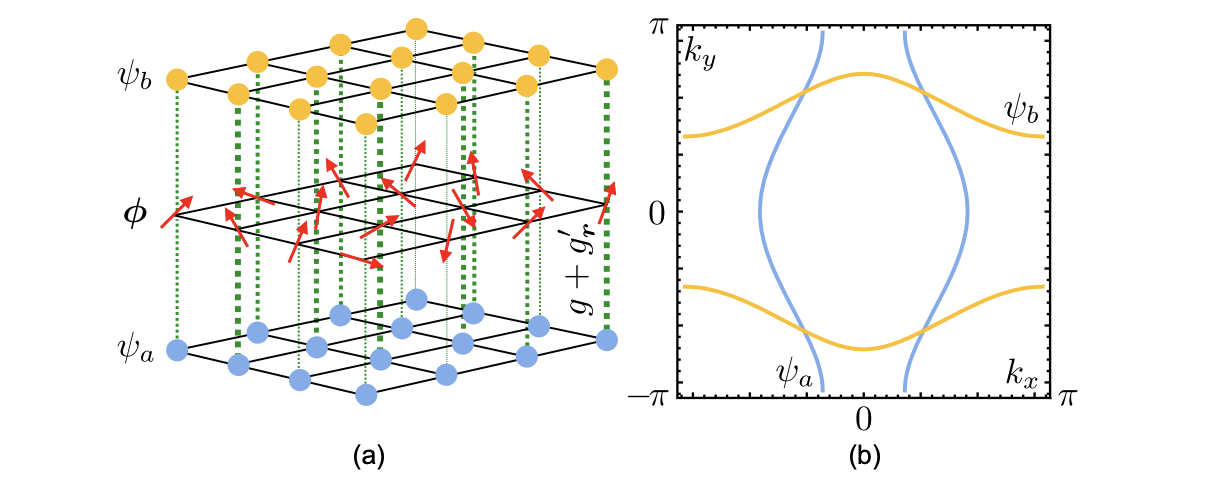
This research establishes a strong theoretical foundation for simulating quantum field theories, specifically those describing fundamental forces, on quantum computers. The team utilizes hybrid quantum-classical algorithms to overcome the limitations of classical simulations, focusing on discretizing spacetime to investigate interactions like the strong and electromagnetic forces. A key strategy involves decomposing the Hamiltonian, the mathematical description of the system’s energy, to reduce computational complexity, employing techniques for digitizing gluon fields and efficiently representing complex interactions with contraction trees. The study leverages computational tools like Mathematica for symbolic calculations and optimization algorithms, contributing a novel way to decompose and represent the Hamiltonian optimized for quantum simulation. Researchers developed a method to reduce the number of degrees of freedom and contraction terms, making simulations more manageable and minimizing the quantum resources, qubits and computational steps, required. This work applies to either Quantum Chromodynamics or Quantum Electrodynamics.
Loop Variables and Variational Basis Compression
Researchers developed a resource-efficient technique to simplify simulations of non-Abelian gauge theories, enabling computations across a wider range of interaction strengths with limited quantum resources. This approach represents the Hamiltonian on periodic lattices using loop variables and their corresponding electric fields, skillfully exploiting Gauss’s law to retain only the gauge-independent components. Scientists identified a local basis for both small and large loops, employing a variational method to minimize truncation errors while calculating the running of the coupling on small tori. This careful basis selection allows computations at arbitrary values of the bare coupling and lattice spacing, utilizing current quantum computers, simulators, and tensor-network calculations in regimes previously inaccessible. The method overcomes challenges associated with traditional quantum link models and addresses the difficulty of maintaining gauge symmetry during truncation by strategically choosing a basis where link operators are diagonal, ensuring the magnetic part of the Hamiltonian remains easily manageable. This innovative approach circumvents computational costs, making simulations more feasible for current and near-future quantum hardware and tensor-network algorithms.
Gauge Theory Simulations Simplified with Compression
Researchers have developed a new method to simplify simulations of non-Abelian gauge theories, a crucial step towards understanding the strong force governing interactions within atomic nuclei. This breakthrough addresses the computational complexity of accurately modeling these theories by compressing the data representing the gauge fields, effectively reducing the number of variables needed to describe the system without sacrificing accuracy. The core of this advancement lies in a novel dualization procedure and encoding scheme applied to the theory’s Hamiltonian. By carefully reformulating the equations, researchers were able to identify and eliminate redundant degrees of freedom, focusing only on the truly independent variables needed for accurate simulations. This approach was initially demonstrated on a minimal torus and is generalizable to larger, more complex lattices. The impact of this work is demonstrated by a dramatic reduction in the computational cost required to achieve a specific level of accuracy; for example, to reach 1% accuracy in calculating the ground-state energy of the pure SU(2) lattice gauge theory, the standard electric representation requires 2744 states, while utilizing the new interpolating basis reduces this number to just 64 states.
Compressed Gauge Field Simulation Achieves High Precision
This research presents a new method for simulating non-Abelian gauge theories with reduced computational demands. The team developed a scheme that compresses the data representing the gauge fields, enabling more accurate predictions across a range of interaction strengths using limited quantum resources. By deriving an encoded Hamiltonian and identifying an optimal basis for calculations, they achieved percent-level precision in computing key quantities, such as the ground state and the average value of the plaquette operator, even with a relatively small number of states per plaquette. This advancement offers a pathway towards demonstrating continuum-limit computations, essential for making realistic physical predictions, on existing quantum hardware. The authors highlight the potential to use their method in conjunction with established techniques like the step scaling approach and plan to compare their results with those obtained using open boundaries. Future research will explore implementing this scheme using variational quantum circuits with qudit architectures, leveraging platforms like Rydberg atoms or trapped ions, and simultaneously optimizing both the quantum state and the computational basis.
🗞 Efficient Finite-Resource Formulation of Non-Abelian Lattice Gauge Theories beyond One Dimension
🧠 DOI: http://link.aps.org/doi/10.1103/k9p6-c649

See today’s quantum computing news on Quantum Zeitgeist for the latest breakthroughs in qubits, hardware, algorithms, and industry deals.