Generating multiple entangled pairs of particles, known as Bell pairs, represents a crucial step towards building powerful quantum networks and distributed computing systems. Z. M. McIntyre and W. A. Coish demonstrate a new method for creating these entangled states in a parallelized fashion, utilising a hybrid quantum system that encodes information in both light and matter. Their approach cleverly encodes quantum information within Schrödinger’s cat states, allowing the detection and correction of photon loss, a significant challenge in quantum communication. This loss-tolerant protocol, compatible with both optical and microwave technologies, offers a pathway towards building more robust and scalable quantum systems with near-term implementation potential.
Quantum Repeaters and Long Distance Communication
This collection of research papers explores the building blocks for a future quantum internet, focusing on overcoming the challenges of transmitting quantum information over long distances. Key areas of investigation include quantum repeaters, which extend communication range without simply amplifying signals, and quantum error correction, essential for protecting fragile quantum data. The research also delves into quantum memory for synchronizing operations, methods for converting quantum information between different carriers, and the design of complete quantum networking architectures. Several papers examine various hardware platforms, including superconducting qubits, trapped ions, and photonic systems, each offering unique advantages for implementing these components.
Researchers are actively improving the efficiency of entanglement distribution using techniques like multiplexing and reducing the demands on quantum memory. Heralded entanglement and time-bin multiplexing are also under investigation. A significant focus lies on cat codes, a robust form of quantum error correction particularly resilient to photon loss. Novel approaches, such as flying cat parity checks, offer the potential for error detection and correction without the need for long-lived quantum memories, a major advancement for photonic quantum networks. The research highlights the importance of surface codes and dynamically protected qubits as promising avenues for fault-tolerant quantum computation. Studies on superconducting qubits, trapped ions, and cavity quantum electrodynamics are advancing the development of robust quantum hardware, demonstrating the potential of creating long-lived quantum states and mediating interactions between qubits. Ultimately, this collection provides a comprehensive overview of the current state of quantum networking research, showcasing the challenges and opportunities in building a future quantum internet.
Phase Encoding Generates Parallel Bell Pairs
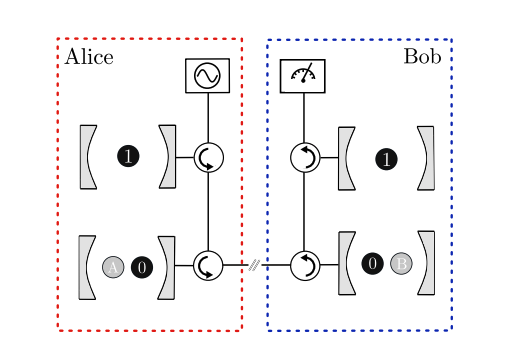
Scientists have engineered a protocol for generating multiple entangled pairs of quantum bits, known as Bell pairs, in parallel. This is achieved by encoding information within the phase of a coherent light pulse, allowing simultaneous entanglement of multiple quantum registers. The method involves preparing a light pulse entangled with qubits through interactions with cavity modes, then transmitting the light to a distant register, effectively transferring entanglement. This technique enables the creation of entanglement without waiting for single-photon detection, potentially speeding up communication.
To enhance resilience against errors, the team encoded a qudit using Schrödinger’s cat states, allowing for the detection of photon loss during transmission by entangling the light pulse with ancillary qubits. Measurements of these ancillary qubits reveal any lost photons, allowing for single-qubit rotations to correct the resulting errors. The experimental setup utilizes coupled qubits, quantized cavity modes, coherent light sources, and heterodyne detection to measure the light pulse’s phase. This method achieves parallel Bell-pair generation by leveraging the multi-level nature of the qudit, enabling multiple qubits to be entangled with a single light pulse. It avoids the need for delay lines common in other entanglement schemes, making it particularly suitable for microwave-regime circuit quantum electrodynamics. The protocol’s performance isn’t limited by the duration of the light pulse, and the study establishes a baseline for future analysis of realistic error sources.
Multiple Entangled Qubits from Light-Matter States
Researchers have developed a protocol for simultaneously generating multiple entangled pairs of qubits, a crucial resource for quantum networks and distributed computing. The method encodes information using a qudit within a pulse of light, enabling the parallel creation of several entangled pairs at once. This relies on encoding the qudit in light-matter Schrödinger’s cat states, allowing for the detection of photon loss through a parity syndrome and deterministic correction of errors via single-qubit rotations. The team measured the phase shifts acquired by coherent light pulses reflected off a series of single-sided cavities, each containing one of the qubits.
They found that carefully controlling the interaction between the qubits and their cavities allowed them to implement the necessary entangling operations. Further analysis revealed that even with imperfections, the corrections to the phase shifts remain manageable, and the reflection probability remains high. In the context of circuit quantum electrodynamics, this parallelized scheme offers a significant advantage: the communication channel between qubits is occupied for a duration independent of the number of entangled pairs created, unlike sequential schemes. This increased flexibility allows for more efficient scheduling and synchronization of operations across the entire quantum device.
Deterministic Entanglement via Error-Corrected Bell Pairs
This research presents a new protocol for generating multiple entangled pairs of qubits, known as Bell pairs, using a technique that encodes information in light and matter. The method leverages Schrödinger’s cat states to simultaneously create several entangled pairs, offering a potentially efficient approach for quantum networks and distributed computing. Crucially, the protocol incorporates a mechanism to detect and correct errors caused by photon loss during transmission, ensuring the fidelity of the generated entanglement. This correction relies on parity checks of ancillary qubits, allowing the system to deterministically compensate for lost photons and maintain the integrity of the quantum state.
The team quantified the impact of photon loss and qubit dephasing on the protocol’s performance, demonstrating that the cat-state encoding offers improved resilience against these errors compared to traditional phase-based encoding. Calculations reveal that the fidelity of the generated entangled states degrades more slowly with increasing photon loss when using cat states. The authors acknowledge that the analysis simplifies certain aspects of the system and suggest that future work could explore strategies to mitigate these remaining error sources and further optimize the protocol for practical implementation.
🗞 Loss-tolerant parallelized Bell-state generation with a hybrid cat qudit
🧠 ArXiv: https://arxiv.org/abs/2509.08577