Accurate noise calibration represents a critical challenge for continuous-variable quantum key distribution (CV-QKD), a promising technology for secure communication, and researchers are continually seeking ways to improve its precision. Guillaume Ricard, Yves Jaouën, and Romain Alléaume, from Telecom Paris and Inria Saclay, now present a new approach that addresses limitations in existing calibration methods. Their work establishes a framework for understanding noise dynamics at the receiver, allowing them to determine the optimal calibration time and introduce a novel calibration technique. This improved method accounts for the specific properties of noise, offering greater performance and resilience to imperfections in real-world CV-QKD systems, ultimately paving the way for more practical and cost-effective secure communication networks.
Practical Noise Calibration for Continuous-Variable QKD
Researchers are improving the practicality and performance of Continuous-Variable Quantum Key Distribution (CV-QKD) systems by tackling the challenges of noise. This work focuses on accurately identifying and quantifying noise sources, maintaining calibration stability over time, and optimizing system performance in real-world scenarios. The team investigates comprehensive noise modelling, statistical analysis, and methods for isolating white noise, a crucial component for accurate calibration. The exploration of combined quantum and classical communication channels is a promising approach for improving system performance, and the emphasis on practical implementation, system stability, and field testing is particularly valuable.
Scientists have developed novel calibration methods for CV-QKD systems, addressing limitations in existing techniques that often oversimplify noise characteristics. These methods involve carefully designed calibration cycles measuring specific noise components over time, and incorporate noise dynamics into calibration models, inspired by techniques used in oscillator frequency stability analysis. Advanced signal processing techniques, including Digital Signal Processing (DSP), are employed to improve signal quality and key rates, and the integration of CV-QKD with symmetric encryption is considered for enhanced security. This research provides a thorough analysis of noise sources affecting CV-QKD systems and proposes valuable methods for isolating white noise. The inclusion of methods for estimating signal stationarity adds to the robustness of the system, and represents a significant contribution to the field, paving the way for viable CV-QKD technology for secure communication.
Optimal Calibration Mitigates Noise in CV-QKD
Scientists have developed an improved method for calibrating noise in Continuous-Variable Quantum Key Distribution (CV-QKD) systems, crucial for secure quantum communication. This new approach focuses on precisely characterizing noise spectral properties and establishing optimal calibration durations, revealing that typical shot noise calibration can be significantly affected by calibration time. Detailed analysis demonstrates that impairments like Receiver Input Noise (RIN) and frequency spikes cause a step-like effect, increasing the variance estimate when calibration extends beyond the inverse of the impaired frequency. The data shows that the minimum in the observed variance occurs at approximately 10−1 seconds, representing the optimal calibration duration for achieving the most precise shot noise estimate with the chosen parameters.
Furthermore, the team introduced a novel shot noise calibration method leveraging the known spectral properties of true shot noise, which is white. By assuming that the only sources of white noise are shot noise and electronic noise, they derived equations to estimate the shot noise level, providing a more robust and precise calibration. This new method is less sensitive to the duration of the calibration process and ultimately enhances the performance and cost-effectiveness of CV-QKD systems.
Dynamic Noise Calibration Improves CV-QKD Performance
This work addresses fundamental limitations in noise calibration for Continuous-Variable Quantum Key Distribution (CV-QKD) systems by explicitly characterizing the dynamics of noise variance over time. The researchers developed a comprehensive framework built upon a critical examination of the stationarity of noise, a method for determining optimal calibration duration, and a novel technique to isolate the shot noise component. Results demonstrate that this approach enhances performance and robustness against receiver imperfections, particularly those related to local oscillator fluctuations and detection electronics, paving the way for more practical and cost-effective CV-QKD implementations. A key contribution of this research is the formalization of calibration procedures, which are integral to CV-QKD protocols; by clarifying previously implicit assumptions and establishing a rigorous framework, the authors lay essential groundwork for the certification of these procedures, a crucial step toward reliable deployment of this technology in secure quantum communication networks. Future work will focus on integrating digital signal processing techniques within the time-gated variance framework to further refine calibration strategies and system performance.
Precise Receiver Noise Calibration for CV-QKD
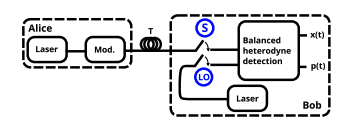
Scientists have developed a novel calibration method for Continuous-Variable Quantum Key Distribution (CV-QKD) systems, addressing limitations in existing techniques. The study centres on accurately determining shot noise levels at the receiver, a critical parameter for detecting potential eavesdropping attempts. The team engineered an experimental setup employing heterodyne detection and precise switching between different operational regimes to isolate and characterise noise sources. The core of the method involves a carefully designed calibration cycle consisting of three distinct steps, each measuring a specific noise component over time.
First, the system measures electronic noise with both the local oscillator and signal paths turned off. Next, receiver noise is measured with the local oscillator on and the signal path off. Finally, a combined measurement, incorporating both signal and local oscillator, is taken to account for the impact of the local oscillator and any excess noise. By meticulously analysing the variances obtained during each step, the team derived a more accurate estimate of the shot noise level. This approach moves beyond traditional methods that often neglect contributions from local oscillator imperfections and dynamic effects stemming from coloured noise sources. The researchers explicitly incorporated noise dynamics into their calibration model, improving accuracy and offering increased tolerance to receiver imperfections, promising to improve the cost-effectiveness of future quantum communication networks.
🗞 Receiver Noise Calibration in CV-QKD accounting for Noise Dynamics
🧠 ArXiv: https://arxiv.org/abs/2509.07549
See today’s quantum computing news on Quantum Zeitgeist for the latest breakthroughs in qubits, hardware, algorithms, and industry deals.