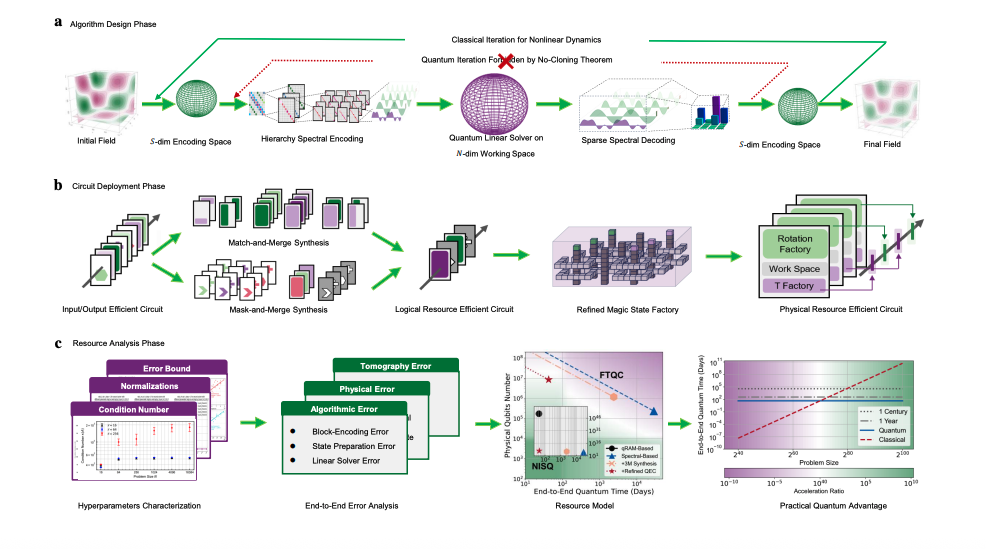
Solving the Navier-Stokes equations, which describe fluid motion, remains a significant challenge for even the most powerful computers due to the equations’ inherent complexity and computational demands. Xi-Ning Zhuang, Zhao-Yun Chen, and Ming-Yang Tan, along with colleagues, now present a full-stack framework that charts a pathway towards achieving a practical quantum advantage in simulating these equations. The team’s approach combines innovative algorithms for data input and output, a streamlined quantum circuit design, and a refined error-correction protocol, resulting in an exponential speedup in computational complexity. Crucially, their detailed resource analysis demonstrates that simulating fluid dynamics on a substantial grid becomes feasible with approximately 8.71 million qubits over a period of 42.6 days, a task that would take a leading supercomputer over a century to complete, thus bridging the gap between theoretical potential and real-world application of quantum computing in scientific simulation.
Quantum Computing for Fluid Dynamics Simulations
This document presents a comprehensive overview of applying quantum computing to solve problems in computational fluid dynamics (CFD) and related scientific computing areas. It explores not only whether quantum computers can speed up CFD, but how, the challenges involved, and the various algorithms and techniques under investigation. The work also covers the necessary supporting infrastructure and theoretical foundations, serving as a detailed literature review and potential roadmap for future research. The document categorizes research into several key areas, beginning with quantum computing fundamentals, including algorithms for linear algebra, which are core to CFD.
Algorithms like the Harrow-Hassidim-Lloyd (HHL) algorithm, Variational Quantum Eigensolver (VQE), and Quantum Approximate Optimization Algorithm (QAOA) are highlighted as promising approaches for optimization problems within CFD, while quantum simulation offers the potential to directly model fluid dynamics at a fundamental level. Quantum machine learning is also presented as a tool for accelerating or improving the accuracy of CFD models. The work then examines standard CFD techniques, including finite difference, finite volume, and finite element methods, highlighting the importance of efficient discretization schemes and turbulence modeling. The ability to model fluid dynamics at multiple scales, from molecular to macroscopic, is also discussed, alongside the current reliance on high-performance computing (HPC) and the potential for quantum computing to serve as a future complement.
Several quantum-enhanced CFD techniques are then explored, including quantum solvers for partial differential equations, quantum surrogate modeling, and quantum data assimilation. Specific algorithms and techniques, such as the HHL algorithm, VQE, QAOA, Quantum Fourier Transform, Quantum Singular Value Decomposition, and Quantum Monte Carlo, are detailed. While quantum computing holds significant potential to accelerate CFD simulations, substantial challenges remain. Current quantum hardware is not yet powerful enough to outperform classical computers for most CFD problems. Hybrid quantum-classical algorithms are likely to be the most practical approach in the near term, and developing efficient quantum algorithms for solving PDEs is a critical research area. Error correction and fault tolerance are essential for realizing the full potential of quantum computing.
Navier-Stokes Solved with Spectral Encoding
Scientists have engineered a full-stack quantum algorithm to solve the Navier-Stokes equations, a notoriously difficult challenge in computational fluid dynamics, and demonstrate a pathway towards practical quantum advantage. The research team circumvented limitations in transferring data between classical and quantum systems by designing a novel input/output protocol that leverages the inherent spectral structure of the problem, rather than relying on a quantum random access memory (qRAM) architecture. This approach expands the computational space using a quantum circuit that encodes prior knowledge, scaling information transfer with spectral sparsity, S, instead of the full grid size, N, significantly reducing the number of qubits required. The method transforms the Navier-Stokes equations into a series of iterative linear systems using established numerical techniques, then solves these systems exponentially faster with a quantum linear solver.
During algorithm design, scientists developed a qRAM-free I/O protocol, focusing on encoding spectral and structural information into the quantum circuit to minimize data transfer bottlenecks. This encoding allows the algorithm to solve the equations in O(S log N) time, utilizing only O(S, Poly log N) logical qubits, a substantial improvement over previous approaches. To further optimize the quantum circuit, the team developed a match-mask-and-merge circuit synthesis strategy, exploiting the symmetry inherent in their I/O method to reduce gate counts and circuit depth. They also implemented a hybrid quantum error correction method, incorporating a refined magic state factory to minimize the physical resource overhead.
Extensive numerical experiments were conducted to validate hyperparameters and model errors, enabling a rigorous resource estimation for scalability. The research demonstrates that solving the Navier-Stokes equations on a 240x 240 grid, a 282-dimensional linear system, is feasible using 8. 71 million physical qubits, with a physical error rate of 5x 10⁻⁴, within 42. 6 days. This represents a projected 1100x speedup compared to state-of-the-art supercomputers.
Quantum Simulation Accelerates Fluid Dynamics Calculations
Scientists have established a full-stack framework demonstrating a pathway towards quantum advantage in simulating the Navier-Stokes equations, which govern fluid dynamics and present a significant computational challenge for classical computers. The team’s approach integrates a novel input/output algorithm, a specifically designed quantum circuit, and a refined error-correction protocol, achieving an end-to-end exponential speedup in asymptotic complexity that meets the theoretical lower bound for solving general linear systems. This breakthrough represents a substantial advancement in the potential for quantum computers to tackle classically intractable problems. Experiments reveal that the method significantly reduces the required quantum resources, decreasing the need for both logical and physical qubits by two orders of magnitude compared to previous approaches.
Concrete resource analysis demonstrates the feasibility of solving the Navier-Stokes equations on a -grid with 8. 71 million physical qubits, operating at an error rate of, in just 42. 6 days, a stark contrast to the over a century required by a state-of-the-art supercomputer for the same task. This result highlights the potential for quantum computers to dramatically accelerate scientific simulations. Through careful design of the encoding and decoding processes, they created a system where the complexity is directly linked to the underlying physics of the problem, rather than the quantum algorithm itself. Measurements confirm that this approach allows for an exponential speed-up, provided the encoding and decoding pair is well-designed with a low iteration-tolerant bandwidth. Furthermore, the research demonstrates that the Navier-Stokes equations can be solved with exponential speedup on asymptotic complexity for practical problems, establishing a clear path toward realizing quantum advantage in computational fluid dynamics.
Quantum Fluid Dynamics Simulation Achieves Practical Advantage
This research establishes a complete framework for simulating the Navier-Stokes equations, a notoriously difficult problem in computational fluid dynamics, using quantum computing. The team demonstrates a pathway towards achieving a practical quantum advantage.
🗞 A Pathway to Practical Quantum Advantage in Solving Navier-Stokes Equations
🧠 ArXiv: https://arxiv.org/abs/2509.08807


See today’s quantum computing news on Quantum Zeitgeist for the latest breakthroughs in qubits, hardware, algorithms, and industry deals.