Quantum technologies promise revolutionary advances, but creating and manipulating complex quantum states remains a significant challenge, particularly for continuous variable systems. Shao-Hua Hu and Ray-Kuang Lee from National Tsing Hua University, along with their colleagues, address this problem by extending a technique called circuit knitting to the infinite-dimensional realm of quantum information. This research establishes a theoretical framework for generating non-Gaussian states, which are essential for many quantum applications, from a limited set of initial resources. The team also demonstrates fundamental limits to this approach, revealing that perfectly replicating certain quantum operations demands an impractical amount of computational overhead, and explores practical applications including the creation of specific states useful for quantum computation and communication.
Efficient Quantum Process Decomposition for Simulation
Scientists are developing methods to break down complex quantum operations into simpler steps, a technique called quantum process decomposition (QPD). This is crucial because simulating quantum systems on classical computers is incredibly challenging, and QPD aims to make these simulations more manageable. The goal is to find decompositions that require fewer computational resources, allowing researchers to better understand and verify quantum algorithms and devices. This work focuses on tailoring QPD strategies to specific types of quantum states and operations, seeking both accuracy and computational efficiency.
Researchers have explored QPD strategies for important quantum states, including cat states, Bell-like states, and Fock states. For cat states and Bell-like states, they developed methods that amplify the state or express it as a combination of other states. For Fock states, representing a specific number of photons, they utilized a photon bunching technique to create a more efficient decomposition. Throughout this work, the team emphasizes tailoring the decomposition to the unique properties of each quantum state. The team also investigated fundamental limits to QPD, proving that for certain operations, specifically non-local Gaussian unitaries, an efficient decomposition using separable states is impossible. This finding establishes a theoretical boundary on the efficiency of QPD for these operations and provides valuable insights into the capabilities and limitations of QPD, paving the way for more efficient quantum simulations.
Quasi-Probability Decomposition for Infinite Systems
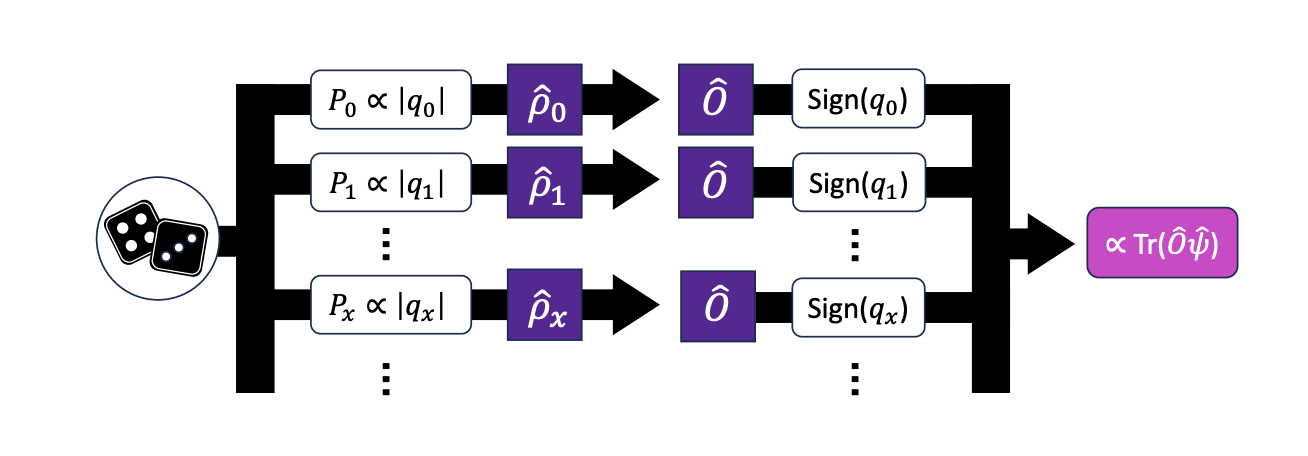
Scientists are extending circuit knitting techniques to systems with infinite dimensions, allowing them to manipulate complex quantum states in new ways. The core of this approach is quasi-probability decomposition (QPD), which breaks down a complex quantum state into a weighted sum of simpler, readily available states, effectively simulating complex operations with limited resources. Researchers formally define QPD as a way to represent a target quantum state as an average over available states, each weighted by a specific coefficient. They employ a Monte Carlo simulation protocol, preparing available states with probabilities proportional to the absolute values of their weights and adjusting measurement outcomes by the sign of the weight.
This innovative method enables the simulation of complex quantum states using simpler building blocks, but introduces a sampling overhead, an increase in the number of measurements needed for accuracy. To quantify this overhead, scientists define the optimal sampling overhead as the minimum total weight needed to accurately represent the target state, linking it to robustness, a key resource measure in quantum information theory. A diverging optimal sampling overhead indicates the impossibility of accurately decomposing the target state using the available resources, laying the foundation for efficiently preparing and manipulating complex quantum states for advancements in quantum computing and communication.
Infinite Resources Limit Quantum State Creation
Scientists are extending circuit knitting techniques to systems with infinite dimensions, allowing them to generate complex quantum states from a limited set of initial states. Researchers demonstrate that creating certain complex quantum operations requires an infinite amount of sampling, revealing fundamental limitations within the circuit knitting approach for multi-mode Gaussian operations. Researchers explored practical applications, including methods for generating approximate Fock states and GKP states, and amplifying cat-state qubits. They developed a protocol to amplify the size of a cat state, although this amplification exhibits super-exponential scaling, limiting its practicality.
Analysis of the sampling overhead reveals that, for larger parameters, the amplification process requires approximately three times the initial resources. Importantly, the research confirms that circuit knitting can significantly reduce the number of quantum measurements needed compared to traditional random walk approaches. While not currently more efficient than existing classical simulation techniques, its compatibility with real experimental setups offers a significant advantage, allowing for the flexible replacement of quantum elements with virtual states or operations, showcasing its potential for a wide range of applications in quantum information processing.
Circuit Knitting Enables Continuous Variable States
This work extends circuit knitting techniques, originally developed for finite systems, to the realm of continuous-variable quantum systems. The researchers establish a theoretical framework for generating non-Gaussian states from a limited set of available states, demonstrating that approximate Fock states and GKP states can be created using this approach. They also investigate fundamental limitations, proving that simulating certain multi-mode Gaussian operations requires infinite sampling overhead when using separable operations. The study highlights the potential of circuit knitting to reduce the resources needed for quantum simulations, offering an exponential improvement over random walk methods in certain scenarios.
Furthermore, the team proposes a protocol for amplifying cat states, achieving a size increase with a modest overhead. Its primary advantage lies in its compatibility with real experimental implementations, allowing for the flexible replacement of physical elements with virtual states or operations within a quantum system. Future research could explore ways to improve the efficiency of circuit knitting and further investigate its applications in practical quantum technologies.
🗞 Circuit Knitting for Continuous-Variable Quantum States
🧠 ArXiv: https://arxiv.org/abs/2509.07947

See today’s quantum computing news on Quantum Zeitgeist for the latest breakthroughs in qubits, hardware, algorithms, and industry deals.