Variational quantum algorithms hold immense promise for unlocking the potential of today’s nascent quantum computers, offering solutions for complex problems in fields like materials science and machine learning. However, the effectiveness of these algorithms hinges on the careful design of the quantum circuits, known as ansatze, which must balance the ability to represent complex solutions with the practical limitations of current hardware. Manish Mallapur, Ronit Raj, and Ankur Raina, all from the Indian Institute of Science Education and Research, Bhopal, present a novel method for automatically designing these circuits, employing a genetic algorithm inspired by natural selection. Their approach evolves circuits through iterative improvement, prioritising both expressibility, the ability to represent a wide range of solutions, and shallow depth, ultimately yielding circuits that consistently outperform traditional designs and avoid common performance bottlenecks, offering a scalable solution for a wide range of quantum applications.
Genetic Algorithms Optimise Variational Quantum Circuits
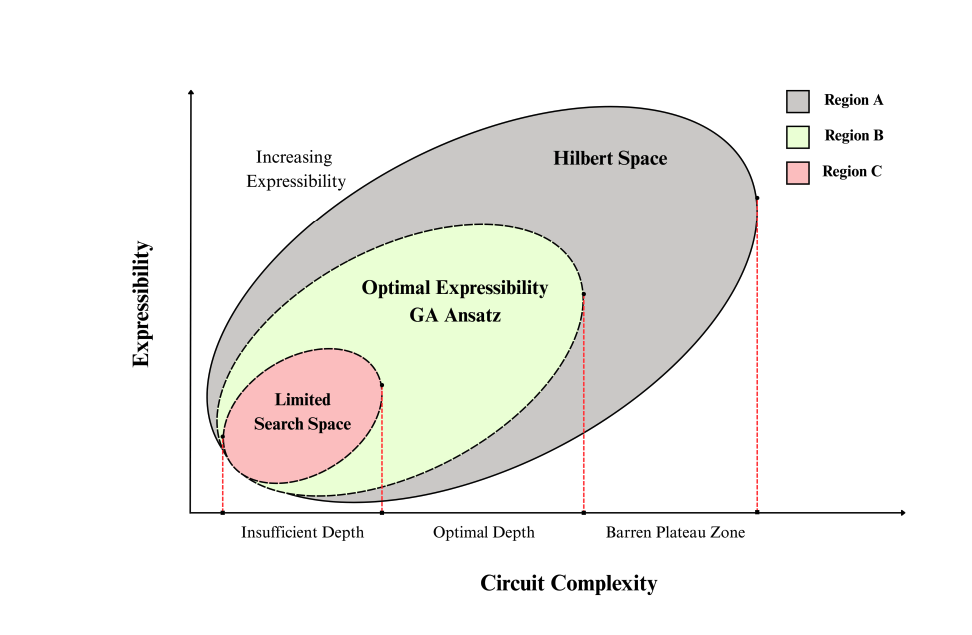
Scientists are tackling a fundamental challenge in quantum computing: designing effective quantum circuits for variational quantum algorithms (VQAs). These algorithms, which combine quantum and classical processing, rely on carefully constructed circuits to solve complex problems, but finding the optimal design is notoriously difficult. Researchers are now employing genetic algorithms, inspired by natural selection, to automatically generate circuits that balance expressibility, the ability to represent a wide range of quantum states, and trainability, the ease with which the circuit’s parameters can be optimized. The team’s approach systematically evolves circuit designs through a process of mutation and selection, prioritizing those that maximize expressibility while maintaining a shallow depth, meaning they require fewer quantum operations. This is crucial because deeper circuits, while potentially more expressive, become increasingly difficult to optimize and are more susceptible to errors on near-term quantum hardware. By intelligently searching the vast landscape of possible circuit configurations, this method creates resource-efficient circuits that converge quickly during optimization.
Evolving Quantum Circuits for Enhanced Expressibility
Scientists have developed a novel genetic algorithm-inspired framework for designing variational quantum circuits, achieving high expressibility while maintaining shallow depth and a low parameter count. This breakthrough addresses a critical challenge in quantum computing, where circuits must be both powerful enough to represent complex quantum states and trainable on near-term quantum devices. The team’s approach evolves circuit designs through mutation and selection, guided by an expressibility metric, consistently generating circuits that perform comparably to traditional designs but avoid the limitations of barren plateaus, a phenomenon that hinders optimization. Experiments demonstrate the effectiveness of this new framework across a range of molecular systems, including H2, LiH, BeH2, and H2O, and a non-molecular transverse field Ising model.
The circuits were benchmarked against established ansatz designs like Unitary Coupled Cluster with Singles and Doubles (UCCSD) and ADAPT-VQE, demonstrating competitive performance. Researchers assessed expressibility using a fidelity-based method, quantifying how well the generated circuits explore the Hilbert space and approximate the uniform Haar distribution. Results show that the newly designed circuits consistently achieve high expressibility at any target depth, offering a scalable solution for a wide range of applications. While UCCSD and ADAPT-VQE are established methods, their computational cost scales rapidly with system size, limiting their applicability to larger molecules. The new framework overcomes this limitation, offering a pathway to designing expressive, low-depth circuits that require design only once and can be applied to diverse quantum computing tasks. This advancement promises to accelerate progress in areas like materials science, drug discovery, and fundamental quantum simulations.
Evolving Quantum Circuits for Enhanced Performance
This research introduces a new method for designing variational quantum circuits, known as ansatze, which are essential components of many quantum algorithms. The team developed a genetic algorithm-inspired framework that automatically evolves circuits to achieve both high expressibility, the ability to represent a wide range of quantum states, and shallow depth, meaning they require fewer quantum operations. This approach addresses a key challenge in the field, as traditionally, increasing expressibility often comes at the cost of making circuits more difficult to train and susceptible to errors. The resulting ansatze consistently demonstrate strong performance across various molecular and non-molecular systems, matching the capabilities of established designs while avoiding the issues associated with barren plateaus, a phenomenon that hinders optimization. This work provides a general and scalable solution for ansatz design, offering circuits that can be created once and applied to a broad range of quantum computing applications. The authors acknowledge that the performance of these circuits, like all variational algorithms, still depends on the effectiveness of the classical optimization process used to train them.
🗞 Genetic optimization of ansatz expressibility for enhanced variational quantum algorithm performance
🧠 ArXiv: https://arxiv.org/abs/2509.05804