Quantum communication promises unhackable data transmission, but building the necessary hardware remains a significant hurdle, as researchers strive to miniaturise complex systems. Joseph A. Dolphin, Rosemary O. E. Scowen, Louise M. Wells, and colleagues at the University of Cambridge, alongside Toshiba Europe Ltd, now present a breakthrough in this field, demonstrating high-performance arrays of single-photon detectors. The team overcomes longstanding challenges in efficiently controlling and connecting these detectors, fabricating compact, hybrid-integrated devices using indium gallium arsenide and indium phosphide. This innovation enables secure key rates exceeding 2 Mbps over short distances and 15 kbps over 100km of fibre, paving the way for practical and scalable quantum communication networks and broader applications in quantum information processing.
Hybrid Chip for Quantum Key Distribution
Researchers have developed a new hybrid integrated chip that advances quantum key distribution (QKD), a method for secure communication. The team aimed to create a more compact and efficient QKD system by integrating essential components onto a single chip, reducing size, complexity, and cost. This approach combines InGaAs/InP single-photon detectors with a silicon photonics platform, leveraging the strengths of both materials for efficient light detection and compact circuit design. The system incorporates an array of these detectors to improve key rates and system reliability. The researchers successfully integrated the detector array with the silicon photonics chip, significantly reducing optical crosstalk between detectors, a major challenge in achieving high performance. This work represents a crucial step towards practical, deployable QKD systems, offering a path to scalability for higher key rates and longer distances, while also reducing the overall cost of implementation. Future efforts will focus on further optimising detector performance and improving system efficiency, paving the way for wider adoption of this secure communication technology.
Gigahertz Gated Arrays Advance Quantum Key Distribution
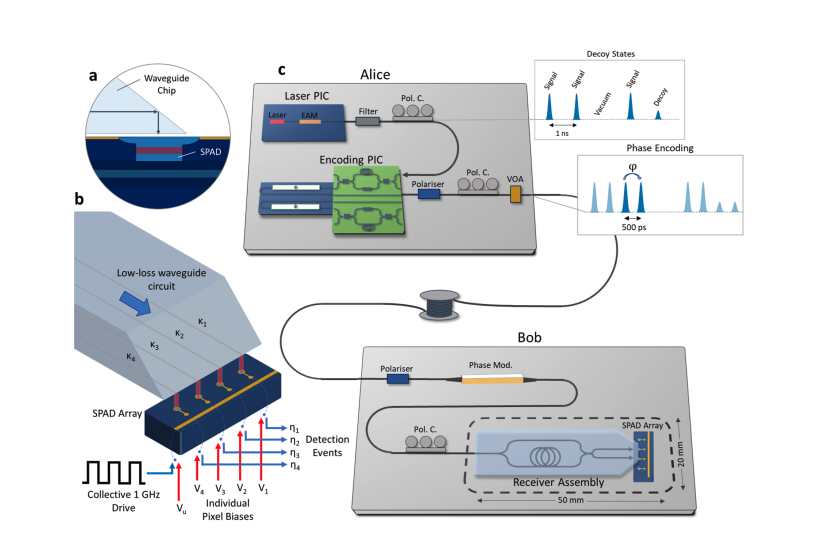
Scientists have achieved a significant breakthrough in quantum key distribution (QKD) by developing gigahertz-gated InGaAs/InP SPAD arrays and integrating them into compact hybrid receivers. This work overcomes longstanding challenges in miniaturising QKD hardware, specifically the difficulty of integrating single photon detectors without requiring cryogenic cooling. The team successfully fabricated and tested arrays exhibiting competitive performance, achieving a single photon detection efficiency of 15% across all pixels, with dark count rates below 8kHz and minimal afterpulsing. The team then combined these arrays with low-loss silica waveguide chips, creating compact hybrid receivers capable of high-speed secure communication.
Results from BB84 protocol experiments demonstrate a secure key rate exceeding 2 Mbps at short distances and, crucially, 15 kbps over 100km of fibre. This performance, achieved using room-temperature detectors, represents a substantial improvement over existing systems and establishes a viable path toward practical QKD receivers for metropolitan and access quantum networks. The innovative architecture shares expensive driving circuitry between detectors, reducing costs and simplifying scaling to larger arrays, while also enabling individual pixel optimisation and enhancing security against detector efficiency mismatch attacks. This represents a significant step towards miniaturising QKD systems, moving beyond reliance on bulky external detector setups. The developed receiver architecture offers a pathway to compact, scalable QKD systems with practical cooling requirements, mirroring the form factor of classical fibre-optic transceivers.
While the current demonstration includes an external phase modulator, the authors note that a fully passive receiver utilising a larger waveguide circuit is feasible and would further reduce optical loss. Future work will focus on addressing the engineering challenges of packaging the hybrid receiver into a compact, hermetically sealed form factor, though operation at room temperature relaxes some of these requirements. Beyond QKD, the authors highlight the potential of this scalable, waveguide-coupled SPAD array technology for applications in quantum sensing and communication, particularly benefiting from the demonstrated crosstalk suppression techniques.
🗞 Hybrid-Integrated InGaAs/InP SPAD Arrays for Quantum Communications
🧠 ArXiv: https://arxiv.org/abs/2509.05134


See today’s quantum computing news on Quantum Zeitgeist for the latest breakthroughs in qubits, hardware, algorithms, and industry deals.