Integrated sensing and communications, a key technology for future 6G networks, promises to combine wireless connectivity with detailed environmental awareness, and a new framework achieves significant progress in this area. Ahmad Bazzi, Mingjun Ying, Ojas Kanhere, Theodore S. Rappaport, and Marwa Chafii demonstrate a method for creating detailed images of surroundings using information gleaned from wireless signals, effectively turning communication infrastructure into a sensing network. Their approach leverages channel state information, data describing how signals travel, and combines it with precise ray tracing techniques to pinpoint the location of reflected signals, even those bouncing multiple times. This allows the reconstruction of three-dimensional point clouds representing objects in the environment, offering a level of detail previously unattainable and paving the way for applications ranging from autonomous navigation to immersive augmented reality. The team’s work represents the first demonstration of multi-bounce ISAC imaging using wireless ray tracing at 6. 75GHz, marking a substantial step towards realising the full potential of 6G technology.
Realistic Wireless Channel Prediction for 6G
This body of work focuses on modelling wireless communication channels, specifically predicting how radio waves propagate for current 5G and future 6G networks. A significant emphasis is placed on mid-band frequencies, particularly 6. 75GHz and 16. 95GHz, and on understanding signal behaviour in indoor and urban environments. The research aims to create accurate and realistic channel models to optimise the design and performance of future wireless systems.
The core of this work is propagation modelling, exploring techniques to predict radio wave travel. Ray tracing, a method simulating wave propagation by tracking individual rays, is central to this research, with improvements including three-dimensional ray launching and handling complex environments. Physical-based modelling and statistical channel modelling are also key areas of investigation. Researchers are extensively measuring and modelling signal propagation at mid-band frequencies to understand their characteristics for 5G and 6G deployments. Detailed characterisation of radio channels inside buildings, including factories and homes, is crucial for applications like indoor navigation and high-speed wireless access. Investigations also extend to complex urban environments, considering the impact of buildings, streets, and foliage on signal propagation. This research relies heavily on real-world measurements to validate and refine the channel models, characterising the angular distribution and polarization of radio waves, important for beamforming and multiple-input multiple-output (MIMO) systems.
ISAC Imaging via Ray Tracing and Optimization
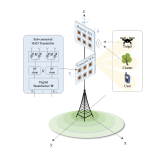
Scientists have developed an innovative imaging framework, known as integrated sensing and communications (ISAC), to simultaneously map environments and provide wireless connectivity at 6. 75GHz. This approach leverages channel state information, alongside precise transmitter and receiver positions obtained through calibrated ray tracing. The core of the technique involves extracting individual multipath components from the estimated channel and converting each into a three-dimensional reflection point, even for complex multi-bounce reflections. To achieve precise geometric reconstruction, the team engineered a two-segment reflection point optimization algorithm.
This algorithm independently estimates the path lengths from both the transmitter and receiver positions to an equivalent reflection point on the object’s surface. Subsequently, the scientists aggregate these equivalent reflection points, derived from multiple transmitter-receiver positions, to generate dense three-dimensional point clouds representing the objects within the wireless channel. A detailed ray tracing simulation generates synthetic channel state information for validating the imaging algorithm’s capabilities. Researchers modelled physical interactions within the ray tracer, incorporating diffuse scattering by using material-specific coefficients to determine whether energy reflects directly or scatters.
When scattering occurs, the team generated a set of rays with randomised phases to emulate incoherent reflections, carefully scaling amplitudes to conserve energy. Computational cost was managed by limiting the number of bounces and stochastically pruning low-power paths, while cross-polarization discrimination was included using measured material ratios. The system calculates equivalent reflection points by determining the intersection of lines originating from the transmitter and receiver, guided by the angles of arrival and departure, and the path delays, ultimately enabling the reconstruction of object surfaces, edges, and curved features.
Wireless Imaging Maps Environments with Ray Tracing
Scientists have demonstrated a groundbreaking integrated sensing and communications (ISAC) imaging framework, paving the way for sixth-generation (6G) wireless systems that simultaneously map environments and provide connectivity. This research delivers the first demonstration of multi-bounce ISAC imaging using wireless ray tracing at 6. 75GHz, a significant advancement over previous single-bounce reflection limitations. The team successfully transformed readily available channel state information (CSI) into detailed three-dimensional maps, achieving a level of environmental awareness previously unattainable with standard wireless infrastructure.
The core of this innovation lies in a novel two-segment reflection point optimization algorithm. This method independently estimates path lengths from the transmitter and receiver to equivalent reflection points on object surfaces, enabling precise geometric reconstruction even with complex, multi-bounce reflections. By converting angle and delay information from CSI into spatial coordinates, the system accurately represents the geometry of surrounding objects, creating dense three-dimensional point clouds. Experiments validate that the framework accurately reconstructs object surfaces, edges, and curved features, demonstrating a high degree of fidelity in the resulting maps.
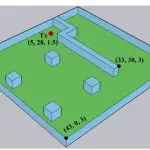
This research leverages a site-specific three-dimensional ray tracer to simulate realistic wireless environments and validate the imaging process. The ray tracer’s ability to model propagation delays, angles of arrival and departure, and power levels with physical accuracy ensures the fidelity of the simulated channel. The convergence of ray tracing and CSI allows for the creation of precise radiofrequency (RF) imaging native to communication links, opening possibilities for network-embedded localization, blockage prediction, and environment-aware beam management in future 6G systems. This technology promises to underpin applications such as city-scale digital twins, autonomous vehicles, and extended reality services, all requiring accurate three-dimensional mapping and reliable connectivity.
D Reconstruction From Wireless Signal Reflections
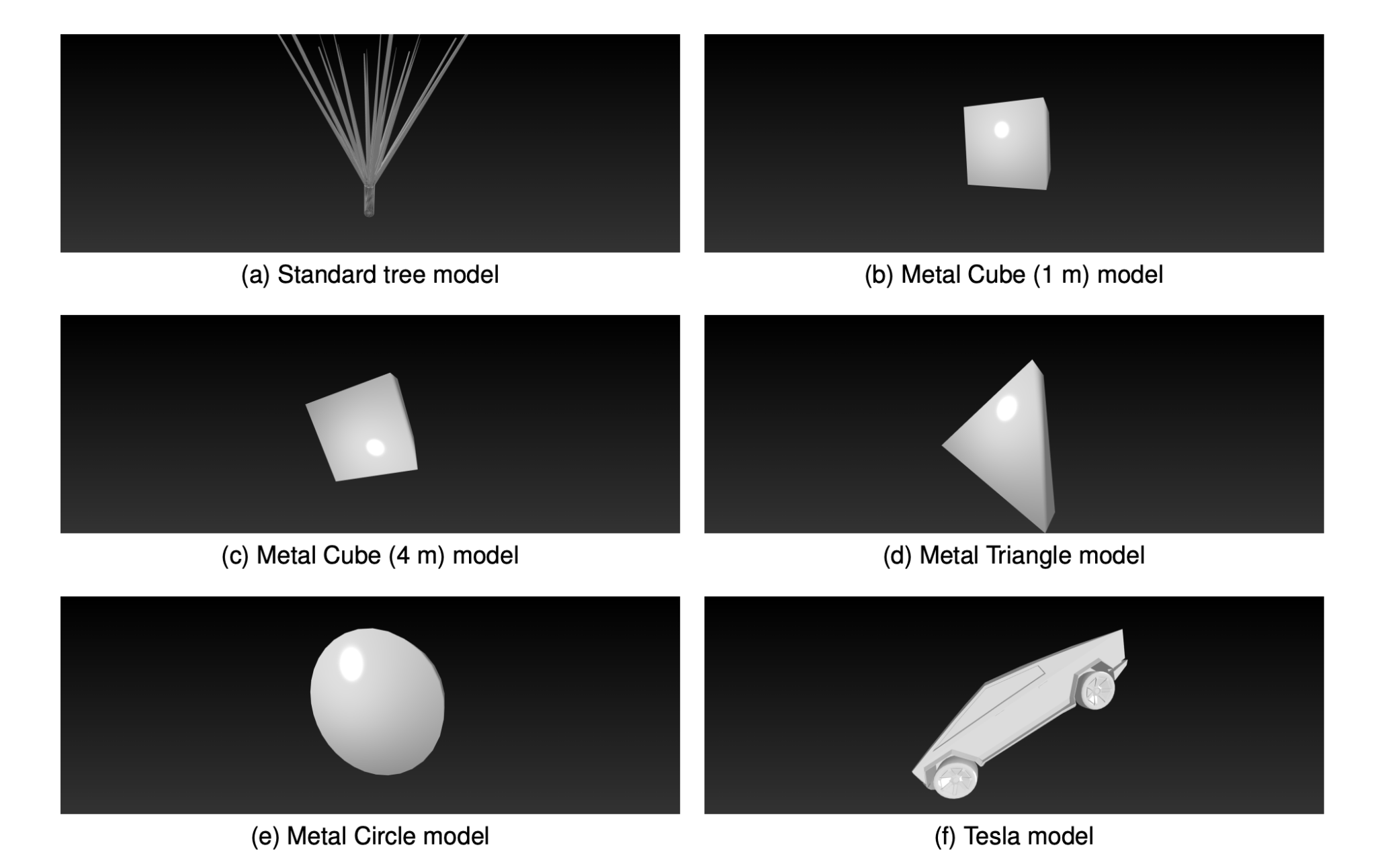
This research presents a novel imaging framework for integrated sensing and communications (ISAC), a key technology for future 6G wireless systems. The team successfully demonstrates how to reconstruct three-dimensional object shapes using information gleaned from wireless signals, specifically by extracting and interpreting individual multipath components within the signal. A core achievement is an algorithm that accurately locates equivalent reflection points on object surfaces, even for complex multi-bounce reflections, and aggregates these points to create dense 3D point clouds representing the objects in the environment. The method was validated using a ray-tracing engine to simulate wireless propagation at 6. 75GHz, and the results demonstrate accurate reconstruction of object surfaces, edges, and curved features for various shapes and sizes, including metal cubes, vehicles, and trees. Importantly, the framework operates without prior knowledge of the object’s surface, relying solely on the information contained within the received wireless signals, and the team shows that the necessary parameters can be obtained from existing 5G and LTE standards.
🗞 ISAC Imaging by Channel State Information using Ray Tracing for Next Generation 6G
🧠 ArXiv: https://arxiv.org/abs/2509.06672

See today’s quantum computing news on Quantum Zeitgeist for the latest breakthroughs in qubits, hardware, algorithms, and industry deals.