Researchers are increasingly exploring ways to harness the unique properties of light for advanced sensing technologies, and a new study led by Junayet Hossain, Sajid Muhaimin Choudhury, and Mohammed Imamul Hassan Bhuiyan, all from the Bangladesh University of Engineering and Technology, demonstrates a particularly promising approach using specially designed photonic crystals. These structures, known as valley-hall photonic crystals, guide light in a remarkably robust manner, even when significantly distorted or damaged, a characteristic stemming from their unique topological properties. The team’s design not only achieves exceptional resilience in light propagation but also exhibits an extraordinary ability to confine light, resulting in a biosensor capable of detecting carcinoma cells with high sensitivity and a strong quality factor. This advance holds considerable potential for improving medical diagnostics and ultimately, patient care, by offering a new platform for innovative healthcare applications.
Topological Photonics Enables Robust Refractive Sensing
Scientists engineered a new sensor platform based on topological photonics, a field leveraging the unique properties of light within specifically designed structures. This sensor utilizes valley-hall photonic topological insulators, guiding light in a way that protects it from disruption and enhances reliability. The sensor detects changes in a substance’s refractive index, allowing for identification and characterization of different materials, with potential applications in biomedical, chemical, and environmental sensing. The sensor’s high sensitivity allows it to detect even small changes in refractive index, while its topological nature makes it less susceptible to imperfections and disturbances.
Researchers can tune the sensor’s performance by adjusting the design of the photonic crystal structure, tailoring it to specific applications. This compact design makes it suitable for integration into portable devices, expanding its potential uses, including detecting cancer cells, analyzing DNA and RNA, identifying proteins, monitoring pollutants, ensuring food safety, and enhancing terahertz imaging and spectroscopy. This sensor outperforms existing technologies like terahertz metamaterial sensors and traditional refractive index sensors, offering higher sensitivity and robustness, alongside the potential for miniaturization and tunability. It is fabricated using silicon-on-insulator technology, a well-established microfabrication process, allowing for the creation of compact and integrated devices. This research presents a promising new sensor technology with the potential to advance the field of sensing and enable new diagnostic and monitoring capabilities.
Topological Photonic Crystals Guide Light Robustly
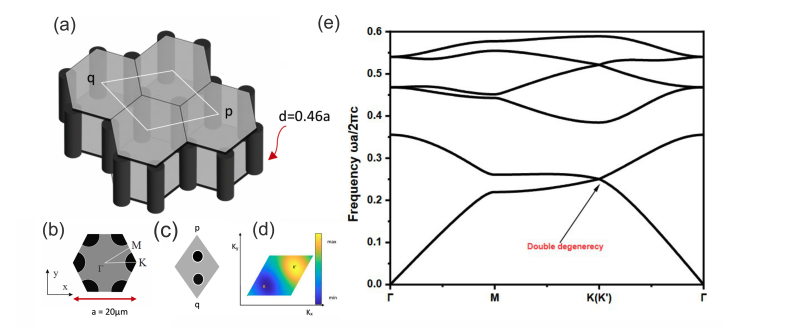
Scientists developed a new platform for guiding light using topological photonic crystals, structures inspired by concepts from materials science and quantum physics. The team designed a valley-hall photonic crystal to achieve robust light propagation, even with structural imperfections, leveraging topology to break symmetry and create unique light-guiding properties. Detailed analysis confirmed its topological nature, providing a comprehensive framework for understanding its behavior and predicting its properties. Researchers developed an analytical model incorporating parameters defining symmetry-breaking perturbations and the group velocity of light.
They designed and simulated both linear and Ω-shaped waveguides, constructing them from unit cells arranged to create interfaces with opposite topological properties. These interfaces support the formation of valley-polarized edge states, inherently protected from backscattering. Simulations visualized and characterized the electromagnetic field distribution within the waveguides, confirming the durability of the edge states. Rigorous testing of the linear waveguide, consisting of numerous unit cells, demonstrated a maximum transmission even with imperfections. The Ω-shaped waveguide, mimicking sharp bends, demonstrated continued resilience, preserving topological properties despite structural alterations. These results confirm the platform’s ability to maintain stable light transport even with realistic fabrication defects.
Robust Light Guiding in Defective Photonic Crystals
Scientists have developed a novel topological photonic crystal platform demonstrating exceptional resilience in guiding light, even with significant structural imperfections. This research introduces a design capable of maintaining robust light propagation through both linear and Ω-shaped waveguides, paving the way for advanced optical devices. Experiments reveal minimal transmission loss, even when defects are introduced, demonstrating the design’s robustness. The team further demonstrated efficient light confinement within a hexagonal resonant cavity formed by integrating two distinct photonic crystals.
This cavity preserves the interface between the crystals, enabling strong coupling and light localization. This research extends beyond fundamental light manipulation to address critical biosensing applications, specifically cancer cell detection. By matching the refractive index of the topological cavity with that of cancer cells, scientists observed significant alterations in the transmission spectrum, providing a sensitive and dynamic response. The developed biosensor achieves a remarkable quality factor and a sensitivity indicating exceptional precision in detecting refractive index changes. Tests conducted on several cancer cell lines yielded promising results, confirming the platform’s potential for clinical diagnostics. This breakthrough delivers a highly sensitive and precise method for cancer cell detection, promising innovative applications in healthcare and medical diagnostics.
This work introduces a honeycomb-structured photonic crystal designed to guide light along topological interfaces, demonstrating robust light propagation even with structural imperfections. The researchers successfully maintained stable light transport through both straight and sharply curved waveguides, highlighting the design’s resilience to potential fabrication defects. Furthermore, incorporating a hexagonal cavity transformed the structure into a highly sensitive optical sensor, capable of detecting subtle changes in its environment. The resulting sensor achieves a high quality factor and sensitivity, demonstrating its potential for distinguishing between different types of cancer cells. These results suggest a promising contribution to the field of medical diagnostics and advanced optical sensing applications.
🗞 Harnessing Topological Valley-Hall States in Photonic Crystals for Robust Cancer Cell Detection
🧠 ArXiv: https://arxiv.org/abs/2509.05690

See today’s quantum computing news on Quantum Zeitgeist for the latest breakthroughs in qubits, hardware, algorithms, and industry deals.