Detecting and characterizing entanglement remains a central challenge in quantum physics, and researchers are now exploring machine learning techniques to improve this process. Mohammad Rezaei Shokouh from Ferdowsi University of Mashhad and Hossein Davoodi Yeganeh from AriaQuanta Quantum Computing Center, along with their colleagues, present a new hybrid quantum-classical approach that learns to identify entanglement directly from data. Their system uses continuous-variable quantum neural networks, combining quantum optical elements with a small classical computer component, to create a powerful entanglement witness. The team demonstrates over 99% accuracy in classifying entangled states, significantly outperforming traditional methods, and establishes a clear path towards leveraging near-term photonic quantum computers for advanced state characterization.
Detecting Complex Entanglement With Quantum Neural Networks
Characterizing entanglement is a major challenge in quantum information science, and researchers rely on entanglement witnesses to verify its presence in quantum states. This research addresses limitations of traditional methods, particularly in continuous-variable systems, by exploring machine learning techniques to design more powerful entanglement witnesses. Machine learning offers the potential to overcome analytical constraints and discover witnesses capable of detecting entanglement in highly complex quantum states. This study investigates the application of continuous-variable quantum neural networks (CVQNNs) for learning nonlinear entanglement witnesses. CVQNNs utilize quantum mechanics to perform computations on continuous variables, offering advantages in computational power and efficiency. The team demonstrates that a hybrid quantum-classical learning framework can effectively learn and optimize entanglement witnesses capable of detecting entanglement in complex continuous-variable states, establishing a novel methodology for entanglement characterization with potential applications in quantum information processing and communication.
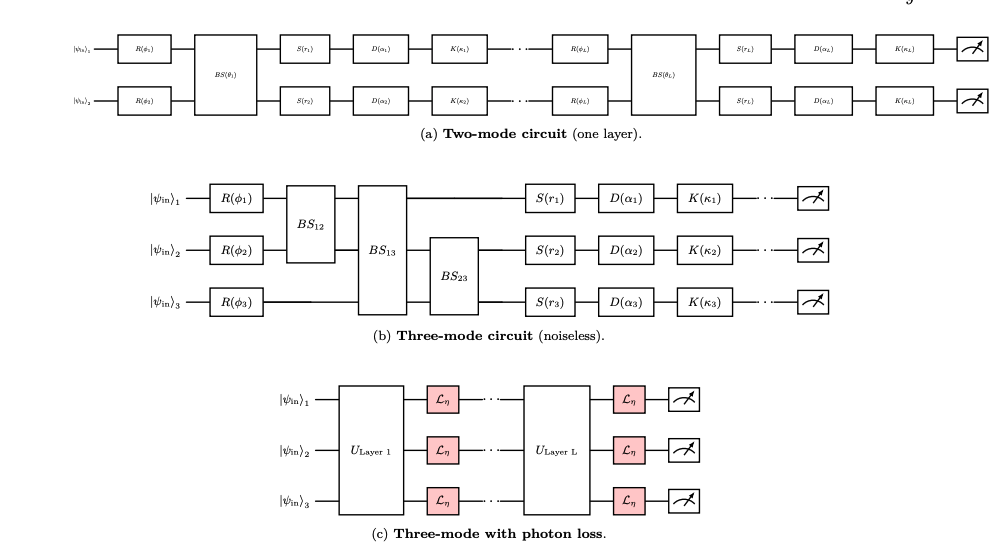
Entanglement witnesses provide effective means of detecting quantum correlations. The researchers introduce a hybrid quantum-classical framework that learns a nonlinear entanglement witness directly from quantum data using continuous-variable quantum neural networks (CV-QNNs). Their architecture combines variational interferometers, squeezers and non-Gaussian gates with a small classical neural network to output a scalar witness value. Numerical simulations on two- and three-mode quantum states, including both Gaussian and non-Gaussian states, revealed over 99% classification accuracy and a robust performance advantage over strong classical baselines, especially as complexity increased.
Hybrid Neural Network Distinguishes Quantum Entanglement
This research investigates whether a hybrid quantum-classical neural network can effectively distinguish between entangled and separable quantum states, and outperform classical machine learning models. The team employed a hybrid model combining a variational quantum circuit with a classical multilayer perceptron. The quantum circuit generates feature vectors from quantum states, which are then fed into the classical network for classification. A synthetically generated dataset of mixed quantum states, both entangled and separable, was used to train and test the model. The results demonstrate that the hybrid quantum-classical model consistently achieves higher accuracy in distinguishing entangled and separable states compared to classical models, particularly as the problem’s complexity increases. Statistical analysis, using stratified bootstrapping, confirms that these performance differences are statistically significant. The model also exhibits robustness to variations in the dataset and training parameters, and its performance improves with increasing complexity, suggesting potential for scaling to more complex quantum systems.
Data-Driven Entanglement Detection Exceeds Classical Limits
This research presents a novel hybrid quantum-classical framework for detecting entanglement in continuous-variable quantum systems. The team developed a model that learns to identify entanglement directly from data, using a combination of quantum optical elements, including interferometers, squeezers, and non-Gaussian gates, alongside a small classical neural network. Through numerical simulations involving two- and three-mode quantum states, the model achieved over 99% accuracy in classifying entangled and non-entangled states, demonstrating a significant performance advantage over existing classical methods, particularly as the system’s complexity increases. This approach offers a promising avenue for data-driven quantum state characterization and highlights potential benefits for near-term photonic quantum platforms. The study acknowledges the impact of photon loss during measurement and quantifies the model’s robustness under realistic conditions. Future research will focus on mitigating the effects of loss and exploring the model’s performance with even more complex quantum states.
🗞 Hybrid Quantum-Classical Learning of Nonlinear Entanglement Witnesses via Continuous-Variable Quantum Neural Networks
🧠 ArXiv: https://arxiv.org/abs/2509.05924