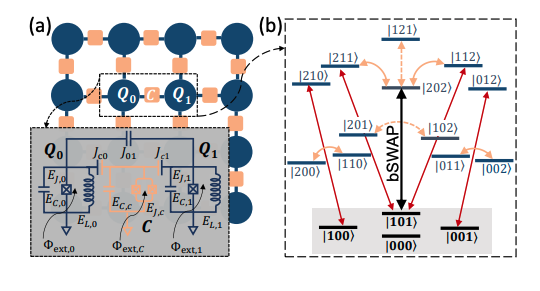
Researchers are continually seeking more versatile and reliable methods to control quantum processors, and a team led by Peng Zhao of the Quantum Science Center of Guangdong-Hong Kong-Macao Greater Bay Area, along with Peng Xu and Zheng-Yuan Xue from Key Laboratory of Atomic and Subatomic Structure and Quantum Control, South China Normal University, now presents a novel approach to achieving fast and precise control over superconducting circuits. They demonstrate a technique for creating rapid entanglement between quantum bits, known as fluxoniums, by carefully manipulating the interaction between them using precisely timed pulses of energy. This method leverages a tunable connection between the fluxoniums, allowing for the creation of controlled-phase gates with sub-100 nanosecond speeds and remarkably low error rates, potentially paving the way for more scalable and robust quantum computers. The operational flexibility of this technique offers a promising framework for building complex quantum processors that can overcome current limitations in control and connectivity.
Fluxonium Qubits and Plasmonic Entangling Gates
Researchers are developing faster methods for entangling qubits, essential building blocks of quantum computers, using fluxonium qubits. These qubits offer improved performance over other types, but creating fast and reliable connections between them remains a significant challenge. This work investigates a novel approach to achieve this by parametrically modulating the interaction between fluxonium qubits via a shared plasmonic resonator, enhancing their connection. This new method dynamically controls the interaction between qubits, generating a strong, time-dependent connection that enables fast entangling gates with potentially high fidelity.
The research demonstrates the feasibility of implementing a controlled-Z (CZ) gate between two fluxonium qubits linked by a plasmonic resonator. By carefully controlling the modulation, the researchers aim to achieve gate times below 10 nanoseconds, with a target fidelity exceeding 99. 9%. The investigation explores various parameters to optimise performance and minimise errors caused by leakage and decoherence.
Transmon Qubit Control and Scalability Challenges
A vast body of research focuses on superconducting qubits and the challenges of building larger, more reliable quantum computers. Research on transmon and fluxonium qubits dominates the field, with studies focusing on their design, fabrication, and control. Connecting qubits to enable multi-qubit operations is a central theme, with researchers exploring tunable and fixed-frequency couplers. Techniques to reduce errors caused by unwanted qubit interactions are also being developed. Achieving high-fidelity quantum gates, particularly CNOT and iSWAP gates, is paramount.
Researchers are exploring fast gates, parametrically driven gates, and cross-resonance gates for entangling qubits. Error mitigation and suppression are crucial, with studies focusing on reducing leakage, frequency collisions, static interactions, and decoherence. Optimal control algorithms are used to design control pulses that maximise gate fidelity. Precise control of qubit states using microwave signals and magnetic flux is a recurring theme. Researchers are also investigating dispersive coupling, which uses the interaction between qubits and resonators to control and measure qubit states.
Theoretical and simulation tools are used to model qubit behaviour and optimise control pulses. Understanding and mitigating unwanted interactions between qubits is essential for maintaining coherence and fidelity. Key trends and challenges highlighted include scalability, fidelity, error mitigation, and control complexity. Building larger quantum processors requires addressing challenges related to wiring, control signal distribution, and maintaining qubit coherence in complex systems. Accurate theoretical models and simulations are needed to understand qubit behaviour and optimise control pulses.
In conclusion, this body of research paints a picture of a vibrant and rapidly evolving field. Researchers are actively working to overcome the challenges of building scalable, reliable, and high-performance superconducting quantum computers. The focus is on improving qubit design, control techniques, and error mitigation strategies, ultimately paving the way for practical quantum computation.
Fast Entangling Gates in Fluxonium Qubits
Researchers have developed a new control strategy for creating fast entangling gates in scalable fluxonium-based superconducting processors. The method uses parametric modulation of the interaction between fluxonium qubits, enabling the implementation of controlled-phase gates with speeds under 100 nanoseconds and errors below 0. 1%. Importantly, the approach demonstrates strong interactions, exceeding 10 MHz, without significant interference from unwanted transitions, highlighting its potential for building more complex quantum circuits. The team’s findings suggest this parametric modulation strategy offers considerable operational flexibility and could be extended to implement multi-controlled phase gates, further enhancing the capabilities of fluxonium architectures.
Achieving even lower error rates requires improvements in plasmon coherence, potentially through optimisation of fabrication processes and device design. Addressing leakage into non-computational states and mitigating the influence of parasitic modes within the Josephson junction array are also crucial for effective quantum error correction. Future work will likely focus on balancing these various design considerations to enable the development of scalable and high-performing fluxonium quantum processors.
🗞 Fast entangling gates on fluxoniums via parametric modulation of plasmon interaction
🧠 ArXiv: https://arxiv.org/abs/2509.04762


See today’s quantum computing news on Quantum Zeitgeist for the latest breakthroughs in qubits, hardware, algorithms, and industry deals.