Approximating the multiple states that exist within a quantum system presents a significant computational challenge, yet understanding these states is crucial for modelling complex materials and phenomena. Waleed Sherif, from the Institute for Quantum Gravity at Friedrich-Alexander-Universität Erlangen-Nürnberg, and colleagues demonstrate a new method for simultaneously approximating these multiple, often identical, quantum states using a single neural network. Their approach, a ‘single-trunk multi-head’ neural network state, dramatically reduces the computational resources needed compared to traditional methods, by sharing core calculations across all states. The team proves this method can accurately represent every state within a degenerate manifold, and validates its effectiveness on a complex magnetic model, achieving high accuracy with significantly fewer computing resources, paving the way for simulations of larger and more intricate quantum systems.
Multi-Head Variational Monte Carlo with Orthogonality
Scientists have developed a new Variational Monte Carlo (VMC) method that uses multiple “heads” to optimise a wavefunction while ensuring these heads remain distinct. This approach aims to improve the accuracy and efficiency of calculations by exploring a wider range of possibilities within the quantum system. The method represents the wavefunction with multiple heads, allowing for a more flexible and comprehensive description, and employs an orthogonality penalty to prevent convergence to the same solution. The team focused on calculating gradients efficiently, particularly for the shared components of the multi-head wavefunction, using reverse-mode automatic differentiation and importance sampling.
They carefully considered the orthogonality penalty and developed estimators to accurately calculate energy and the penalty, addressing potential biases. A key innovation involves correcting per-sample coefficients to counteract a tendency for the optimisation to inflate the norms of the heads. The method benefits from calculating gradients in a single pass, significantly improving efficiency for large systems. Simulations were performed on chains of up to six sites, using a relatively small learning rate and a substantial number of Monte Carlo samples. The strength of the orthogonality penalty was gradually increased during the simulation.
The results demonstrate the method’s efficiency, robustness, and ability to enforce orthogonality between the heads, allowing for a more flexible representation of the wavefunction and a more efficient exploration of the parameter space. This method has potential applications in various fields, including quantum chemistry, condensed matter physics, and nuclear physics. It could be used to calculate the ground-state energy and other properties of molecules, materials, and nuclei. The careful design of the algorithm suggests that this method could be a powerful tool for studying a wide range of quantum systems, particularly for tackling larger and more complex systems.
Shared Trunk Multi-Head Neural Network Ensemble
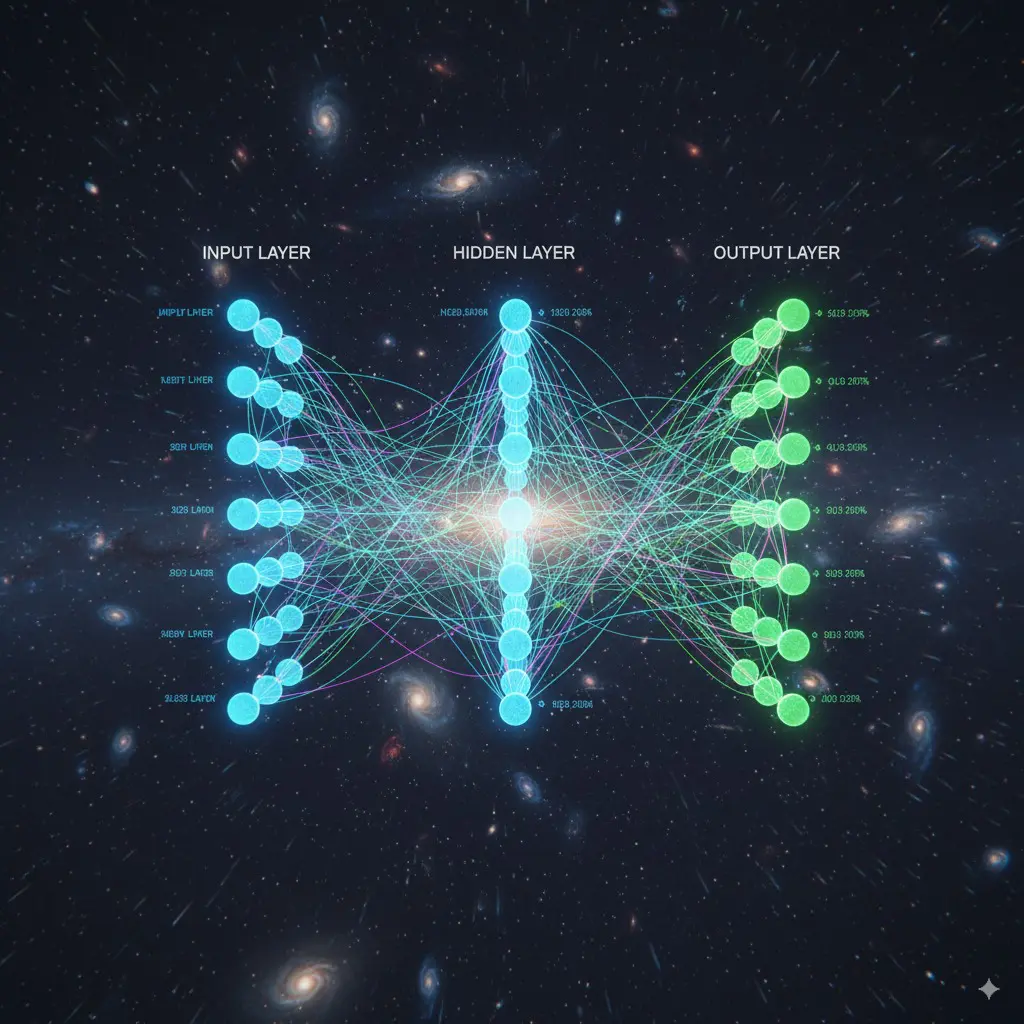
Scientists have created a new neural network ensemble, termed single-trunk multi-head (ST-MH), to efficiently approximate multiple degenerate states within complex quantum systems. This method employs a shared feature-extracting network “trunk” coupled with lightweight, linearly parametrised “heads”, each dedicated to representing a specific eigenstate, reducing the overall parameter count and computational cost. This innovative design draws inspiration from multi-task learning and shared-orbital techniques used in quantum chemistry. The team rigorously proved that, under specific conditions relating to the width of the shared trunk, the ST-MH ensemble can exactly represent the entire degenerate manifold without sacrificing expressivity.
Furthermore, scientists derived closed-form analytic gradients for both the energy and overlap penalties, alongside efficient sampling strategies, enabling seamless integration of the ST-MH ensemble into standard Variational Monte Carlo (VMC) workflows. To validate their approach, researchers focused on the frustrated spin-1/2 J1-J2 Heisenberg chain, successfully obtaining the degenerate momentum eigenstates. Experiments demonstrate that the ST-MH ensemble achieves comparable fidelity and energy accuracy to traditional methods while significantly reducing memory and runtime demands, highlighting its potential for tackling larger and more complex quantum systems. The team also provides a computational cost analysis, incentivising the applicability of the ST-MH ensemble under specific criteria.
Efficiently Representing Degenerate Quantum States with Networks
Scientists have developed a new approach to representing multiple quantum states simultaneously, significantly improving computational efficiency. This method, termed the single-trunk multi-head (ST-MH) neural network, addresses the challenge of accurately approximating all states within a degenerate manifold. The ST-MH network shares a core feature-extracting component, reducing the overall number of parameters needed while maintaining individual “heads” dedicated to representing each target state. Experiments demonstrate that the ST-MH ensemble can accurately represent degenerate eigenstates, achieving high fidelity and energy accuracy across complex systems like the frustrated spin-Heisenberg model.
Crucially, the team proved that under specific conditions regarding the network’s latent width, the ST-MH can exactly represent every degenerate eigenstate. This innovative architecture reduces the computational cost, offering substantial savings compared to traditional methods, particularly when the degeneracy is modest. Performance comparisons reveal that the ST-MH ensemble maintains a consistent compute time even as the number of states increases, whereas a multi-trunk approach exhibits a linear increase in computation. For relatively low network widths, the multi-trunk approach initially shows higher accuracy, but as the network width increases, the ST-MH quickly matches and even surpasses its performance.
Results show that both ST-MH and multi-trunk ensembles achieve similar accuracy, especially with larger trunk widths, indicating the ST-MH’s ability to effectively represent complex states with a fraction of the feature space. Further analysis confirms that the ST-MH ensemble not only converges to the correct ground energy but also generates mutually orthogonal states, demonstrating its ability to resolve the entire degenerate ground space. Tests on systems with up to eight sites show that the ST-MH remains faster than the multi-trunk approach, offering a promising pathway for tackling complex quantum simulations with reduced computational resources. The team’s findings establish a new benchmark for efficiently representing and resolving degenerate quantum states, paving the way for advancements in materials science, condensed matter physics, and quantum computing.
Neural Network Ensemble Approximates Quantum States
The research presents a new approach to approximating multiple quantum states simultaneously, using a neural network quantum state (NQS) ensemble termed single-trunk multi-head (ST-MH). This method addresses the computational expense of finding all states within a degenerate manifold by sharing a common feature-extracting “trunk” within the neural network, while employing lightweight “heads” specific to each target state. The team demonstrates that, under certain conditions relating to the network’s architecture and the target states, the ST-MH ensemble can accurately represent degenerate eigenstates with a reduced number of parameters and potentially lower computational cost compared to traditional methods.
🗞 Simultaneous approximation of multiple degenerate states using a single neural network quantum state
🧠 ArXiv: https://arxiv.org/abs/2509.02658



See today’s quantum computing news on Quantum Zeitgeist for the latest breakthroughs in qubits, hardware, algorithms, and industry deals.