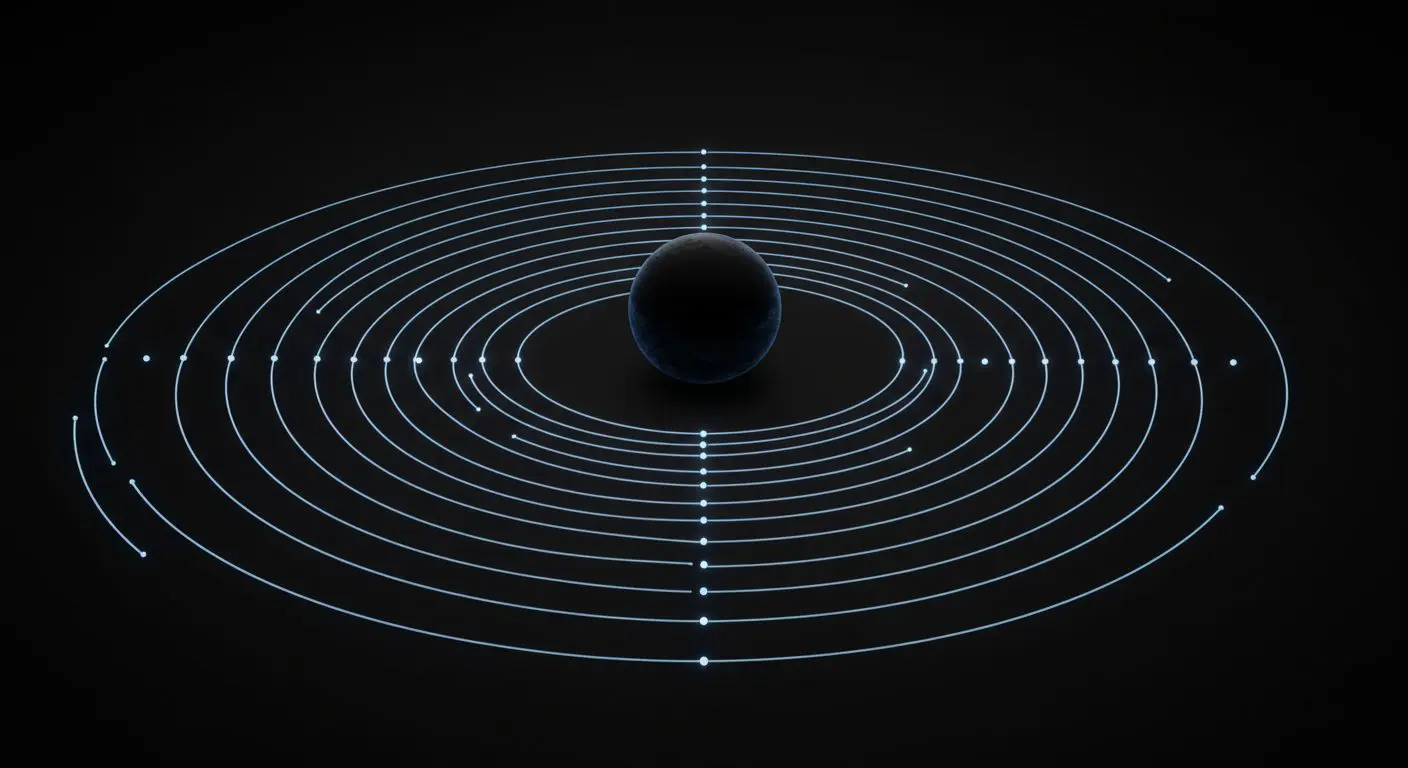
The dramatic collapse of matter under gravity presents a fundamental challenge to our understanding of the universe, potentially leading to singularities where the laws of physics break down, and challenging the principle of weak cosmic censorship. Marija Tomašević from the University of Amsterdam, alongside Chih-Hung Wu, and colleagues, now provide compelling evidence for how this collapse actually unfolds, revealing a surprising resolution to this long-standing problem. Their research employs a sophisticated semiclassical analysis to investigate the critical point where collapse begins, demonstrating that quantum effects prevent the formation of a naked singularity. The team finds that these quantum corrections not only enforce weak cosmic censorship, but also induce a phase transition in the collapsing matter, fundamentally altering its behaviour and offering new insights into the interplay between gravity and quantum field theory in extreme environments.
Naked Singularities and Critical Gravitational Collapse
Critical gravitational collapse offers a unique opportunity to explore extremely strong gravity, potentially leading to the formation of a naked singularity from smooth initial conditions. This phenomenon, predicted by classical general relativity, challenges our understanding of predictability in gravity and the validity of current theories at the smallest scales. The formation of a naked singularity, where the singularity is not hidden by an event horizon, could allow observation of quantum gravitational effects, but also raises questions about causality and determinism. Recent advances in numerical relativity have enabled increasingly accurate simulations of collapsing stars, revealing the existence of a critical point separating those that form black holes from those that produce naked singularities.
Existing studies have primarily focused on spherically symmetric collapse, which simplifies the problem but may not capture the complexity of realistic astrophysical scenarios. Understanding the dynamics near this critical point is crucial for determining whether naked singularities can realistically form in nature and for developing a consistent theory of quantum gravity. This research investigates whether the critical behaviour observed in spherically symmetric collapse persists under more general conditions, by extending previous studies to include perturbations and non-spherically symmetric initial data. The team aims to characterise the nature of the instability that leads to either black hole formation or singularity growth, analysing the behaviour of perturbations with different angular momentum modes and quantifying the sensitivity of the critical solution to variations in the initial data.
This work provides a dynamical counterexample to weak cosmic censorship, suggesting that singularities may not always be hidden. Near the critical regime, quantum effects from the collapsing matter are expected to intervene before full quantum gravity resolves the singularity. In this research, the team performs a one-loop semiclassical analysis using a robust anomaly-based method within the framework of Einstein gravity minimally coupled to a free, massless scalar field. Focusing on explicitly solvable critical solutions in both two-plus-one and three-plus-one dimensions, the researchers analytically solve the semiclassical Einstein equations and provide definitive answers to several long-standing questions.
Gravitational Collapse and Singularity Research Overview
This is a comprehensive list of references related to gravitational collapse, singularities, black holes, and related topics in theoretical physics, including string theory and the AdS/CFT correspondence. The key themes revolve around understanding the fundamental problem of gravitational collapse, the formation of singularities, and attempts to resolve or avoid them. Several papers focus on critical collapse, inspired by the work of Choptuik, where small changes in initial conditions can dramatically affect the outcome. A significant theme is the possibility of naked singularities, and the question of whether cosmic censorship holds.
The list also covers research on black holes and Hawking radiation, including the information paradox and the study of black hole thermodynamics. String theory and the AdS/CFT correspondence provide powerful tools for studying gravity and black holes, allowing physicists to study gravity using the tools of quantum field theory. Research in this area explores the duality between gravity in Anti-de Sitter space and conformal field theories, and investigates the appearance of black hole singularities in the dual CFT description. Current and emerging directions include revised cosmic censorship conjectures, the effects of quantum fluctuations on spacetime geometry, and the proper time it takes to reach the singularity from the perspective of an infalling observer. Research also explores holographic signatures of critical collapse and the connection between the Operator Product Expansion and the black hole singularity. Overall, this list reflects intense research activity in these areas, with the field moving towards a deeper understanding of the quantum nature of gravity, the fate of singularities, and the holographic principle.
Quantum Collapse Yields Finite Mass Gap
This research presents a first-principles semiclassical analysis of gravitational collapse, addressing a long-standing problem in understanding what happens when matter collapses under its own gravity. The team successfully performed calculations within quantum field theory, focusing on the behaviour of scalar fields in a collapsing spacetime, and developed a consistent theoretical framework for describing these complex scenarios. The results demonstrate that quantum effects uniquely determine the state of the collapsing matter, selecting a specific configuration that incorporates genuine vacuum polarization. Importantly, the analysis reveals the emergence of a finite mass gap, indicating a transition from classical behaviour to a modified state, and providing support for the weak cosmic censorship conjecture. The study resolves several previously debated questions regarding self-similarity and the quantum Lyapunov exponent, offering definitive answers within the framework of their calculations. Future research could explore the implications of these findings for other types of matter and investigate the potential role of even stronger quantum gravity effects not captured by their semiclassical approach.
🗞 Unveiling horizons in quantum critical collapse
🧠 ArXiv: https://arxiv.org/abs/2509.03584