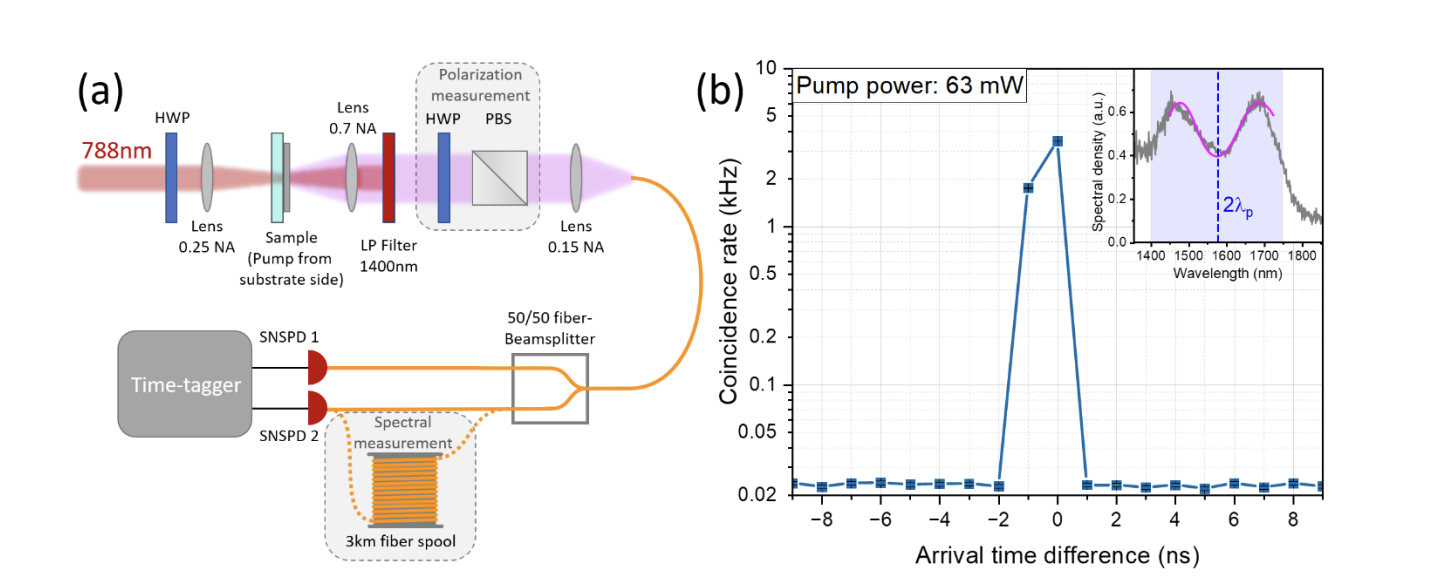
The quest for efficient sources of entangled photons takes a significant step forward with research demonstrating the potential of a novel material platform, as Simon Stich, Vitaliy Sultanov, Trevor Blakie, and colleagues reveal. They investigate thin films of aluminium gallium arsenide, specifically a composition of Al0. 30Ga0. 70As, grown with a unique (111) surface orientation, to overcome limitations found in conventional materials used for generating these fundamental particles of light. This innovative approach allows the team to create a flat-optics-based source that efficiently produces pairs of entangled photons at telecom wavelengths, achieving a high generation rate and broad bandwidth. Importantly, the (111) orientation facilitates the creation of photons with orthogonal polarization, a crucial property for applications in quantum communication and computation, and opens new avenues for exploring nonclassical polarization effects through advanced optical engineering.
Efficient Entangled Photon Source via AlGaAs Heterostructures
This research details the creation of a highly efficient source of entangled photons using aluminum gallium arsenide and gallium arsenide heterostructures grown on a specific crystal plane. The team successfully engineered a quantum light source that generates entangled photon pairs with improved efficiency through careful material selection, precise growth techniques, and optimized design. This advancement addresses a critical need for brighter and more reliable sources of entangled photons for emerging quantum technologies. The researchers chose aluminum gallium arsenide and gallium arsenide due to their strong ability to convert light and their compatibility with standard semiconductor manufacturing processes.
Growing the material on a (111) substrate proved crucial for maximizing the generation of entangled photons and achieving efficient nonlinear optical conversion. The resulting source demonstrates a substantial improvement in efficiency compared to previous designs, generating tunable biphotonic states and offering flexibility for diverse quantum optics applications. Its compact design also suggests potential for integration into larger quantum systems. The team observed and analyzed interesting polarization effects related to the generated photon pairs, including a phenomenon known as hidden polarization and the generation of polarization-squeezed states. These observations provide valuable insights into the fundamental properties of the generated light and enhance the potential for precision measurements. This high-efficiency and tunable source holds promise for a wide range of quantum technologies, including secure quantum communication, powerful quantum computation, advanced quantum imaging, and highly sensitive precision metrology.
Efficient Telecom Photon Pairs from Novel AlGaAs Crystals
Scientists have developed a novel approach to generating entangled photons by utilizing flat-optics platforms and specifically, aluminum gallium arsenide crystals with a unique orientation. This study pioneered the use of aluminum gallium arsenide crystals grown with a (111) surface, overcoming limitations found in conventionally-oriented crystals and enabling efficient photon-pair generation. This method achieves high photon-pair generation rates and bandwidths, reaching up to 0. 24 Hz per milliwatt of pump power per nanometer of bandwidth, by relaxing traditional constraints typically required for spontaneous parametric down-conversion.
The team carefully selected an aluminum gallium arsenide composition with 30% aluminum concentration, a crucial step to minimize unwanted light emission and reduce noise by at least an order of magnitude compared to pure gallium arsenide. This precise control over material composition significantly enhances the purity of the generated photon pairs at telecom wavelengths, essential for long-distance quantum communication applications. The (111) crystal orientation facilitates the generation of orthogonally polarized entangled photons, a prerequisite for creating high-quality polarization-entangled states. The experimental setup harnesses the benefits of thin-film flat optics, naturally relaxing phase-matching requirements and enabling efficient nonlinear interactions across multiple wavelengths. Rather than directly measuring entanglement, scientists observed the effect of hidden polarization, providing insights into the nonclassical behavior of the generated photons. This technique reveals the potential of aluminum gallium arsenide (111) as a promising material for scalable quantum photonic sources and expands understanding of nonlinear polarization effects accessible through advanced optical engineering.
Efficient Telecom Photon Pairs from Aluminum Gallium Arsenide
Scientists have achieved a significant breakthrough in generating entangled photons using aluminum gallium arsenide, a material offering exceptionally high nonlinear properties. The team demonstrated a flat-optics-based source capable of generating photon pairs in the telecom range, achieving a photon-pair generation rate of up to 0. 24 Hz per milliwatt of pump power per nanometer of bandwidth. This performance surpasses previous limitations imposed by conventional nonlinear crystals and their strict phase-matching requirements. The researchers overcame challenges associated with gallium arsenide, specifically its tendency for spontaneous emission and unwanted light emission, by incorporating 30% aluminum into the material.
This precise composition reduced unwanted light emission and photoluminescence background by at least an order of magnitude compared to pure gallium arsenide, significantly improving the purity of the generated photon pairs at telecom wavelengths. The choice of aluminum concentration represents a crucial compromise, balancing the need to increase the material’s properties with maintaining a substantial ability to convert light. Furthermore, the team employed a unique crystal orientation, fabricating the material with a (111) surface. This specific orientation facilitates the generation of orthogonally polarized entangled photons, a prerequisite for creating high-quality polarization-entangled states. By moving beyond conventional crystal growth, scientists were able to exploit the full nonlinear potential of the material, even under normally incident pump light. The results highlight aluminum gallium arsenide as a promising platform for scalable quantum photonic sources and open new avenues for exploring nonclassical polarization effects through advanced flat-optics engineering.
Gallium Arsenide Boosts Photon Pair Generation
This research demonstrates the effective use of gallium arsenide and aluminum gallium arsenide thin films, specifically with a (111) surface orientation, for generating photon pairs through a process called spontaneous parametric down-conversion. By utilizing these materials, the team achieved significantly higher photon-pair generation rates compared to conventional materials like lithium niobate or gallium phosphide, while maintaining compact source dimensions. The introduction of aluminum into the gallium arsenide structure reduced optical losses at the pump wavelength, leading to increased photon-pair rates and a reduction in unwanted background light. Notably, the aluminum gallium arsenide film achieved a normalized photon-pair rate of 0.
24 Hz/mW/nm, exceeding previously reported values for similar thin-film sources. The (111) orientation automatically satisfies the conditions for generating orthogonally polarized entangled photons, a key requirement for certain quantum technologies, and facilitates a high degree of purity in the generated photon pairs. These findings establish (111)-grown aluminum gallium arsenide as a promising platform for developing efficient, broadband, and compact sources of entangled photons for future quantum applications.
🗞 Thin-film Al0.30Ga0.70As (111) as a flat source of high-purity orthogonally polarized entangled photons
🧠 ArXiv: https://arxiv.org/abs/2509.03978