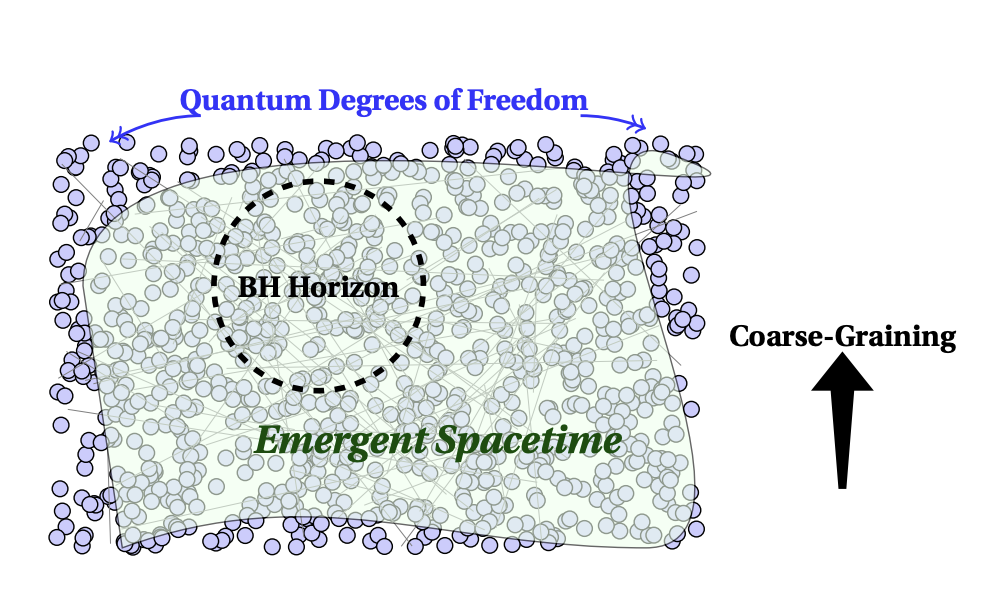
The fundamental connection between gravity and thermodynamics continues to reveal surprising insights, and a new study by F. Barzi, H. El Moumni, and K. Masmar investigates how treating the horizon of spacetime as a system with finite heat capacity alters our understanding of Unruh thermodynamics. The researchers demonstrate that Jacobson’s established method for deriving Einstein’s equations remains valid even when these horizons are not treated as infinitely large heat reservoirs, a common simplification in previous work. This refined approach yields an entropy that aligns with Rényi entropy, or a novel “Einstein entropy”, and crucially, establishes a clear link between finite heat capacity and non-extensive entropy, modifying the expected Unruh temperature. The team’s findings not only strengthen the idea that gravity emerges from thermodynamics, but also predict potentially observable effects in diverse areas such as heavy-ion collisions, particle spin polarization, and experiments mimicking gravity using other physical systems.
Finite Heat Capacity Resolves Unruh Paradox
This research demonstrates that Einstein’s equations remain valid when considering the finite heat capacity of local Rindler horizons, resolving a long-standing issue with standard Unruh thermodynamics which assumes infinite heat capacity. The team achieved this by treating these horizons as finite heat-capacity systems, resulting in an entropy that aligns with Rényi entropy or a new “Einstein entropy” which preserves the Einstein equations across all heat capacities. This work establishes a clear link between finite-capacity thermodynamics and nonextensive entropy, modifying the standard Unruh temperature in the process. The findings strengthen the emergent-gravity paradigm, suggesting that gravity may arise from underlying thermodynamic principles, and connect spacetime dynamics to generalized entropies.
Finite Heat Capacity Modifies Gravity’s Thermodynamics
The research investigates how finite heat capacity affects our understanding of gravity as an emergent phenomenon, building on the idea that Einstein’s equations can be derived from thermodynamic principles. It demonstrates that when considering horizons with limited heat capacity, the standard Clausius relation requires modification. Incorporating Rényi entropy naturally arises from this finite heat capacity and provides a consistent thermodynamic framework. To preserve the validity of Einstein’s equations, the researchers introduce “Einstein entropy,” which reproduces the standard equations even with finite heat capacity. Using Rényi entropy leads to corrections to Einstein’s equations, specifically quadratic terms involving the energy-momentum tensor, resonating with modified gravity theories like Energy-Momentum Squared Gravity. The findings sharpen the thermodynamic foundation of gravity and suggest potential avenues for experimental tests, ranging from analog gravity experiments to observations of strongly coupled systems like those created in heavy-ion collisions, highlighting that realistic physical constraints can extend the validity of general relativity.
Notably, the corrected Einstein equation obtained predicts an upper bound on horizon energy flux, potentially offering testable signatures in diverse areas such as heavy-ion collisions, accelerator spin polarization experiments, and analog gravity systems.
The authors acknowledge that their approach involves approximations and further research is needed to fully explore the implications of finite heat capacity effects, and highlight the potential for this work to provide a thermodynamic foundation for models involving higher-order matter couplings.
🗞 Modified Unruh Thermodynamics in Emergent Gravity: Finite Heat Capacity and Rényi Entropy
🧠 ArXiv: https://arxiv.org/abs/2509.03470




See today’s quantum computing news on Quantum Zeitgeist for the latest breakthroughs in qubits, hardware, algorithms, and industry deals.