Unified multimodal artificial intelligence takes a significant step forward with the introduction of OneCAT, a new model developed by Han Li, Xinyu Peng, and Yaoming Wang, along with colleagues at their institutions. This research presents a uniquely efficient system that seamlessly combines image and text understanding, generation, and editing within a single, decoder-only transformer architecture. OneCAT distinguishes itself by eliminating the need for separate visual processing components, resulting in faster performance, particularly with detailed images, and it achieves this through a novel training approach and a multi-scale visual autoregressive mechanism that drastically reduces processing steps. The results demonstrate that a pure autoregressive model provides a powerful and elegant foundation for unified multimodal intelligence, establishing a new performance standard across key benchmarks and surpassing existing open-source alternatives.
Multimodal Models and Image Editing Techniques
Researchers are actively developing a range of multimodal models, systems capable of processing and integrating information from multiple sources, such as text and images. Several recent advancements focus on creating models that can not only understand these inputs but also generate new content and edit existing images based on instructions. Notable models include Ultraedit, Transfusion, Capsfusion, and Janus, each contributing to the growing field of multimodal AI. Other significant developments include Ccmb, a large-scale Chinese cross-modal benchmark, and models like Vargpt and Show-o, which aim to unify multimodal understanding and generation. Datasets such as Magicbrush and Imgedit provide valuable resources for training and evaluating these models, while benchmarks like Mm-vet assess their integrated capabilities.
Unified Decoder Architecture for Multimodal Processing
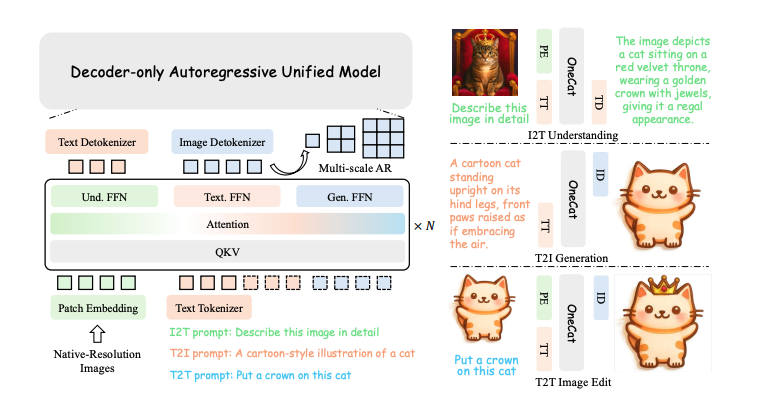
Researchers developed OneCAT, a novel unified multimodal model, by engineering a completely decoder-only transformer architecture that streamlines understanding, generation, and editing within a single system. This approach moves away from traditional modular frameworks, prioritizing deep, early-stage fusion of information and efficient inference. The team directly tokenizes raw visual inputs into patch embeddings and processes them alongside text tokens within the decoder stack, eliminating the need for external components like Vision Transformers or dedicated vision tokenizers. A critical innovation lies in the implementation of a modality-specific Mixture-of-Experts (MoE) layer, which dynamically routes vision and text tokens to specialized experts.
This allows the model to efficiently process diverse inputs and achieve robust feature fusion without requiring complex encoders. For generative tasks, scientists pioneered a multi-scale autoregressive mechanism within the Large Language Model (LLM), augmented with scale-aware adapter modules, to predict image tokens progressively from low to high resolution. This design circumvents the latency issues of diffusion-based models and enables the model to learn a coarse-to-fine generative process, significantly improving both speed and output quality. To train this unified system, researchers leveraged a mixed training strategy, combining large-scale web-scraped image-text pairs with curated, instruction-following datasets. This heterogeneous data mixture forces the shared decoder to develop a generalized representation capable of seamlessly switching between comprehension, generation, and editing tasks. Comprehensive evaluations demonstrate that OneCAT achieves state-of-the-art performance for pure decoder-only unified models and provides a significant inference speedup, particularly for high-resolution inputs.
Unified Multimodal AI From First Principles
OneCAT presents a new unified multimodal model that integrates image and text understanding, generation, and editing within a single architecture. The model achieves strong performance across various benchmarks, demonstrating its ability to handle diverse multimodal tasks effectively. Notably, OneCAT eliminates the need for external encoders and tokenizers, streamlining the process and improving computational efficiency, particularly when processing high-resolution images. This efficiency stems from a unique combination of a modality-specific Mixture-of-Experts design and a multi-scale autoregressive generation mechanism.
The research demonstrates the viability of a simplified, first-principles approach to multimodal modelling, establishing a new baseline for future development in the field. OneCAT significantly reduces inference time for both image generation and editing compared to existing open-source models. The authors acknowledge that further research is needed to explore the full potential of the model and address limitations in specific applications.
Unified Multimodal Model Achieves Efficient Processing
Researchers have developed OneCAT, a novel unified multimodal model that seamlessly integrates understanding, generation, and editing capabilities within a single, decoder-only transformer architecture. This breakthrough eliminates the need for external components like Vision Transformers or specialized vision tokenizers during inference, resulting in significant efficiency gains, particularly when processing high-resolution images. The team achieves this through a modality-specific Mixture-of-Experts (MoE) structure, trained with a single autoregressive objective, which also natively supports dynamic resolutions, allowing the model to adapt to varying input sizes. OneCAT introduces a multi-scale visual autoregressive mechanism that drastically reduces the number of decoding steps required for image generation compared to diffusion-based methods, while maintaining state-of-the-art performance.
Experiments demonstrate the powerful potential of a pure autoregressive approach as a sufficient and elegant foundation for unified multimodal intelligence, surpassing existing open-source unified multimodal models across benchmarks for multimodal generation, editing, and understanding. The model utilizes a lightweight Patch Embedding layer to losslessly convert raw images into continuous visual tokens, enabling efficient multimodal understanding without the information loss associated with traditional discretization methods. At its core, OneCAT integrates a Mixture-of-Experts (MoE) architecture comprising three specialized feed-forward network experts: one for text, one for visual understanding, and one for visual generation. All key layers are shared across modalities and tasks, promoting parameter efficiency and robust cross-modal alignment for instruction-following.
For visual generation, OneCAT innovatively employs a Next-Scale Prediction paradigm, generating images in a coarse-to-fine, hierarchical manner, progressively predicting visual tokens from the lowest to the highest resolution scale, achieving high-quality visual outputs with reduced computational demands. Initialized from the pre-trained Qwen2. 5 LLM, OneCAT leverages strong language modeling capabilities as a foundation for its multimodal abilities.
🗞 OneCAT: Decoder-Only Auto-Regressive Model for Unified Understanding and Generation
🧠 ArXiv: https://arxiv.org/abs/2509.03498
See today’s quantum computing news on Quantum Zeitgeist for the latest breakthroughs in qubits, hardware, algorithms, and industry deals.