Solving the complex equations that govern electrical power flow represents a significant challenge as power grids evolve to incorporate renewable energy sources, and researchers are now exploring the potential of quantum computing to accelerate these crucial calculations. Thinh Viet Le, Md Obaidur Rahman, and Vassilis Kekatos, all from Purdue University, present a new approach that utilises a trainable quantum circuit to both find and predict solutions to the AC power flow problem. Their work demonstrates how this quantum model can learn from power grid specifications and accurately predict power flow behaviour, achieving enhanced performance compared to traditional deep learning methods while requiring fewer computational resources. This research establishes a foundation for tackling increasingly complex grid management tasks using quantum techniques, potentially revolutionising how we analyse and optimise future power networks.
Quantum Machine Learning for Power Systems
Researchers are exploring the potential of quantum machine learning to address the computationally intensive problem of power flow analysis, a fundamental task in operating and planning power systems. Traditional methods struggle with large-scale systems, and quantum computing offers a potential pathway to faster and more accurate solutions. This work investigates how quantum machine learning can overcome these limitations and improve power system analysis. The team employs a hybrid approach, combining the strengths of both quantum and classical computing through variational quantum algorithms. These algorithms utilize quantum computers for specific calculations while relying on classical optimization techniques for overall problem-solving, a crucial strategy given the current limitations of quantum hardware.
A key innovation lies in reformulating the power flow problem into a form suitable for quantum machine learning, expressing it in terms of expectations efficiently estimated on a quantum computer. Efficient gradient measurement is central to training the quantum model, allowing for optimization of model parameters. The method also carefully considers how power system data is encoded into the quantum state, as this significantly impacts performance. By incorporating knowledge of power system physics into the model’s design, the team enhances accuracy and generalization ability. Validation on a standard benchmark system demonstrates that the quantum machine learning model achieves comparable or better accuracy than classical methods.
Future research will focus on optimizing the structure of the quantum circuits, designing circuits tailored to power grid structures, and exploring advanced data encoding strategies. Implementing the model on actual quantum hardware and conducting scalability studies on larger power systems are also key priorities. Investigating the model’s robustness to noise and uncertainties will further refine its practical application. In summary, this work presents a promising approach to applying quantum machine learning to power flow analysis. By combining quantum and classical computing, the researchers demonstrate the potential for improved accuracy, scalability, and computational efficiency, representing a step towards realizing the benefits of quantum computing for power system applications.
Quantum Machine Learning for Power Flow Prediction
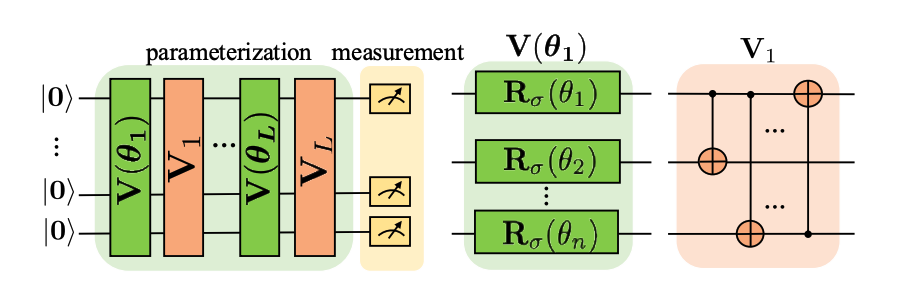
Researchers have developed a novel quantum power flow framework to accelerate interconnection studies, essential for navigating the evolving energy landscape. The team engineered a hybrid classical-quantum algorithm to solve the AC power flow problem by reformulating it as a nonlinear least-squares fit over the trainable parameters within a variational quantum circuit. This approach allows the system to find solutions using both classical and quantum processing, potentially accelerating calculations significantly. To further enhance performance, scientists leveraged a data-embedded variational quantum circuit and trained a quantum machine learning model to predict general power flow solutions in an unsupervised manner.
This innovative technique circumvents the need for large, labeled datasets typically required for training classical machine learning models, streamlining the process and reducing computational demands. The method involves encoding power flow specifications as features and inputting them into the quantum circuit, enabling the model to learn and predict solutions efficiently. A key breakthrough lies in the development of a novel protocol to efficiently measure AC power flow observables, exploiting the underlying graph structure of a power network. Recognizing that traditional measurement techniques can become computationally prohibitive with complex networks, the team reformulated the problem to minimize the number of expectations over quantum observables required for computation. This reformulation, combined with the innovative measurement protocol, significantly reduces the computational burden and enables faster, more accurate predictions. Numerical tests conducted on a standard system demonstrate that the proposed framework predicts solutions with smaller errors while utilizing significantly fewer parameters than a comparable deep neural network.
Quantum Circuits Predict Power Flow Solutions
Researchers have successfully trained variational quantum circuits to solve power flow problems, essential for simulating and analysing electrical grids. The method embeds power flow specifications directly into the model’s parameters, demonstrating improved prediction accuracy and faster training times when compared to classical deep neural networks, all while utilising significantly fewer parameters. The team’s method reformulates the power flow problem to facilitate efficient gradient computations on the circuits, enabling the development of a machine learning model capable of predicting grid behaviour. Tests on a standard electrical system demonstrate the potential of this approach to address the increasing computational demands of modern grid analysis. Future research will focus on optimising circuit structure and exploring alternative data encoding strategies, potentially paving the way for more efficient and accurate simulations of complex power systems.
🗞 Learning AC Power Flow Solutions using a Data-Dependent Variational Quantum Circuit
🧠 ArXiv: https://arxiv.org/abs/2509.03495


See today’s quantum computing news on Quantum Zeitgeist for the latest breakthroughs in qubits, hardware, algorithms, and industry deals.