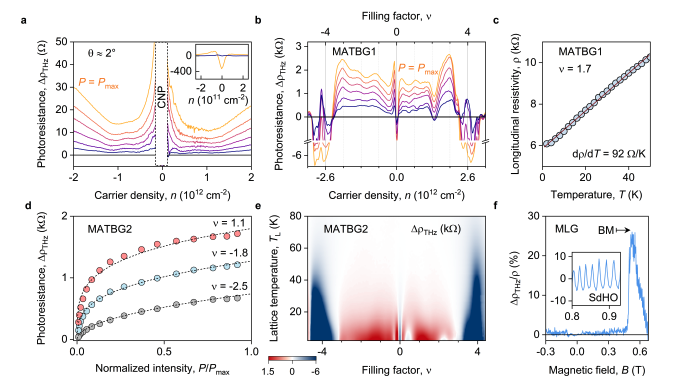
Understanding the factors that limit electrical conductivity remains a central challenge in materials science, particularly in novel materials exhibiting complex electronic behaviour. A. L. Shilov, M. Kravtsov, J. Covey, and colleagues now reveal that electronic interactions, rather than vibrations within the material’s structure, play a dominant role in determining conductivity within twisted bilayer graphene. The team achieves this breakthrough by selectively heating electrons within the material using terahertz light, effectively isolating the contribution of electron-electron interactions from that of electron-phonon interactions, a technique previously difficult to implement. This approach demonstrates a significant increase in resistance upon terahertz excitation, reaching up to 70% in optimally twisted devices, and challenges existing interpretations of conductivity in these materials, even at very low carrier densities. The findings not only illuminate the fundamental physics governing electron transport in twisted bilayer graphene, but also establish a powerful new method for investigating scattering mechanisms in a wide range of low-density materials.
Twisted Graphene’s Unusual Electronic Properties Explained
Twisted bilayer graphene (TBG) exhibits remarkable electronic properties, particularly near a specific twist angle where strong interactions between electrons lead to unusual behaviour and the potential for superconductivity. This research explores the roles of electron interactions, vibrations within the material, and the unique geometric arrangement created by the twisted layers in driving this behaviour. The “magic angle”, around 1. 1 degrees, is crucial, as it creates conditions where electron interactions become exceptionally strong, leading to a “strange metal” state where electrical resistance increases linearly with temperature.
TBG consists of two layers of graphene stacked with a slight twist, creating a repeating pattern called a moiré superlattice that alters the material’s electronic structure. The unique quantum geometry of the moiré superlattice enhances these interactions, further contributing to the strange metal behaviour. This state is often found near conditions where superconductivity emerges, suggesting a connection between these phenomena. Researchers employ techniques like terahertz spectroscopy and photoresistance measurements to probe these properties. These experiments demonstrate that electron-electron interactions are a primary driver of the observed resistance, even though vibrations within the material also contribute.
The study of TBG offers a platform for investigating the interplay between electron interactions, vibrations, and quantum geometry. Understanding the electronic properties of TBG could lead to the development of new materials and devices with unique functionalities. This challenges conventional theories of electron behaviour and provides new insights into correlated electron systems, where electrons strongly influence each other.
Terahertz Excitation Isolates Electron Heating in Graphene
Researchers have developed a novel method to selectively heat electrons in twisted bilayer graphene (TBG) while keeping the material’s atomic structure cold. By using terahertz radiation, they can isolate the contributions of electron-electron and electron-vibration interactions to electrical resistance. This technique exploits the weak interaction between electrons and vibrations in graphene-based systems, allowing scientists to study the effects of varying electron temperature on femtosecond timescales. The team carefully designed the experiment to exclude unwanted effects from light-induced conductivity changes, ensuring that the measurements accurately reflect the response of electrons to the terahertz radiation.
By exposing TBG devices to continuous-wave terahertz radiation and meticulously measuring the resulting change in resistance, they can probe the fundamental mechanisms governing electron transport. Experiments reveal a pronounced increase in resistance at specific electron densities, demonstrating a strong contribution from electron interactions to the overall resistivity. Analysis of the terahertz-induced changes in electronic oscillations, alongside measurements of resistance, estimates that electrons can be heated up to 15 Kelvin above the cold lattice temperature. In magic-angle devices, the team observed exceptionally large resistance changes, further solidifying the dominance of electronic interactions in transport. This innovative approach establishes terahertz-driven hot-electron transport as a general framework for disentangling scattering mechanisms in low-density materials, offering a powerful tool for understanding the complex interplay between electrons and vibrations in these systems.
Electronic Interactions Dominate Resistance in Twisted Graphene
Researchers have made a significant breakthrough in understanding the origins of electrical resistance in twisted bilayer graphene (TBG) and similar materials. By selectively heating electrons while keeping the material’s atomic structure cold, they have isolated the contributions of electron-electron and electron-vibration interactions to resistivity. Experiments reveal that electronic interactions, rather than vibrations, dominate transport, even in regimes previously attributed to vibrations. This discovery challenges existing interpretations of the linear-in-temperature resistance observed near the magic angle, a specific configuration of TBG known for its unusual electronic properties.
Away from the magic angle, the team observed both resistance changes and a predictable relationship between resistance and temperature, even at extremely low electron densities where conventional electron interactions are typically restricted. Analysis of these results indicates that a breakdown of a fundamental principle of physics, known as Galilean invariance, within the material’s unique electronic structure is responsible for this behaviour. This leads to current relaxation through collisions between electrons in different regions of the material. The findings unify the unusual transport properties of magic-angle devices with the predictable scaling observed in higher-angle systems, linking TBG to other materials exhibiting interaction-limited conductivity. This establishes a broadly applicable framework for understanding transport in moiré materials and other low-density quantum materials, offering a pathway to control and optimize their electronic properties for future applications. The team’s approach provides a powerful new tool for disentangling scattering mechanisms in low-density systems, paving the way for advancements in materials science and condensed matter physics.
Electron Interactions Dominate Resistivity in Twisted Graphene
Research has successfully separated the contributions of electronic and vibrational interactions to resistivity in twisted bilayer graphene (TBG). By using terahertz radiation to selectively heat electrons while keeping the material’s atomic structure cold, researchers have demonstrated that electronic interactions play a crucial role in determining the material’s conductivity, even in regimes where vibrations were previously thought to dominate. The study reveals a substantial contribution from electron-electron interactions to the overall resistivity, even when electrons are heated to temperatures significantly above the cold lattice. This is particularly notable near the magic angle, where the material exhibits unusual electronic properties.
Furthermore, the research identifies that even at extremely low electron densities, where conventional electron interactions are restricted, interactions continue to play a crucial role. Analysis suggests that a breakdown of a fundamental principle of physics within the material’s unique band structure, stemming from collisions between electrons in different regions, may underpin this interaction-limited conductivity. The authors acknowledge that the observed phenomena are most pronounced in high-quality samples with low disorder. Future research directions include exploring these interaction mechanisms in other low-density materials and investigating the potential for controlling conductivity through manipulation of these electronic interactions.
🗞 Interaction-limited conductivity of twisted bilayer graphene revealed by giant terahertz photoresistance
🧠 ArXiv: https://arxiv.org/abs/2509.02552



See today’s quantum computing news on Quantum Zeitgeist for the latest breakthroughs in qubits, hardware, algorithms, and industry deals.