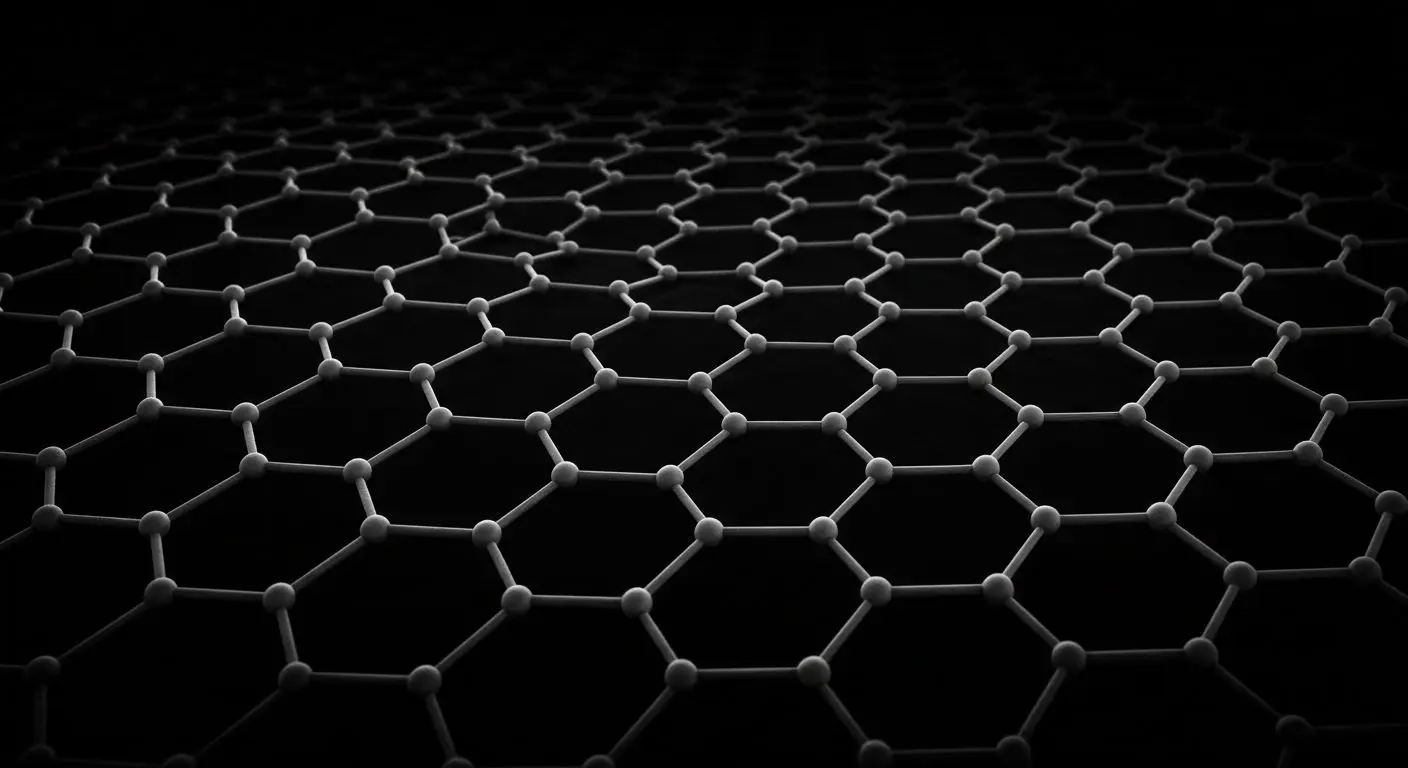
Geometric phases, fundamental properties of quantum systems, emerge in graphene nanostructures according to new research. M. Dantas, A. Carvalho, and G. Garcia, along with colleagues, demonstrate how defects within graphene’s carbon lattice generate measurable quantum effects. The team connects the behaviour of electrons in curved graphene to a mathematical concept called the Atiyah-Singer index theorem, revealing that these defects create effective forces influencing electron movement and inducing quantized Berry phases. This work provides a new way to classify and understand zero-energy modes in graphene, potentially unlocking applications in areas like holonomic computing and advanced materials design, and establishes a clear link between discrete atomic structures and established continuum physics.
Graphene’s Geometric Phases and Electron Transport
This research investigates the emergence of geometric phases within graphene-based systems. Graphene, a two-dimensional material composed of carbon atoms arranged in a honeycomb lattice, possesses unique electronic properties that make it ideal for exploring fundamental physics. These properties arise from the way electrons move within the material, behaving as massless particles, and its inherent topological characteristics. Geometric phases, also known as Berry phases, develop as a quantum state evolves, independent of the specific path it takes, and are central to manipulating electron transport and creating novel electronic devices.
Unlike conventional electronics that rely on external fields to control charge flow, devices based on geometric phases could offer more robust and energy-efficient control mechanisms. Furthermore, understanding how geometric phases interact with graphene’s topological properties could reveal new quantum phenomena and materials. This work explores the conditions under which significant geometric phases emerge in graphene, and characterises their influence on the material’s electronic behaviour.
Defect-Induced Gauge Fields in Curved Graphene
This study explores how nanostructures behave through the lens of the Atiyah-Singer index theorem. By modelling low-energy quasiparticles in curved graphene geometries, the research demonstrates that topological defects, created by inserting pentagonal or heptagonal carbon rings, generate effective gauge fields that mimic magnetic monopoles. These emergent monopoles induce a non-trivial topology in the electronic band structure, leading to the localisation of zero-energy states at the defect cores. The strength of these localised states is directly proportional to the curvature of the graphene sheet and the magnitude of the induced gauge field, offering a pathway to control electronic properties at the nanoscale.
To investigate this phenomenon, researchers employ a computational model on a triangulated graphene lattice, incorporating curvature through a continuum approximation of the lattice geometry. The methodology involves calculating the local density of states around the topological defects, revealing the presence of spatially confined zero-energy modes. They systematically vary the concentration and arrangement of pentagonal and heptagonal defects, observing a corresponding change in the density of states and the strength of the localised states. Detailed analysis of the band structure confirms the formation of topologically protected edge states around the defects. Researchers also implement a finite-size scaling analysis to extrapolate the properties of the localised states to larger structures, confirming their robustness against imperfections. To validate their theoretical predictions, they compare their results with experimental data obtained from scanning tunnelling spectroscopy measurements on curved graphene samples, demonstrating qualitative agreement between theory and experiment.
Graphene Molecular Topology Dictates Electron Phase
This research delves into the topological properties of graphene-based molecules and their connection to the geometric phase acquired by electrons within these structures. The central idea is that the geometric phase experienced by electrons in graphene-based molecules is fundamentally determined by the topology of the molecule, specifically its genus (number of holes) and the number of open edges or faces. This means the shape and connectivity of the molecule dictate the quantum phase of electrons, not just local electromagnetic fields. The research leverages the Atiyah-Singer index theorem, a mathematical result connecting topological invariants to the number of zero modes in a Dirac operator, to establish a link between the topological characteristics of the graphene structure and an effective magnetic flux induced by topological defects like pentagons and heptagons.
Researchers demonstrate that the geometric phase is quantized and can be calculated using the formula: γ = 3π [2(1 − g) − N], where ‘g’ represents the genus and ‘N’ the number of open faces. This formula allows for the prediction of the geometric phase solely from the topological properties of the molecule. The quantized geometric phase leads to a binary behavior for the electron’s wavefunction after a full rotation: an even phase leaves the wavefunction unchanged, while an odd phase changes its sign, with implications for interference phenomena and the potential for creating robust quantum states. The paper explores the geometric phase for various graphene-based nanostructures, including fullerenes, nanotubes, cones, Y and X junctions, and tori. The research suggests potential applications in holonomic quantum computation, understanding quantum transport, and designing robust quantum states. In essence, this paper provides a powerful framework for understanding and predicting the quantum properties of graphene-based molecules based on their global topological characteristics.
Graphene Topology Dictates Quantum Phase Behaviour
This research demonstrates that geometric phases emerge in graphene-based nanostructures due to topological defects, such as pentagonal or heptagonal carbon rings. By applying the Atiyah-Singer index theorem, the study establishes a relationship between a structure’s global characteristics, specifically its genus and number of open boundaries, and the quantized geometric phase acquired by quasiparticles. The findings reveal that this phase dictates the behavior of quantum states, leading to predictable changes in their configuration upon rotation and influencing interference patterns within the nanostructure. The significance of this work lies in its ability to connect the global topology of graphene structures to their quantum properties, offering a framework for understanding and potentially controlling quantum transport.
🗞 Geometric phases on graphene from Atiyah-Singer index theorem
🧠 ArXiv: https://arxiv.org/abs/2509.01574



See today’s quantum computing news on Quantum Zeitgeist for the latest breakthroughs in qubits, hardware, algorithms, and industry deals.