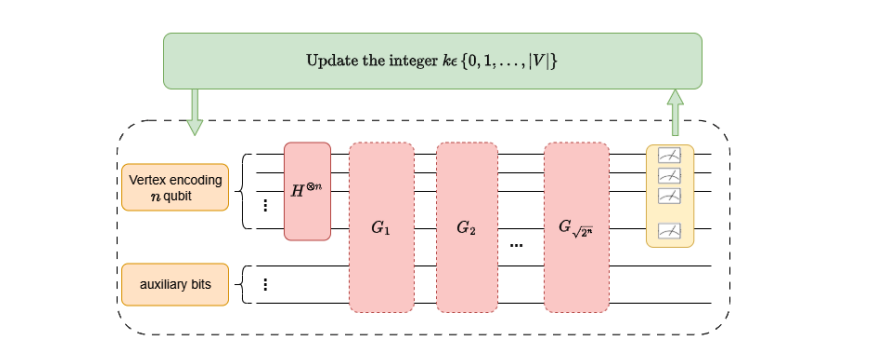
Finding the largest complete subgraph within a complex network, known as the maximum clique problem, presents a significant computational challenge with broad implications for fields ranging from bioinformatics to social network analysis. Wenmin Han, Shiqi Zheng, and Peian Chen, alongside Yukun Wang and their colleagues, address this problem with a novel approach that dramatically improves the efficiency of existing solutions. Their research introduces an algorithm that leverages the power of Grover’s search, but crucially enhances it with real-time tracking of potential clique sizes, informed by established mathematical principles. This dynamic tracking eliminates the need for repeated measurements during the search process, resulting in a substantial speedup, a fold improvement over current Grover-based methods for solving the maximum clique problem in large graphs, and offering a pathway to tackling increasingly complex network analyses.
Grover’s Algorithm for Maximum Clique Problems
This document provides a comprehensive overview of research concerning quantum algorithms, specifically focusing on Grover’s algorithm and its application to the Maximum Clique Problem. It isn’t a single research paper, but rather a detailed bibliography and contextualization of the field. The primary theme is the application of Grover’s algorithm, a quantum search algorithm, to solve the Maximum Clique Problem in graph theory, which involves finding the largest complete subgraph within a given graph. Quantum algorithms, particularly Grover’s, potentially offer speedups over classical algorithms for this computationally challenging problem.
Grover’s algorithm is a quantum algorithm designed to search unsorted databases with a quadratic speedup compared to classical algorithms, leveraging quantum superposition and amplitude amplification. The Maximum Clique Problem is known to be NP-hard, making it a good candidate for quantum algorithms. Researchers also explore quantum amplitude estimation, a technique for estimating the amplitude of a specific quantum state.
Dynamic Quantum Algorithm for Maximum Clique Problem
Researchers developed a novel algorithm to address the maximum clique problem, a computationally challenging task with applications in diverse fields such as bioinformatics and social network analysis. The team engineered a method that dynamically tracks the maximum clique size during computation, overcoming limitations inherent in existing approaches. This involved encoding prior knowledge, derived from Turán’s theorem and complete graph properties, into auxiliary qubits as a dynamic global variable, replacing static parameters used in previous implementations. The approach employs a Pre-Detection and Encoding strategy, which proactively incorporates information about potential clique sizes into the quantum circuit. Scientists harnessed operations like vertex copying, sorting, and XNOR comparison within the Oracle circuit to collaboratively filter and identify the maximum clique using this dynamic global variable. This innovative design significantly reduces computational demands, requiring only O(√2n) Grover iterations, along with a constant number of measurements to deterministically retrieve all maximum cliques within a graph of n vertices.
Dynamic Quantum Algorithm Solves Maximum Clique Problem
Researchers have developed a new quantum algorithm that significantly improves the efficiency of solving the maximum clique problem, a computationally challenging task with applications in diverse fields like bioinformatics and data mining. The team’s approach dynamically tracks the size of the largest possible complete subgraph within a network, achieving a breakthrough in speed and resource utilization. Unlike existing methods, this algorithm avoids iterative measurements by encoding information about potential clique sizes into auxiliary qubits as a dynamic global variable, replacing static parameters used in previous designs. The algorithm leverages Grover’s search, but optimizes its performance by eliminating redundant calculations. Experiments demonstrate that this method delivers a four-fold speedup compared to state-of-the-art Grover-based algorithms when applied to graphs with a substantial number of vertices. The core innovation lies in the pre-detection and encoding strategy, which utilizes Turán’s theorem and the properties of complete graphs to dynamically update the potential clique size during the search process.
Grover’s Algorithm Improves Maximum Clique Solutions
This research presents a new approach to solving the maximum clique problem, a computationally challenging task with applications in diverse fields. The team developed an algorithm that leverages Grover’s algorithm, enhanced by a pre-detection and encoding stage, to efficiently identify the largest complete subgraph within a given network. This method achieves a high success rate, reaching 96% in simulations, comparable to current state-of-the-art methods. The algorithm demonstrates improvements in quantum resource consumption, specifically in qubit complexity. While the initial pre-detection stage introduces computational overhead, this is offset by its single execution during the search process. Future work will explore alternative strategies for reducing this burden, alongside investigations into advanced encoding and circuit optimization to further minimize quantum resource requirements.
🗞 Efficient Maximum Clique Detection via Grover’s Algorithm with Real-time Global Size Tracking
🧠 ArXiv: https://arxiv.org/abs/2509.01261



See today’s quantum computing news on Quantum Zeitgeist for the latest breakthroughs in qubits, hardware, algorithms, and industry deals.