The calculations required for high-precision molecular spectroscopy present significant challenges. H₂⁺, the simplest stable molecule, is amenable to precise calculations, but experimental studies are difficult due to the long lifetimes of its rotational and vibrational states. Researchers overcame this limitation by combining buffer gas cooling, which reduces molecular motion, with quantum logic spectroscopy (QLS) between H₂⁺ and a cotrapped “helper” ion to control the molecule’s hyperfine structure. This combination enables pure quantum state preparation, coherent control, and nondestructive readout of the molecule.
Buffer Gas Cooling and Coulomb Interaction Control
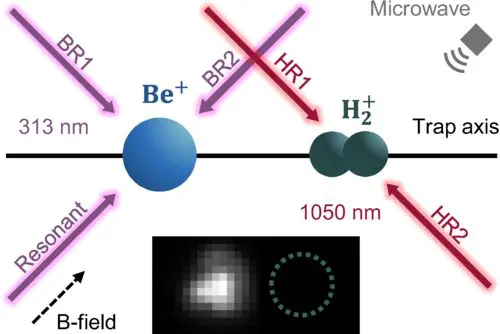
Researchers engineered a novel experimental approach to study the H₂⁺ ion, which lacks the electronic structure necessary for standard quantum control techniques. The team combined buffer gas cooling with quantum logic spectroscopy (QLS) to precisely manipulate and measure a single molecular ion, avoiding the need for direct laser cooling. This innovative method relies on a cotrapped ⁹Be⁺ ion to mediate control through their mutual Coulomb interaction. The experimental setup traps both ions within a linear Paul trap inside an ultrahigh vacuum chamber, cryogenically cooled to minimize thermal noise, with a 313 nm laser cooling and preparing the ⁹Be⁺ ion for fluorescence detection.
Simultaneously, Raman beams address the H₂⁺ ion, allowing manipulation of its hyperfine structure. By carefully controlling the interaction between the two ions, researchers achieved high-resolution microwave spectroscopy of a hyperfine transition with a statistical uncertainty of 2 Hz. This precision demonstrates the power of the combined buffer gas cooling and QLS approach, paving the way for future high-precision spectroscopy of H₂⁺ in both the microwave and optical domains and providing a general tool for controlling other difficult-to-manipulate molecular ion species.
Molecular Control via Quantum Logic Spectroscopy
Researchers have achieved full quantum control of a single H₂⁺ ion, a significant step towards high-precision molecular spectroscopy. The team successfully implemented a novel technique combining buffer gas cooling with quantum logic spectroscopy (QLS) to overcome longstanding challenges in controlling this notoriously difficult molecule. By utilizing a cotrapped ⁹Be⁺ ion, they transferred quantum information through shared motion, enabling precise state preparation and manipulation of the H₂⁺ ion’s hyperfine structure. This breakthrough addresses the issue of long-lived rovibrational states in H₂⁺, which previously prevented thermalization and limited rotational state preparation.
This innovative approach allows for pure quantum state preparation, coherent control, and nondestructive readout of a single H₂⁺ molecule, paving the way for unprecedented spectroscopic measurements. Experiments revealed the capability to perform high-resolution microwave spectroscopy within the hyperfine structure of H₂⁺, achieving a precision of 2 Hz. This level of precision surpasses previous molecular ensemble experiments and promises significantly reduced systematic uncertainties. The demonstrated platform enables precise measurements of the molecule’s internal structure, with implications for testing fundamental physics, determining fundamental constants, and searching for new physics beyond the Standard Model. This advancement opens exciting possibilities for high-precision spectroscopy in both the microwave and optical domains, potentially leading to a deeper understanding of molecular structure and interactions at the quantum level.
Hydrogen Molecular Ion Fully Quantum Controlled
Researchers have demonstrated full quantum control over a single molecular ion of hydrogen, H₂⁺, by employing a technique that transfers quantum information through shared motion with a helper ion. This innovative approach utilizes a beryllium ion to mediate the control of the hydrogen ion, enabling precise preparation of its quantum state and high-resolution spectroscopy. The method involves carefully manipulating the motional states of both ions, effectively using the beryllium ion as a bridge to influence the hydrogen ion’s internal quantum state. This achievement represents a significant step forward in precision measurements and quantum information processing, as controlling molecular ions is crucial for developing accurate atomic clocks and exploring fundamental physics.
The authors acknowledge a limitation in the potential for photodissociation of the hydrogen ion due to the strong resonant beam used in their experiment. Future work could focus on mitigating this effect to further enhance the stability and duration of the quantum control. They also suggest that this technique could be extended to other molecular ions, paving the way for more complex quantum systems and investigations into molecular interactions.
🗞 Quantum Control of a Single {H}2^{+} Molecular Ion
🧠 DOI: http://link.aps.org/doi/10.1103/PhysRevX.15.031009




See today’s quantum computing news on Quantum Zeitgeist for the latest breakthroughs in qubits, hardware, algorithms, and industry deals.