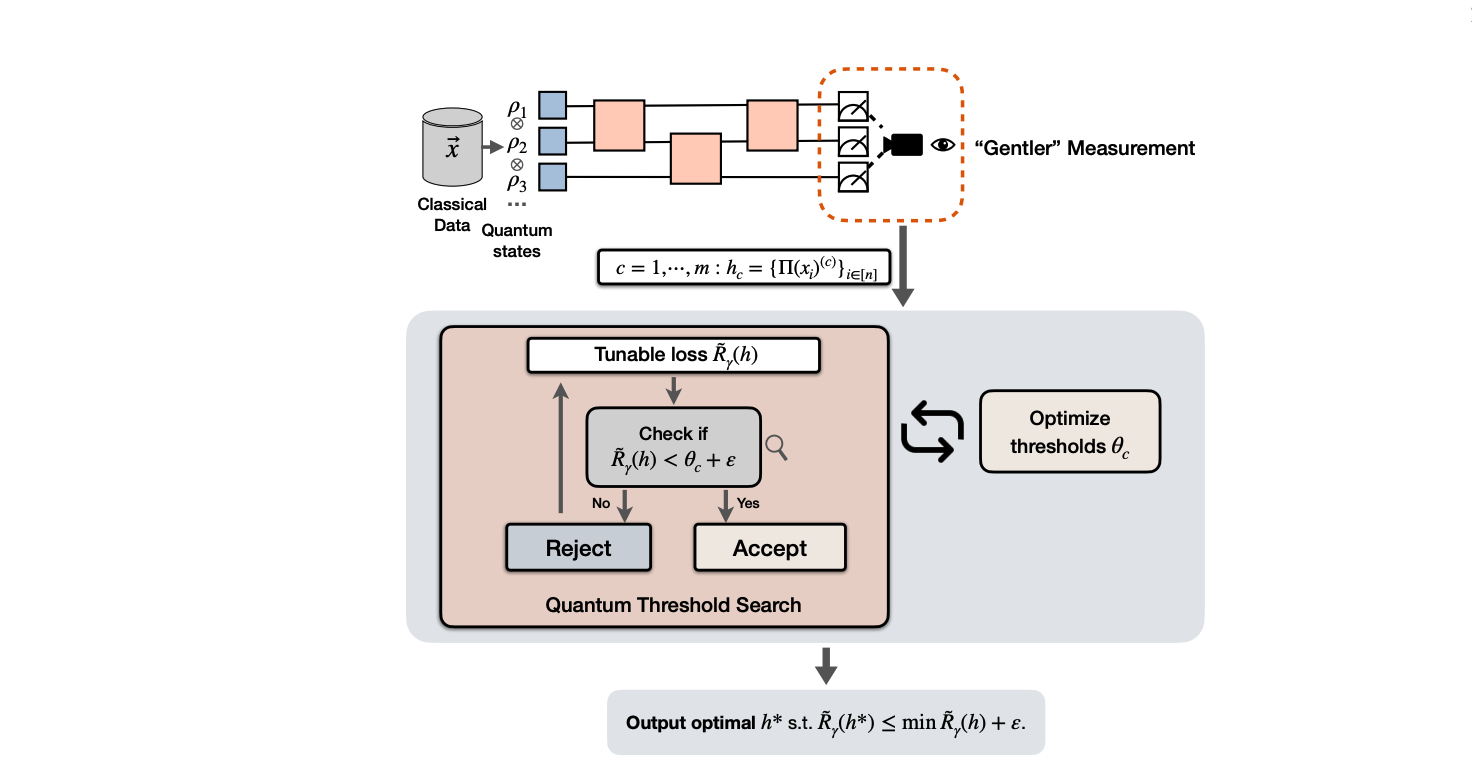
The challenge of efficiently learning from data receives a significant boost from new research into quantum-enhanced methods, as Yixian Qiu, Lirandë Pira, and Patrick Rebentrost from the National University of Singapore demonstrate. Their work addresses a fundamental problem in machine learning, namely how to best train models when dealing with complex processes, and proposes a novel approach called Quantum Tilted Empirical Risk Minimization (QTERM). This method offers a competitive alternative to existing techniques for process learning, potentially improving both the speed and accuracy of training. The researchers prove QTERM’s effectiveness by establishing clear limits on the amount of data required for successful learning, and by developing new benchmarks for generalization, ultimately contributing to a deeper understanding of the feasibility and improvement of learning processes in both classical and quantum contexts.
Quantum Learning Adapts to Loss Function Tuning
Quantum learning, the process of training algorithms on quantum data, presents unique challenges to traditional machine learning approaches. Classical algorithms often struggle with the inherent complexities of quantum systems, such as superposition and entanglement, necessitating new methods. A crucial aspect of successful quantum learning lies in defining appropriate loss functions, which measure the difference between a model’s predictions and the desired outcomes, guiding the learning process. Designing these loss functions for quantum data is difficult due to the complex structure of quantum information and the probabilistic nature of measurements. This work introduces a framework for quantum learning with tunable loss functions, allowing the algorithm to dynamically adjust the loss function during learning, enabling better response to the specific characteristics of the quantum data and learning task, effectively balancing accuracy, robustness, and generalization. This flexibility is crucial for achieving optimal performance in applications like quantum state discrimination, process identification, and quantum control.
This research modifies existing theoretical learning frameworks to incorporate tunable loss functions. This intersection necessitates new ways to measure complexity, including those related to how much quantum data is needed for learning and how well the learned models generalize. Empirical risk minimization serves as a starting point, and recognizing the diversity of learning problems, advanced strategies like tilted empirical risk minimization have been developed. This study proposes a definition for tilted empirical risk minimization suitable for learning quantum processes, resulting in a new approach called quantum tilted empirical risk minimization.
Quantum Machine Learning Research Landscape
The field of quantum machine learning is rapidly expanding, drawing heavily from statistical learning theory. Current research encompasses a wide range of algorithms and techniques, including variational quantum circuits, quantum support vector machines, quantum neural networks, quantum principal component analysis, and quantum Hamiltonian learning. A significant focus lies on understanding and improving generalization, the ability of a model to perform well on unseen data, which is a major challenge due to limited data and complex parameter spaces. Researchers are actively exploring techniques from classical statistical learning theory, such as PAC learning, VC dimension, Rademacher complexity, and margin bounds, to address this challenge. Optimization and gradient estimation are also critical areas of investigation, with research focusing on parameter-shift rules and adapting backpropagation to quantum circuits. Robustness to noise and adversarial attacks, and effective methods for encoding classical data into quantum states, are also receiving considerable attention.
Recent research highlights the potential of tilted empirical risk minimization when applied to quantum systems. The adaptation of Esscher transforms, originally used in finance, to quantum machine learning for learning probability distributions is also noteworthy. Several studies emphasize the importance of margins in achieving good generalization performance, suggesting that techniques for maximizing the margin of a classifier may be particularly effective in the quantum realm. Spectral norm regularization, a method for controlling model complexity and improving generalization, is also gaining traction.
Researchers are exploring combinations of regularization techniques with quantum least squares algorithms, and utilizing PAC-Bayesian methods for analyzing generalization. Reducing the amount of data needed for learning is a key challenge, with research focusing on data compression and quantum data analysis. Learning Hamiltonians using Gibbs states, and developing quantum backpropagation techniques, are also active areas of investigation.
This research landscape demonstrates a strong connection between classical and quantum learning, with many of the fundamental principles of classical learning still applicable to quantum machine learning. Generalization remains the biggest challenge, and regularization techniques are crucial for preventing overfitting and improving performance. Effective data encoding is essential for harnessing the power of quantum computation for machine learning. The field is rapidly evolving, and a combination of classical and quantum techniques will likely be needed to achieve significant progress.
QTERM Improves Generalization and Complexity Bounds
This work introduces a refined framework for tilted empirical risk minimization (TERM), termed QTERM, specifically designed for learning processes. The researchers demonstrate that QTERM offers a viable alternative to both implicit and explicit regularization strategies commonly used in process learning. Key contributions include deriving upper bounds on QTERM’s sample complexity, establishing new generalization bounds for classical TERM, and providing agnostic learning guarantees for hypothesis selection. These results advance understanding of the complexity bounds governing the feasibility of learning processes and offer methods for improving generalization performance.
The study rigorously establishes the theoretical underpinnings of QTERM, building upon existing empirical risk minimization techniques. While the authors demonstrate the benefits of their approach, they acknowledge that the specific implementation of the “tilt mechanism” may require adaptation depending on the quantum learning setting and application. Future research directions include extending these tilted measures to quantum systems, particularly in the context of Hamiltonian learning, and further exploring the nuances of defining the tilt in different quantum learning scenarios.
🗞 Quantum Learning with Tunable Loss Functions
🧠 ArXiv: https://arxiv.org/abs/2508.21369




See today’s quantum computing news on Quantum Zeitgeist for the latest breakthroughs in qubits, hardware, algorithms, and industry deals.