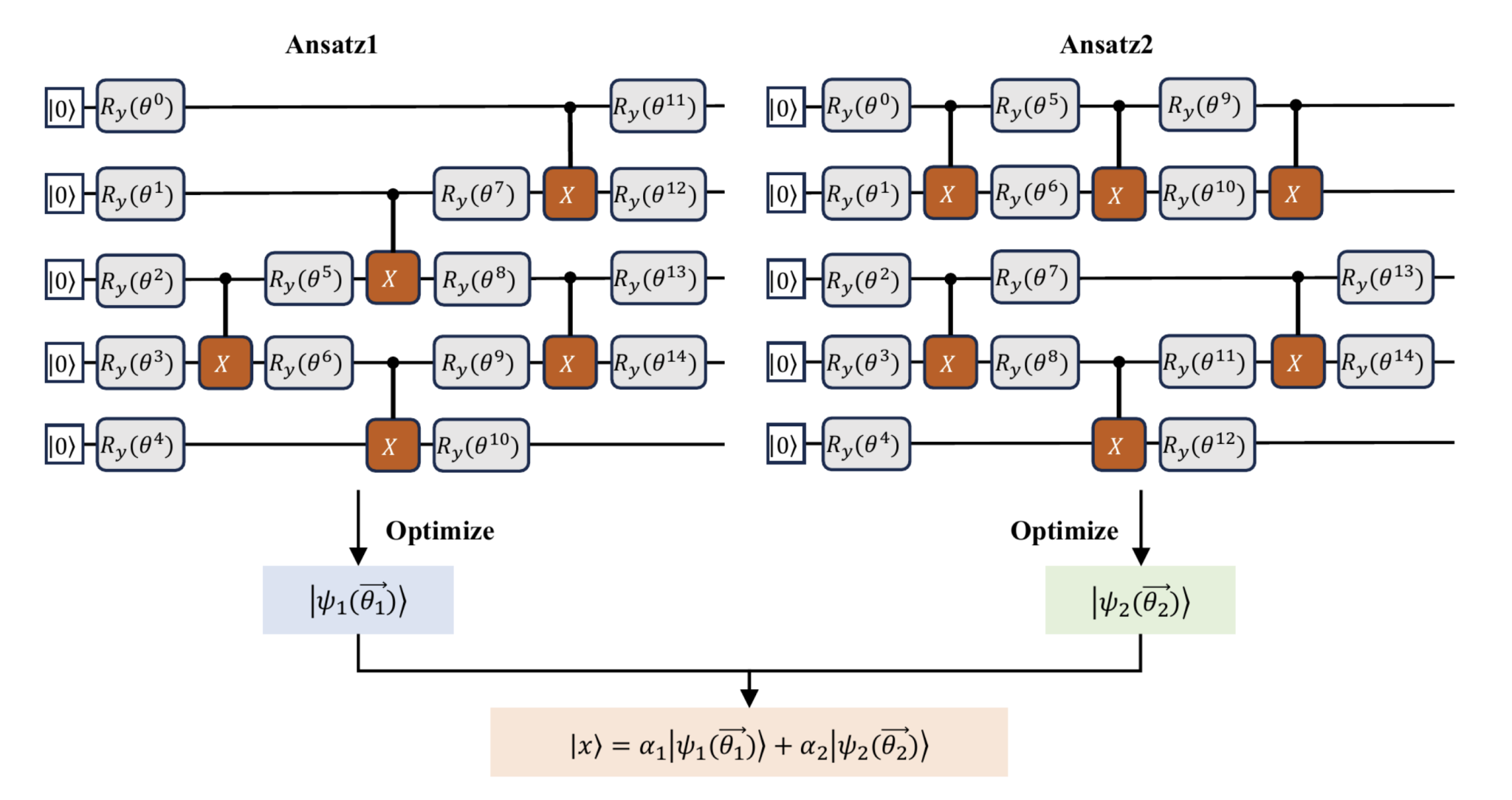
Simulating complex fluid flows, governed by equations like the Navier-Stokes equations, presents a significant computational challenge, particularly when capturing intricate, multiscale dynamics. Shaobo Yao, Zhiyu Duan, and Ziteng Wang, from the School of Aeronautics and Astronautics at Zhejiang University, alongside their colleagues, address this problem by introducing a novel approach to solving the linear equations that arise in these simulations. Their work presents a hybrid classical-quantum framework, built around a variational linear solver enhanced with a multi-ansatz tree architecture, which effectively expands the range of potential solutions and overcomes common training difficulties in quantum algorithms. The team demonstrates, through simulations of one-dimensional shock tubes, that this method accurately captures critical flow features such as shocks, rarefactions, and contact discontinuities, and parametric studies reveal that the solver’s performance improves with increased complexity and strategic domain decomposition, offering a promising route towards incorporating quantum computation into computational fluid dynamics for both near-term and future quantum computers.
This new approach addresses the computational intensity traditionally associated with simulating these equations, particularly when capturing multiscale flow dynamics with implicit time integration methods. At the heart of the innovation lies a variational quantum linear solver (VQLS) enhanced with a multi-ansatz tree architecture, designed to expand the range of accessible solutions and overcome common training challenges in quantum algorithms. Experiments demonstrate the solver accurately captures critical fluid phenomena, including shock, rarefaction, and contact discontinuities, across a range of one-dimensional shock tube simulations.
Parametric studies reveal that increasing the number of ansatz branches within the multi-ansatz tree, alongside the application of domain decomposition techniques, significantly improves both the convergence and stability of the solver, even when using limited qubit resources. These findings suggest that this multi-ansatz VQLS architecture offers a promising pathway for integrating quantum computing into computational fluid dynamics (CFD). The research highlights the potential of this method for both current noisy intermediate-scale quantum (NISQ) hardware and future fault-tolerant devices, paving the way for more efficient and accurate fluid simulations.
Quantum Computing for Fluid Dynamics Simulations
Research is exploring the potential of quantum computing to revolutionise computational fluid dynamics (CFD), a field traditionally limited by computational expense. Scientists are investigating whether quantum algorithms can offer advantages over classical methods for simulating and understanding fluid behaviour. This research encompasses a wide range of approaches, from directly simulating fluid equations using quantum systems to combining quantum and classical algorithms and employing quantum machine learning techniques. Several key areas are under investigation, including adapting quantum algorithms like Harrow-Hassidim-Lloyd to solve the linear equations arising in fluid dynamics modelling.
Variational quantum algorithms (VQAs), employing a hybrid quantum-classical approach, are also prominent, allowing quantum computers to prepare solutions that classical computers then refine. The Quantum Lattice Boltzmann Method (QLBM) aims to create a quantum version of a popular fluid simulation technique, while quantum machine learning is being used to improve turbulence models and accelerate simulations. Some studies focus on directly simulating turbulence and hydrodynamic equations using quantum systems, and exploring quantum implicit representations for complex flow domains. Despite the promise, significant challenges remain.
Current quantum computers are limited by noise, qubit count, and coherence time, restricting the complexity of simulations. Efficiently encoding fluid dynamics data into quantum states is also difficult, and the cost of encoding can outweigh the benefits. Ensuring algorithms scale to large-scale problems and mitigating errors in quantum computations are crucial considerations. Despite these challenges, the research suggests several potential benefits. Quantum algorithms could offer speedups for certain fluid dynamics problems, particularly those involving large linear systems or complex turbulence.
Quantum simulations might capture more of the relevant physics, leading to more accurate results and new insights into fluid behaviour. Quantum machine learning could enhance turbulence modelling and improve the efficiency of simulations. Overall, the field is rapidly evolving, with growing interest and significant research effort. While quantum computing for CFD is still in its early stages, the research highlights both the potential benefits and the significant challenges that need to be addressed before it can become a practical tool for CFD. Continued progress in quantum hardware and algorithm development is expected.
Hybrid Quantum-Classical Navier-Stokes Solver Demonstrated
Researchers have introduced a new hybrid quantum-classical framework for solving the complex equations governing fluid dynamics, specifically the Navier-Stokes equations. The method employs a variational linear solver enhanced with a multi-ansatz tree architecture, which expands the solver’s capacity without increasing circuit complexity, making it more compatible with current quantum hardware. Through simulations of shock tube scenarios, the researchers demonstrate that this approach accurately captures key fluid dynamic features, including shocks, rarefaction waves, and contact discontinuities, achieving improved convergence and reduced errors compared to single-ansatz methods. The findings suggest that combining multiple parameterised quantum circuits with classical optimisation offers a promising pathway for developing quantum-assisted solvers for fluid dynamics. The multi-ansatz architecture effectively mitigates the challenges of barren plateaus, enabling convergence in situations where standard variational quantum algorithms struggle. While acknowledging limitations related to hardware noise and qubit availability, the authors highlight ongoing work focused on implementing the framework on real quantum hardware, exploring adaptive ansatz selection, and integrating quantum error mitigation strategies to further improve solution accuracy and scalability.
🗞 A multi-ansatz variational quantum solver for compressible flows
🧠 ArXiv: https://arxiv.org/abs/2508.20887




See today’s quantum computing news on Quantum Zeitgeist for the latest breakthroughs in qubits, hardware, algorithms, and industry deals.