Universal multiport interferometers represent a crucial technology for manipulating light, underpinning advances in fields like neural networks and quantum computation. Vincent Girouard and Nicolás Quesada, both from École polytechnique de Montréal, present a new method for designing these interferometers that overcomes limitations in existing approaches. Their work introduces a technique to decompose complex transformations using a series of carefully designed phase masks combined with discrete Fourier transform matrices, offering a robust and analytically solvable alternative to designs typically created through complex numerical optimisation. This decomposition promises to simplify the fabrication of interferometers, improve their resilience to errors, and ultimately accelerate progress in photonic information processing.
Integrated Photonics for Scalable Quantum Computing
This compilation details research into optical quantum computing, integrated photonics, and associated mathematical and computational tools. The collection highlights a dominant trend towards building quantum circuits on chips using integrated photonics, offering both scalability and stability. Key areas of investigation include silicon photonics, benefiting from a mature fabrication platform, and research into alternative materials like lithium niobate and aluminum nitride to overcome silicon’s limitations. A significant focus lies on generating the necessary interactions for quantum gates through nonlinear optics and exploring techniques like slow light effects.
Essential components for photonic quantum computing, such as single photon sources and detectors, are also extensively covered. Researchers continually strive to build larger and more complex circuits, while some investigations explore bulk optics approaches as alternatives for proof-of-concept experiments. The mathematical foundations underpinning these advancements include linear algebra, Fourier analysis, and group theory, alongside computational tools like the JAX library for high-performance numerical computation. The collection also touches on quantum algorithms and potential applications, including quantum simulation, secure communication through quantum key distribution, and the exploration of computationally challenging problems like boson sampling. This compilation demonstrates the rapid progress in photonic quantum computing, driven by the need for scalability and stability, and paving the way for practical quantum computers.
Phase Mask and Fourier Transform Interferometer Design
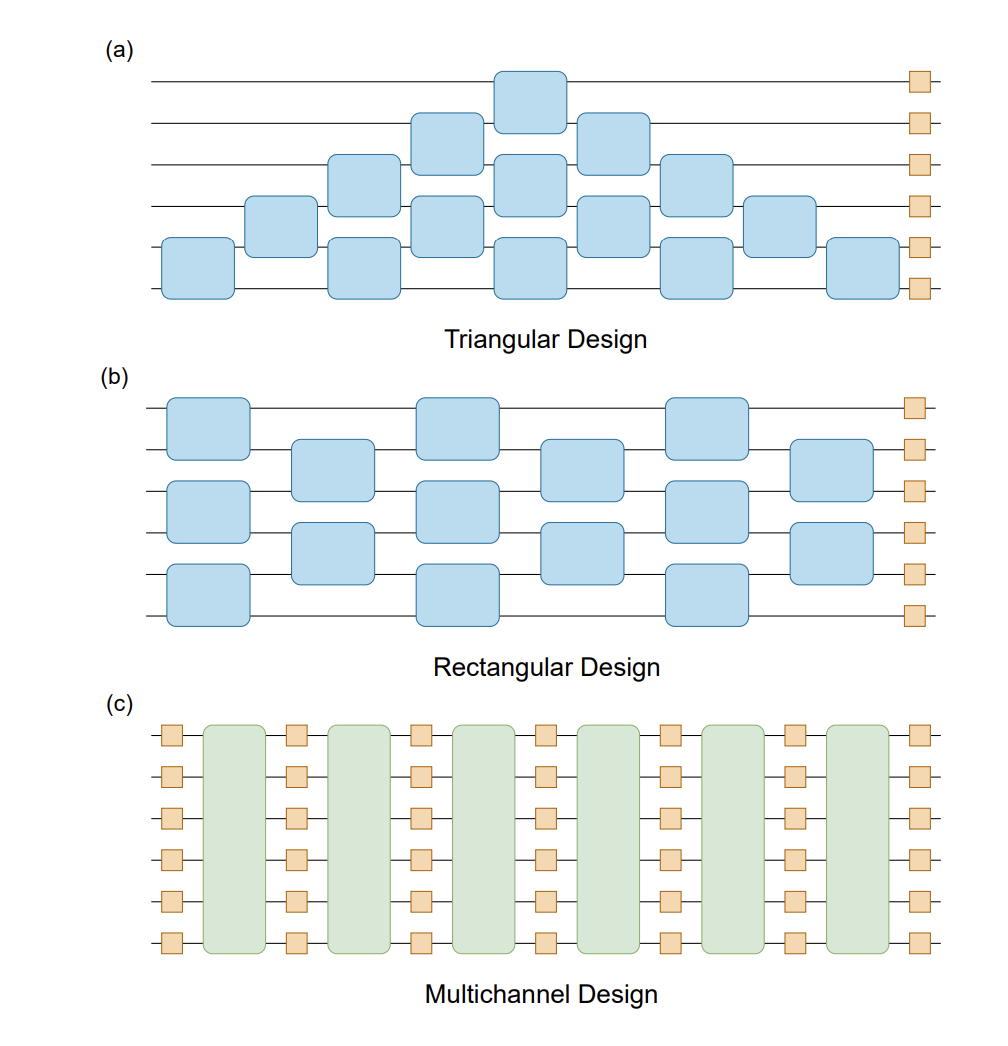
Researchers have developed a new approach to designing universal multiport interferometers (UMIs), crucial for both classical and quantum information processing. Recognizing limitations in traditional UMI architectures, the team pioneered a design based on interleaving phase masks with discrete Fourier transform matrices. This innovative method offers a robust alternative, minimizing the impact of fabrication errors and reducing the need for precise component fabrication. The core of this technique involves decomposing a desired unitary transformation into a sequence of phase masks and discrete Fourier transform matrices, allowing for the creation of UMIs using only these components. This approach circumvents the need for complex numerical optimization typically required in UMI design, providing an analytical solution for parameter computation. By utilizing a sequence of phase masks and discrete Fourier transforms, the researchers achieve a design inherently more tolerant to fabrication errors, simplifying fabrication and improving overall device performance.
Reduced Complexity Universal Interferometer Design
Researchers have developed a new design for universal multiport interferometers (UMIs), essential components for controlling light in advanced technologies. This breakthrough delivers a significant reduction in optical depth, a measure of circuit complexity, by achieving a 66% improvement over previous analytical designs. The team accomplished this by constructing interferometers from symmetric Mach-Zehnder interferometers and cleverly interleaving phase masks with discrete Fourier transform matrices. The core of this advancement lies in a constructive decomposition of unitary matrices, allowing for the creation of UMIs with fewer components.
Experiments demonstrate that this approach results in a more compact, robust, and potentially cheaper architecture with lower propagation losses. The resulting UMI exhibits path-independent losses, making it remarkably tolerant to imperfections and fabrication errors. Furthermore, the analytical method provides a fast and exact way to compute mask parameters, bypassing the need for time-consuming numerical optimization. Researchers anticipate that this framework will accelerate the development of both classical and quantum photonic technologies and facilitate the creation of faster and more accurate error correction strategies.
Compact Interferometer Design via Matrix Decomposition
This research introduces a new method for designing universal multiport interferometers, essential components in photonic circuits. The team developed an analytical decomposition of unitary matrices using sequences of phase masks and discrete Fourier transform matrices, offering a significant improvement in optical depth over existing designs. This approach leverages symmetric Mach-Zehnder interferometers to create highly parametrized phase masks, leading to more compact and potentially more robust circuits. The resulting design offers several advantages, including tolerance to losses and resilience against fabrication errors, as perturbations within the mixing layers do not compromise the interferometer’s functionality.
Importantly, the analytical nature of this method allows for fast and efficient computation of mask parameters, bypassing the need for time-consuming numerical optimization. While the current derivation is limited to unitary matrices of even dimension, the authors demonstrate a method to extend it to odd dimensions. Future work may focus on exploring the continuous family of decompositions revealed by this framework and developing faster error correction strategies, potentially accelerating the development of scalable photonic processors.
🗞 Near-optimal decomposition of unitary matrices using phase masks and the discrete Fourier transform
🧠 ArXiv: https://arxiv.org/abs/2508.20010


See today’s quantum computing news on Quantum Zeitgeist for the latest breakthroughs in qubits, hardware, algorithms, and industry deals.