Reconstructing the complete behaviour of quantum systems, particularly those interacting with their environment, remains a significant challenge in quantum physics, and researchers are now applying advanced techniques to increasingly complex scenarios. Yujie Sun, Marek Kopciuch, and Arash Dezhang Fard, alongside Szymon Pustelny, from the Jagiellonian University in Kraków, present a new method for achieving this reconstruction, known as quantum process tomography, in a room-temperature alkali-metal vapour. This work overcomes substantial experimental hurdles posed by complex atomic interactions and environmental noise, which typically hinder accurate modelling of these systems, and delivers high-fidelity reconstruction of qutrit Liouvillians. The team’s computationally efficient framework not only enables detailed study of non-unitary dynamics, but also provides a powerful tool for benchmarking quantum devices and identifying sources of environmental noise, representing a crucial step towards practical applications of quantum technologies.
Quantum process tomography is a technique for reconstructing how open quantum systems evolve, described by a mathematical entity called a Liouvillian superoperator. This superoperator accounts for both the predictable, coherent changes and the disruptive, dissipative processes affecting a quantum system over time. Applying this technique to more complex multi-level systems, known as qudits, presents considerable experimental challenges due to the rapidly increasing number of parameters needed for accurate reconstruction. Consequently, efficient and robust methods for performing quantum process tomography on these multi-level systems are crucial for advancing our understanding and control of complex quantum phenomena.
Qudit State Tomography with Alkali Vapors
Researchers have developed a method for characterizing the quantum state of a qudit using quantum process tomography, specifically implemented with an alkali-metal vapor, such as rubidium or cesium. This approach allows for accurate reconstruction of the density matrix, completely describing the quantum state of the system, and provides a powerful tool for studying and manipulating complex quantum systems.
High-Fidelity Reconstruction of Quantum System Dynamics
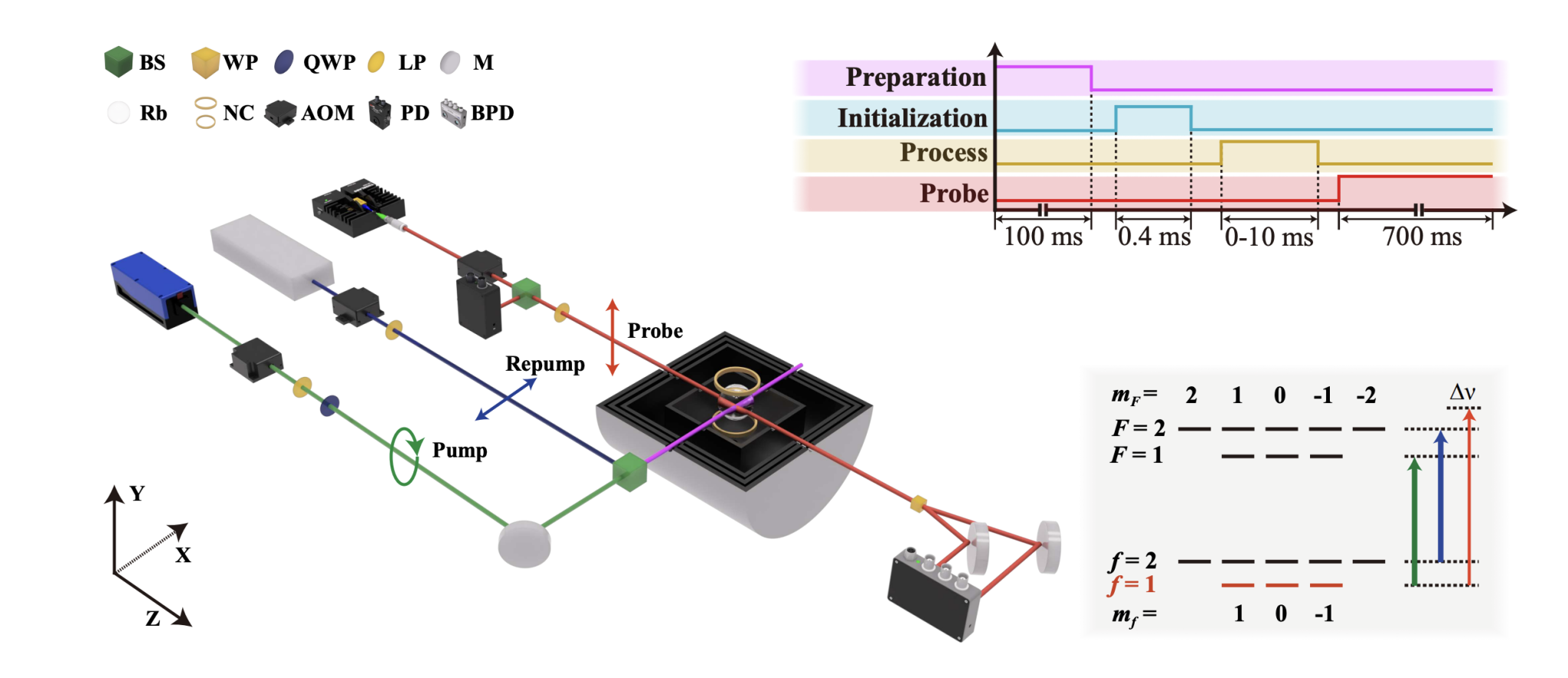
Researchers have successfully reconstructed the dynamics of a three-level atomic vapor with unprecedented fidelity using process tomography. This achievement overcomes significant experimental hurdles inherent in studying multi-level systems at room temperature, including complex atomic interactions and environmental noise. The team validated their method on a rubidium vapor ensemble, demonstrating high-fidelity reconstruction of the system’s Liouvillian superoperator, which describes both the coherent and dissipative processes governing its evolution. This breakthrough establishes a computationally efficient framework for characterizing open quantum systems, enabling detailed study of non-unitary dynamics and providing a powerful tool for benchmarking quantum control techniques. Experiments revealed detailed characteristics of the system’s relaxation, confirming the accuracy of the reconstructed dynamics and revealing complex relaxation mechanisms.
Qutrit Dynamics Reconstructed via Bloch-Fano Approach
Researchers have demonstrated a quantum process tomography method on a room-temperature rubidium vapor ensemble, overcoming limitations of conventional techniques with a computationally efficient scheme based on the Bloch-Fano approach. This allows for accurate characterisation of qutrit dynamics, including both coherent and dissipative processes, and reduces the demands on measurement and data analysis. The method’s versatility extends to potential applications in identifying specific points in the system’s dynamics and characterizing situations where environmental memory effects are significant. Furthermore, the reconstructed Liouvillians can be used to validate analogue quantum simulators and sensors, and the rich dataset generated by this approach is well-suited for machine learning analysis, potentially revealing subtle correlations and improving system calibration.
🗞 Quantum Process Tomography of a Room-Temperature Alkali-Metal Vapor
🧠 ArXiv: https://arxiv.org/abs/2508.19634
See today’s quantum computing news on Quantum Zeitgeist for the latest breakthroughs in qubits, hardware, algorithms, and industry deals.