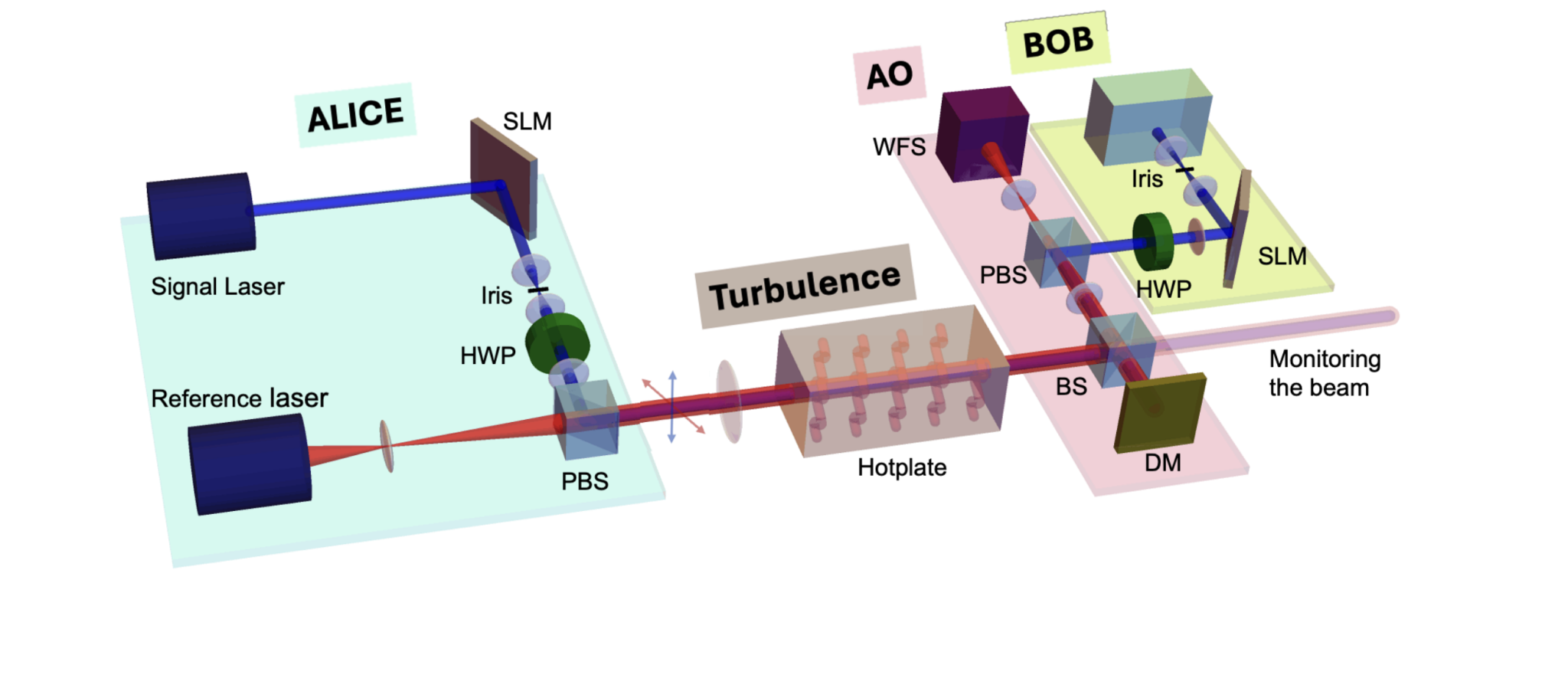
Quantum key distribution offers a fundamentally secure method for exchanging cryptographic keys, and researchers are increasingly exploring the potential of higher-dimensional quantum states to improve both capacity and security, particularly for long-distance communication. Rojan Abolhassani, Lukas Scarfe, and Francesco Di Colandrea, working at the Nexus for Quantum Technologies at the University of Ottawa, alongside colleagues including Alessio D’Errico, Khabat Heshami, and Ebrahim Karimi, investigate how well adaptive optics can counteract the distorting effects of atmospheric turbulence on these advanced quantum signals. The team experimentally tests a high-speed adaptive optics system’s ability to correct different types of quantum states, orbital angular momentum modes, mutually unbiased bases, and symmetric, informationally complete, positive operator-valued measures, transmitted through a turbulent free-space channel. Their results demonstrate that while turbulence significantly distorts quantum signals, adaptive optics effectively corrects orbital angular momentum states, achieving error rates low enough for secure communication, and that careful selection of the encoding basis plays a crucial role in maximizing resilience and correction performance.
Adaptive Optics Enables High-Dimensional QKD
Researchers have achieved a significant step forward in secure communication by successfully implementing high-dimensional quantum key distribution (QKD) through turbulent free-space channels using adaptive optics (AO). The team investigated the performance of various quantum states, including orbital angular momentum (OAM) modes, mutually unbiased bases (MUB), and symmetric informationally complete positive operator-valued measures (SIC-POVM), up to dimension 8, to determine optimal strategies for mitigating the effects of atmospheric turbulence. Experiments reveal that while turbulence strongly distorts OAM states, their inherent cylindrical symmetry allows for optimal correction using AO systems, achieving error rates below established QKD security thresholds. The study establishes that AO systems provide the highest correction performance for pure OAM modes; however, these modes are also the most sensitive to turbulence.
In contrast, MUB and SIC-POVM exhibit greater intrinsic robustness to turbulence, though their error rates are somewhat higher than those of the OAM basis. Nevertheless, applying AO enables recovery of channel security, balancing resilience and correctability across different mode sets. These findings confirm that AO is a key enabler of secure, high-dimensional QKD, paving the way for global quantum networks where fibre optic cables are impractical, such as satellite communications. By carefully selecting basis sets and employing AO, researchers can overcome the challenges posed by atmospheric turbulence and establish secure communication links over long distances. The results demonstrate the potential for encoding more bits per photon, increasing the security threshold against eavesdroppers, and ultimately enhancing the robustness of quantum communication systems.
Turbulence Mitigation Guides Optimal QKD Basis Selection
This research systematically investigates the behaviour of multiple quantum key distribution (QKD) basis sets, including mutually unbiased bases (MUBs) and symmetric informationally complete positive operator-valued measures (SIC-POVMs), in turbulent free-space environments. The study demonstrates that adaptive optics (AO) effectively mitigates turbulence-induced distortions, enabling QKD implementation while maintaining error rates below security thresholds. Importantly, the effectiveness of AO correction varies depending on the chosen basis, with orbital angular momentum (OAM) modes benefiting most from AO despite being initially more distorted by turbulence. The findings provide practical guidance for selecting appropriate basis sets for QKD under different atmospheric conditions.
The authors suggest that QKD schemes could be optimised by prioritising OAM modes for information transmission and utilising MUBs primarily for security checks, leveraging the strengths of each approach. Beyond QKD, the results have implications for fields reliant on spatial modes of light, such as biological imaging and vortex-beam-based coronagraphy, where AO can enhance performance. Future work could explore optimising QKD protocols to fully exploit the benefits of AO correction and the unique characteristics of different basis sets.
Atmospheric Turbulence and Adaptive Optics in QKD
Quantum key distribution (QKD) allows secure key exchange based on the principles of quantum mechanics, with higher-dimensional photonic states offering enhanced channel capacity and resilience to noise. Free-space QKD is crucial for global networks where fibres are impractical, but atmospheric turbulence introduces severe distortions to quantum states, particularly for spatial modes. Adaptive optics (AO) provides a pathway to correct these errors, and its effectiveness depends on the encoding basis. The team investigated how different quantum states perform in turbulent conditions and how effectively AO can correct for these distortions.
Experiments demonstrate that AO significantly reduces errors in QKD systems operating through turbulent air. The study explored various basis sets, including OAM modes, mutually unbiased bases (MUB), and symmetric informationally complete positive operator-valued measures (SIC-POVM), to determine the optimal strategies for mitigating turbulence. The findings reveal that while OAM states are initially more susceptible to turbulence, they benefit most from AO correction. MUB and SIC-POVM exhibit greater inherent robustness to turbulence, but their error rates are somewhat higher. By carefully selecting basis sets and employing AO, researchers can overcome the challenges posed by atmospheric turbulence and establish secure communication links over long distances, paving the way for global quantum networks where fibre optic cables are impractical, such as satellite communications.
🗞 Investigating the Performance of Adaptive Optics on Different Bases of Spatial Modes in Turbulent Channels
🧠 ArXiv: https://arxiv.org/abs/2508.21015




See today’s quantum computing news on Quantum Zeitgeist for the latest breakthroughs in qubits, hardware, algorithms, and industry deals.