
Accurate measurement of electric fields remains a fundamental challenge in metrology, demanding instruments that minimise disturbance to the fields they assess. Ren-Hao, alongside colleagues at institutions including [Institution names not provided in source], now presents a significant step towards ideal electric field measurement with the development of a chip-scale Rydberg atomic electrometer. This innovative device overcomes limitations caused by conventional atomic cell designs, achieving a dramatically reduced radar cross-section, 20 decibels lower than existing commercial instruments. The team’s fabrication process, utilising femtosecond laser writing, not only shrinks the electrometer’s size but also reveals a previously unobserved phenomenon, termed incoherent Dicke narrowing, which promises to refine future revisions to the international system of units and expand the possibilities for precision measurement across diverse scientific and industrial applications.
An ideal electrometer should measure electric fields accurately while causing minimal disturbance to the field itself. Rydberg atomic electrometers offer promising potential as ideal electrometers due to their inherent traceability and non-invasive nature. This research overcomes limitations of conventional designs by fabricating a chip-scale vapor cell using a novel approach, reducing distortion and improving the accuracy and reliability of the electrometer.
Wafer Fabrication of Rydberg Atom Vapor Cells
This document details the fabrication and theoretical underpinnings of miniaturized, wafer-fabricated alkali vapor cells designed for use with Rydberg atoms as sensors for electric fields. The research focuses on creating portable, high-performance sensors through wafer-level fabrication techniques, enabling mass production and miniaturization. A key innovation is the use of fused silica as the housing material, offering advantages over silicon and borosilicate glass in terms of internal electric field distribution and radar cross-section, ultimately improving sensor performance. Detailed simulations model the internal electric field strength and radar cross-section of the cells, optimizing the design.
A significant portion of the research explores Incoherent Dicke Narrowing (ICDN), a phenomenon crucial for understanding spectral narrowing observed in experiments and improving sensor sensitivity. The team developed a modified master equation and detailed the velocity-dependent dephasing mechanism to explain ICDN. Monte Carlo trajectory simulations determined the geometry-limited mean free path for the vapor cells, an important parameter for modeling the ICDN phenomenon. Extensive experimental work and data analysis techniques characterized the performance of the sensors, providing a strong foundation for future advancements in Rydberg atom-based sensing.
Miniature Atomic Electrometer Fabricated on Chip
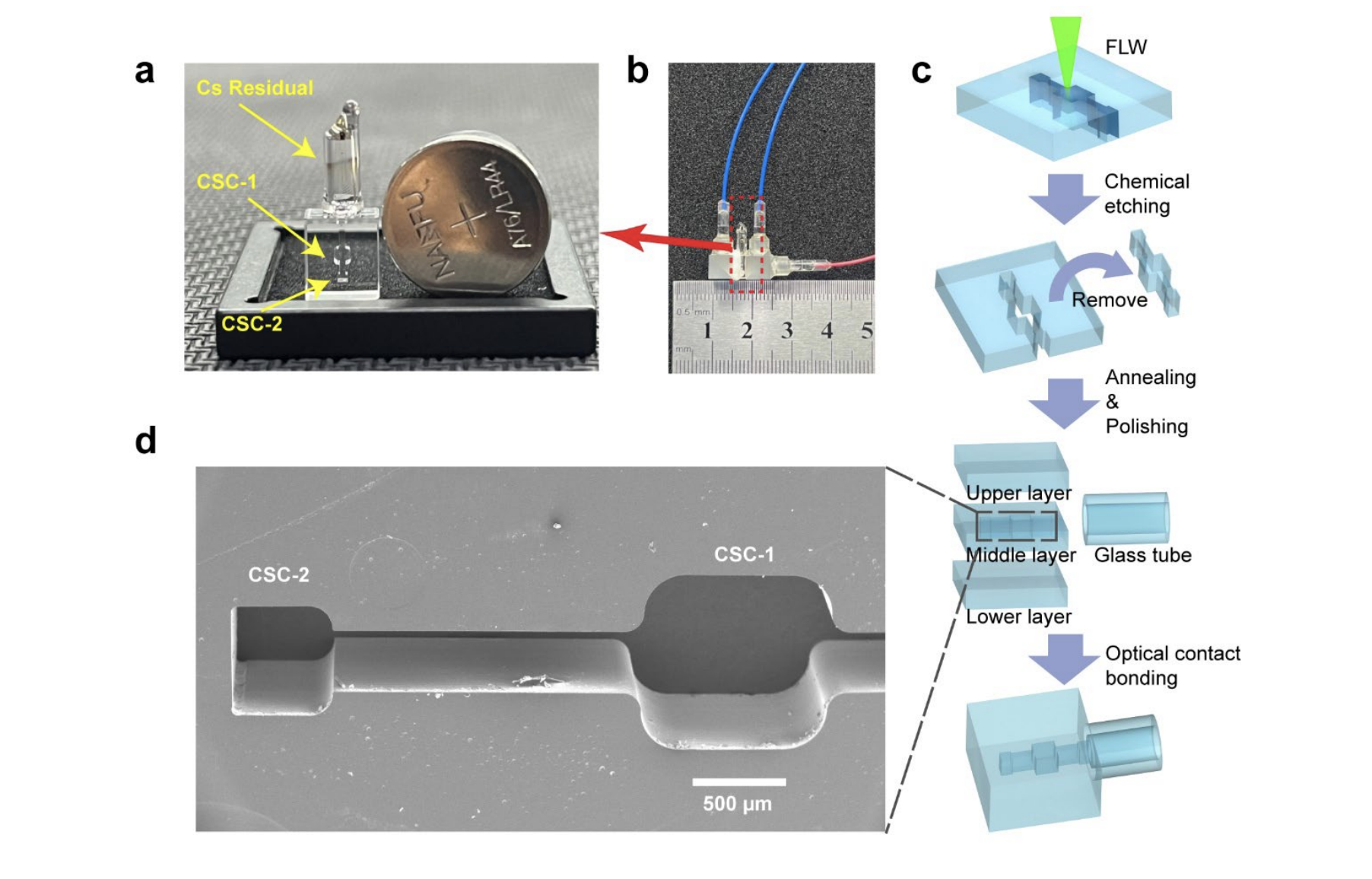
Researchers have developed a novel chip-scale atomic vapor cell fabricated using femtosecond laser writing and optical contact bonding, representing a significant advancement in electrometer technology. This innovative approach delivers a non-invasive atomic electrometer with a radar cross-section 20 dB lower than commercially available devices. The team successfully created a fully functional cell with dimensions of 1 mm x 1 mm x 1 mm, alongside a smaller chamber measuring 0. 5 mm x 0. 5 mm x 1 mm, demonstrating the potential for miniaturization.
The fabrication process utilizes fused silica, prized for its chemical stability, hardness, and optical transmission, while circumventing the challenges of bonding this material through a combination of laser-induced structuring and direct bonding techniques. Laser writing enables precise three-dimensional internal structuring, and the resulting cell exhibits a measured leakage rate below the detection limit, maintaining vacuum integrity for over 20 months. Furthermore, the team fabricated a 25-unit cell array, showcasing the versatility of the method for large-scale production and diverse cell geometries. Performance characterization confirmed successful cesium atom loading and demonstrated electromagnetically induced transparency and microwave-induced Autler-Townes splitting within the chip-scale cell. Notably, experiments revealed a new sub-Doppler spectral narrowing phenomenon, termed incoherent Dicke narrowing, originating from a collision-driven mechanism. This discovery supports future revisions to the International System of Units and broadens the scope of applications in precision metrology and quantum standards.
Chip-Scale Electrometry and Dicke Narrowing Observation
This work demonstrates a chip-scale atomic vapor cell fabricated from fused silica, achieving significant advancements in non-invasive electrometry. The researchers successfully created a device with a radar cross-section at least 20 decibels lower than conventional atomic cell-based electrometers, representing a substantial reduction in interference during measurements. This improvement stems from the cell’s miniaturisation and all-glass construction, which also enables a cross-beam optical excitation configuration. Furthermore, the team observed a novel phenomenon, termed incoherent Dicke narrowing, which arises from collisions within the chip-scale cell. They developed a theoretical model that accurately reproduces the experimental observations of this narrowing effect, enhancing understanding of atomic interactions within these devices. These combined advances, the reduced interference, the innovative cell design, and the understanding of incoherent Dicke narrowing, pave the way for a nearly ideal, non-invasive atomic electrometer with direct traceability to international SI units.
👉 More information
🗞 Chip-Scale Rydberg Atomic Electrometer
🧠 ArXiv: https://arxiv.org/abs/2508.18163