Graph neural networks increasingly tackle complex problems in fields ranging from biology to network analysis, but their performance hinges on effectively capturing relationships within data. An Ning from the Korea Advanced Institute of Science and Technology, along with Tai Yue Li and Nan Yow Chen from the National Synchrotron Radiation Research Center, present a novel approach to this challenge with their Quantum Graph Attention Network. This new network integrates quantum circuits into the attention mechanism, allowing for more expressive and efficient processing of information, and crucially, reducing the computational demands of complex models. The team’s work demonstrates improved performance and robustness against noisy data, suggesting a pathway towards scalable and reliable machine learning across a wide range of applications, and offering a potentially significant advance in how computers analyse complex systems.
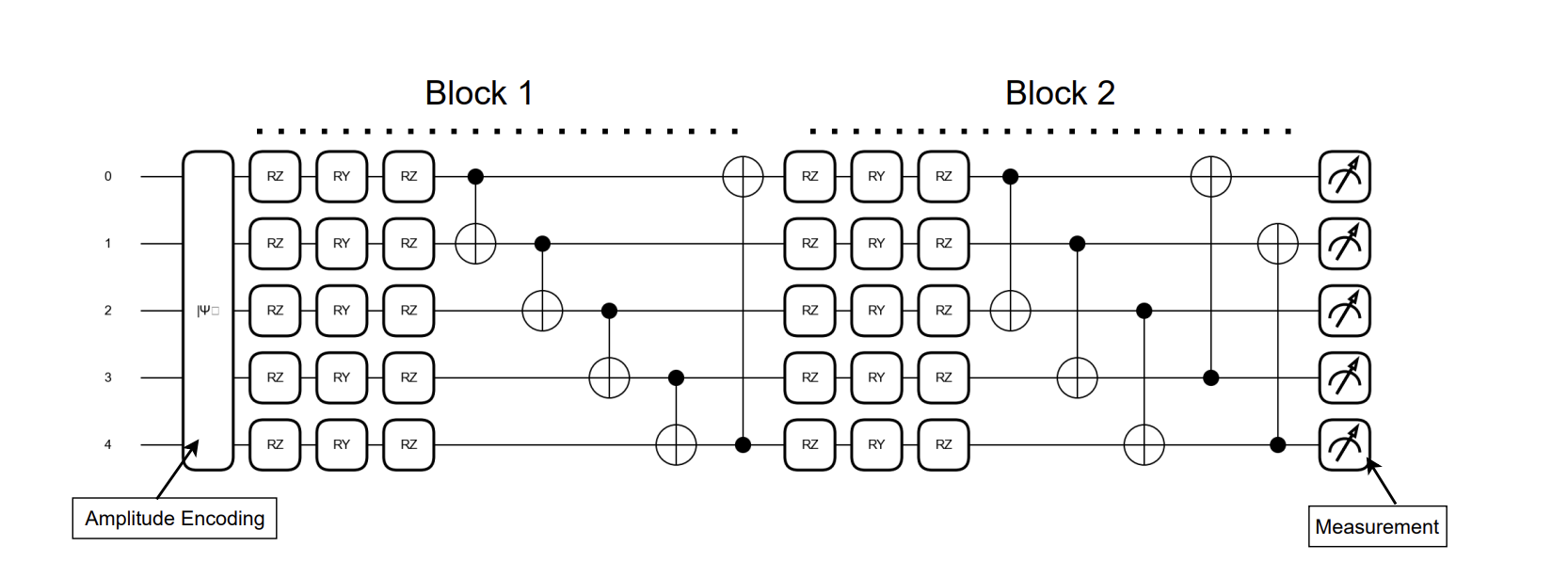
Strongly entangling quantum circuits with amplitude-encoded node features enables expressive nonlinear interactions. Unlike classical multi-head attention, QGAT leverages a single quantum circuit to simultaneously generate multiple attention coefficients, facilitating parameter sharing and reducing computational overhead. Classical projection weights and quantum circuit parameters are optimized jointly, ensuring flexible adaptation to learning tasks. Empirical results demonstrate QGAT’s effectiveness in capturing complex structural dependencies and improved performance.
NeurIPS Submission Checklist, Ethical and Technical Review
This document presents a comprehensive checklist for NeurIPS conference submissions, summarizing key aspects and providing a general assessment. The purpose of this checklist is to ensure that submissions meet ethical, methodological, and transparency standards, covering responsible data handling, societal impacts, resource crediting, and LLM usage. It reflects the increasing emphasis on responsible AI research. The authors affirm adherence to the NeurIPS Code of Ethics and discuss both potential positive and negative societal impacts of their research. They confirm that no high-risk releases are planned and that LLMs were not used as a core component of their methods, only for writing and editing.
Reproducibility is implied through detailed descriptions of methods and datasets, and proper crediting and licensing of all used resources are confirmed. The research does not involve crowdsourcing or human subjects. The authors consistently answer Yes when affirming adherence to standards, and NA (Not Applicable) for irrelevant questions, demonstrating a conscientious approach to responsible research and a clear understanding of NeurIPS requirements. This innovative approach aims to significantly enhance the expressive power and robustness of graph-based machine learning models, particularly when dealing with complex and structurally rich data. QGAT utilizes amplitude encoding to embed node features into quantum states, then employs a single quantum circuit to simultaneously generate multiple attention heads. This quantum parallelism dramatically reduces the total number of parameters required, fostering stronger feature entanglement and enabling the capture of intricate relational patterns within graph structures.
The team demonstrates that this design not only improves computational efficiency but also enhances the model’s ability to generalize to new, unseen data. Experiments confirm that embedding quantum circuits increases robustness against both feature and structural noise, a critical advantage when processing real-world data. By leveraging the principles of quantum mechanics, such as entanglement and superposition, QGAT achieves richer representations in high-dimensional spaces, naturally introducing nonlinearity without relying on traditional activation functions. QGAT uses amplitude encoding and entangled quantum layers to capture complex relationships within graph data, while efficiently implementing multi-head attention in a single quantum circuit. This design reduces the number of parameters needed and improves the model’s ability to represent information, leading to more compact and expressive models. Experiments across various graph learning tasks, including node classification and link prediction, demonstrate that QGAT consistently outperforms classical graph neural networks, such as GAT and GATv2, even with limited computational resources.
Evaluations also show that the quantum-enhanced representation is more robust to noise in both the features and structure of the graph data. The authors acknowledge that a key limitation of the current implementation is hardware scalability, and future work will focus on addressing this constraint through techniques like circuit batching and tensor parallelism, to enable the application of QGAT to larger and more complex graph tasks. The modular design of QGAT facilitates its integration into existing architectures, offering a practical pathway for incorporating quantum-enhanced attention into realistic graph learning applications.
🗞 Quantum Graph Attention Network: A Novel Quantum Multi-Head Attention Mechanism for Graph Learning
🧠 ArXiv: https://arxiv.org/abs/2508.17630

See today’s quantum computing news on Quantum Zeitgeist for the latest breakthroughs in qubits, hardware, algorithms, and industry deals.