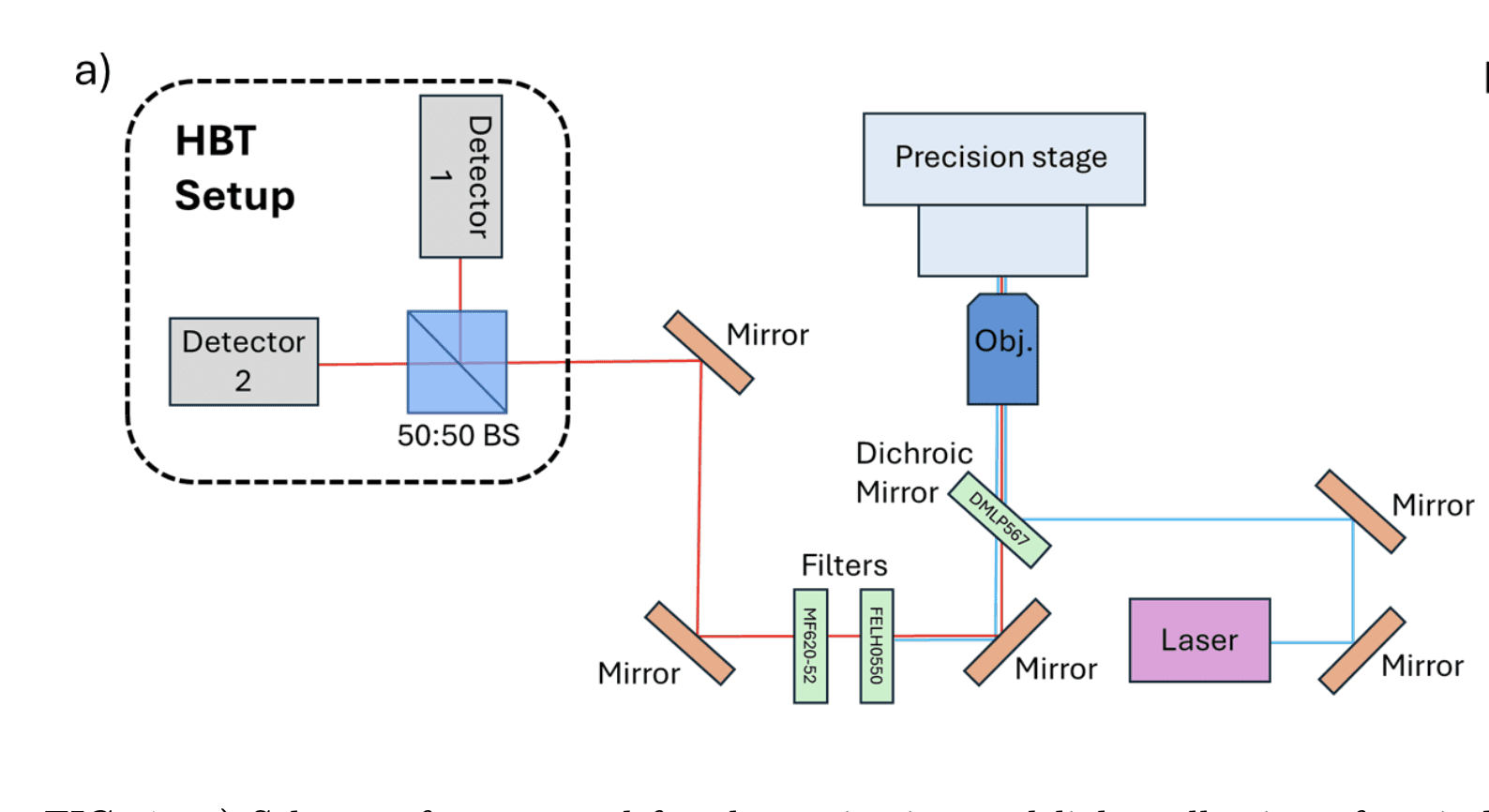
Single photons, the fundamental particles of light, are essential for advances in quantum computing and secure communication, demanding sources capable of generating these particles with precise control. Raul Lahoz Sanz and Bruno Julia-Diaz, from the Institut d’Estudis Espacials de Catalunya and the Universitat de Barcelona respectively, alongside their colleagues, now demonstrate a surprisingly simple and effective solution using readily available fullerene molecules. Their research reveals that C60 fullerenes, embedded in polystyrene, function as reliable, on-demand single-photon emitters even at room temperature, overcoming limitations of existing technologies. This breakthrough promises to lower the cost and complexity of photonic devices, potentially enabling the widespread development of practical and scalable quantum technologies.
Single photon sources are fundamental for applications in quantum computing, secure communication, and sensing, as they enable the generation of non-classical states of light with precisely defined photon number statistics. Current approaches to single photon source fabrication often rely on quantum dots, colour centres, or spontaneous parametric down-conversion, each presenting limitations in terms of efficiency, indistinguishability, or spectral purity. Therefore, the development of bright, pure, and stable single photon sources remains a significant challenge in the field of quantum photonics.
C60 Fullerene Single-Photon Source Characterisation and Comparison
This document provides supporting data and detailed analysis for research investigating C60 fullerenes as single-photon sources, comparing them to colloidal quantum dots. Detailed data, including Raman spectroscopy and measurements of emission characteristics, support the claims made in the main research paper. Raman spectroscopy confirms the sample primarily consists of pristine C60, confirming its suitability as a single-photon source, with minor signs of oxidation due to air exposure. Measurements of emission characteristics reveal differences between C60 and quantum dots. C60 exhibits a lower decay lifetime and a higher value indicating a less ideal single-photon source compared to quantum dots.
Specifically, C60 has a value of 0. 312 and a lifetime of 4. 44 nanoseconds with continuous wave excitation, and 0. 304 and 4. 700 nanoseconds with pulsed wave excitation, while quantum dots have a value of 0.186 and a lifetime of 22. 35 nanoseconds with continuous wave excitation. Lifetime measurements reveal that C60 exhibits a multi-exponential decay, suggesting a greater sensitivity to its environment. The data supports the use of C60 fullerenes as single-photon sources. While C60-based single-photon sources exhibit shorter lifetimes and a broader distribution of lifetimes compared to quantum dots, their potentially simpler fabrication and lower cost could make them an attractive alternative.
Fullerenes Emit Single Photons at Room Temperature
Researchers demonstrate a novel approach to single-photon emission by utilizing readily available C60 fullerene molecules embedded in polystyrene, establishing them as reliable room-temperature sources. This breakthrough addresses limitations found in existing single-photon sources, such as high production costs, cryogenic operating temperatures, and instability. The team successfully achieved on-demand single-photon emission, leveraging the molecules’ short fluorescence lifetimes and consequently, high emission rates. Data confirms the potential of this approach to overcome challenges associated with intermittency and limited operational lifetimes, which often plague other single-photon sources like colloidal quantum dots. Scientists measured high emission efficiency and stability, paving the way for the development of economic and readily deployable quantum technologies. This innovative approach bypasses the need for complex fabrication processes or specialized materials, making it particularly attractive for large-scale implementation in areas like quantum computing, secure communication, and advanced sensing applications.
Fullerenes Enable Bright Room-Temperature Single Photons
The research demonstrates that fullerene C60 molecules embedded in polystyrene can function as reliable, room-temperature single-photon emitters. These molecules exhibit on-demand single-photon emission with notably short fluorescence lifetimes, resulting in high emission rates and brighter photon sources. The team suggests that photo-oxidation of the fullerene molecules, triggered by 405 nm wavelength excitation, plays a key role in enabling emission by breaking molecular symmetry and allowing previously forbidden transitions. While the precise mechanisms at the molecular level remain uncertain, and blinking effects are present, the wide availability, low cost, and ease of preparation of C60 molecules represent a significant step towards the practical implementation of these materials in quantum technologies, particularly in areas like quantum communication and information processing.
👉 More information
🗞 C60 fullerene as an on-demand single photon source at room temperature
🧠 ArXiv: https://arxiv.org/abs/2508.17824