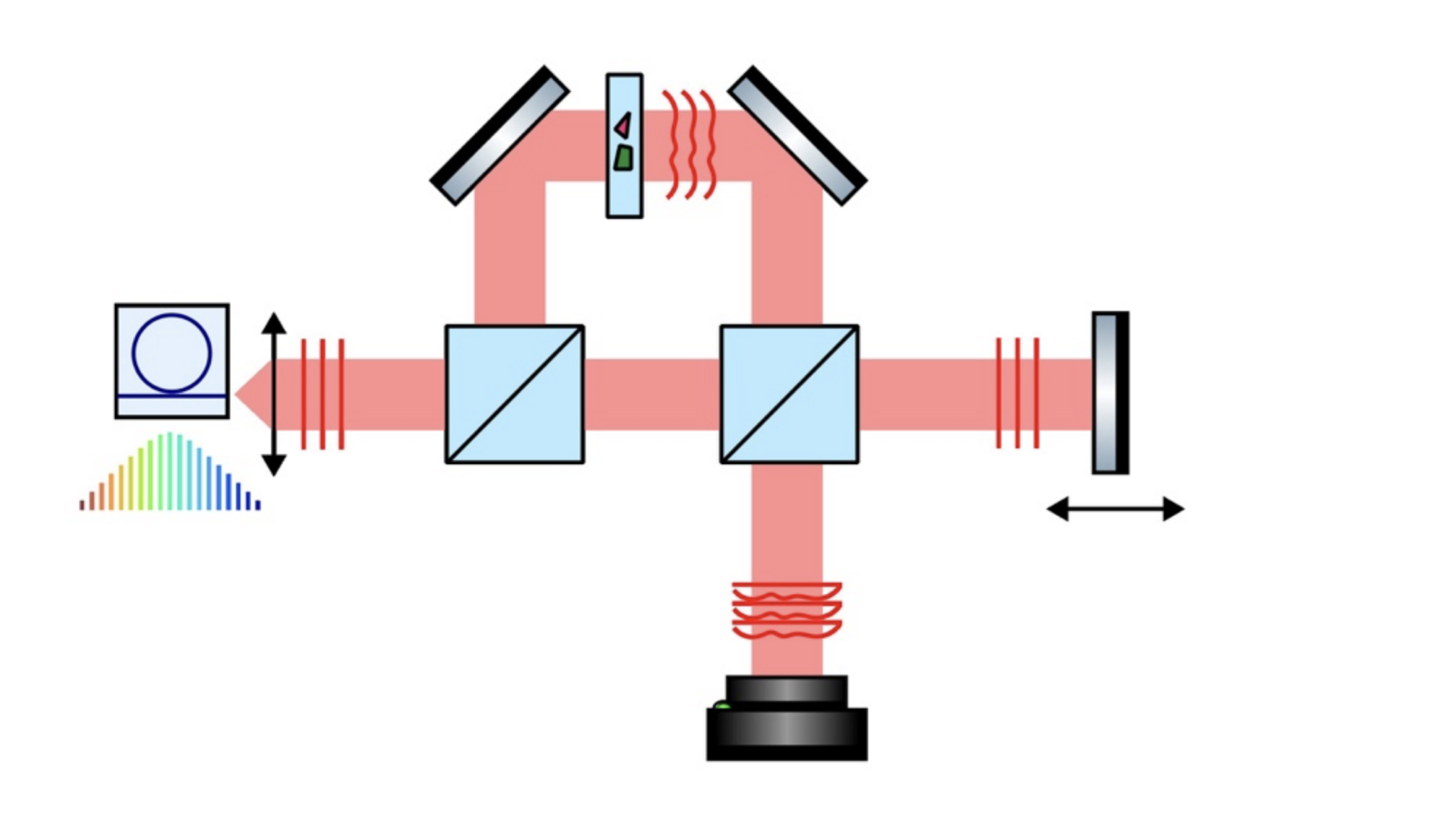
Researchers are developing innovative ways to tackle the growing problem of microplastic pollution, and a new technique promises a significant leap forward in detection and characterisation. Stephan Amann, Edoardo Vicentini, and Bingxin Xu, alongside colleagues from institutions including the University of California, University of Rochester, and the Max-Planck Institute of Quantum Optics, present a three-dimensional imaging method using optical microcombs. This approach simultaneously reveals both the chemical composition and complete three-dimensional geometry of particles, ranging in size from micrometres to millimetres, across a vast number of image pixels. By harnessing the unique properties of microcombs, specifically their large line spacing, the team achieves high-speed, label-free imaging with micrometre-scale precision, offering a powerful new tool for environmental monitoring and the real-time analysis of pollutants in aquatic ecosystems.
Compact Frequency Combs Enable New Applications
Optical frequency combs have revolutionised time and frequency metrology, acting as precise rulers for the frequencies of light and enabling extremely accurate measurements. However, traditional optical frequency combs typically require complex and expensive equipment, limiting their widespread use. Consequently, researchers are actively developing integrated, compact, and cost-effective frequency comb sources, offering the potential to overcome current limitations and enable new applications in fields such as environmental monitoring, medical diagnostics, and on-chip optical communications. A key challenge in developing integrated frequency combs lies in achieving stable and coherent operation. This research focuses on a novel integrated frequency comb source based on microresonator Kerr comb generation, where microresonators enhance nonlinear optical effects necessary for comb formation, while their small size allows for easy integration onto a chip. This work advances the field of integrated photonics and unlocks the full potential of frequency comb technology for a wider range of applications.
D Hyperspectral Imaging via Optical Microcombs
This research details a novel approach to three-dimensional hyperspectral imaging using optical microcombs, combining the benefits of microcombs with digital holography to achieve high-resolution 3D imaging with detailed spectral information. This allows for the identification of materials based on their spectral fingerprint in a three-dimensional space, providing high spatial and spectral resolution and capturing 3D information beyond traditional 2D hyperspectral imaging. Utilizing optical microcombs provides a broad, stable, and coherent light source crucial for high-quality imaging. The system combines a microcomb source, a digital holography setup, and data processing algorithms, illuminating a sample with the microcomb and reconstructing its 3D structure. The spectral content of the captured light is analysed to identify the materials present, representing a significant advancement in hyperspectral imaging with potential applications in diverse fields like environmental monitoring, materials science, biomedical imaging, and security. The technology shows promise for addressing challenges in areas like environmental science, specifically microplastic detection, and materials analysis.
Terahertz Microcombs Reveal Particle Shape and Chemistry
Researchers have developed a groundbreaking three-dimensional imaging technique that simultaneously determines the chemical identity and complete geometry of particulate matter, ranging in size from micrometres to millimetres. This innovative method leverages the unique properties of microcombs to achieve high-speed, label-free analysis of complex materials, demonstrating the ability to image objects with micrometre-scale precision and a throughput exceeding 1. 2 million pixels per second. The core of this advancement lies in the use of microcombs with exceptionally large line spacings, on the order of 1 terahertz.
This large spacing enables precise spectral diagnostics and allows researchers to capture detailed information about the composition and shape of objects without traditional imaging optics. By combining this technology with lensless digital holography, the team created a system capable of reconstructing three-dimensional images from interference patterns, revealing both amplitude and phase information. This technique holds significant promise for real-time detection and characterisation of microplastic pollutants in aquatic ecosystems, providing a powerful tool for environmental monitoring and remediation efforts.
Microcomb Imaging Reveals 3D Composition and Geometry
This research introduces a new three-dimensional imaging technique using optical microcombs, devices that generate light with precisely spaced frequencies. The method simultaneously determines both the chemical composition and the complete three-dimensional geometry of particulate matter, ranging in size from micrometres to millimetres, demonstrating high-throughput imaging exceeding one million pixels per second with micrometre-scale precision. The technique uniquely combines spectral diagnostics with full-field, three-dimensional data acquisition, offering improvements over existing methods. Future enhancements could further increase throughput using faster camera technology and potentially enable real-time analysis. Extending the technology to different wavelengths and developing improved microcomb generators will boost performance and axial precision. The research highlights the potential for this technique, particularly in environmental monitoring, for the real-time detection and characterisation of microplastic pollutants in aquatic ecosystems.
🗞 Three-dimensional hyperspectral imaging with optical microcombs
🧠 ArXiv: https://arxiv.org/abs/2508.18219



See today’s quantum computing news on Quantum Zeitgeist for the latest breakthroughs in qubits, hardware, algorithms, and industry deals.