The creation of slow positrons is crucial for a range of scientific applications, including materials science and fundamental physics, and researchers continually seek ways to improve their production efficiency. Ryland Goldman, Sophie Crisp, and Spencer Gessner, all from SLAC National Accelerator Laboratory, have investigated innovative designs for positron moderators, the components responsible for slowing down these particles. Their work centres on detailed simulations using G4beamline to assess different moderator configurations, including the addition of a radiofrequency cavity to enhance performance. The team’s modelling demonstrates a substantial 39. 3-fold increase in moderated positron numbers using their optimised setup compared to conventional designs, and they also introduce a refined method for calculating how low-energy positrons stop within thin materials, offering a significant advancement in the field of positron source technology.
Results show that a specific configuration, incorporating a tungsten target, adiabatic matching device, RF cavity, and single-crystal tungsten moderator, achieves a 39. 3-fold increase in moderated positrons compared to a conventional polycrystalline foil moderator without the cavity. This improvement stems from optimizing the positron moderation process, and the study also presents a refined method for calculating the stopping distribution of low-energy positrons within thin foils.
Positron Source Optimisation via Monte Carlo Simulation
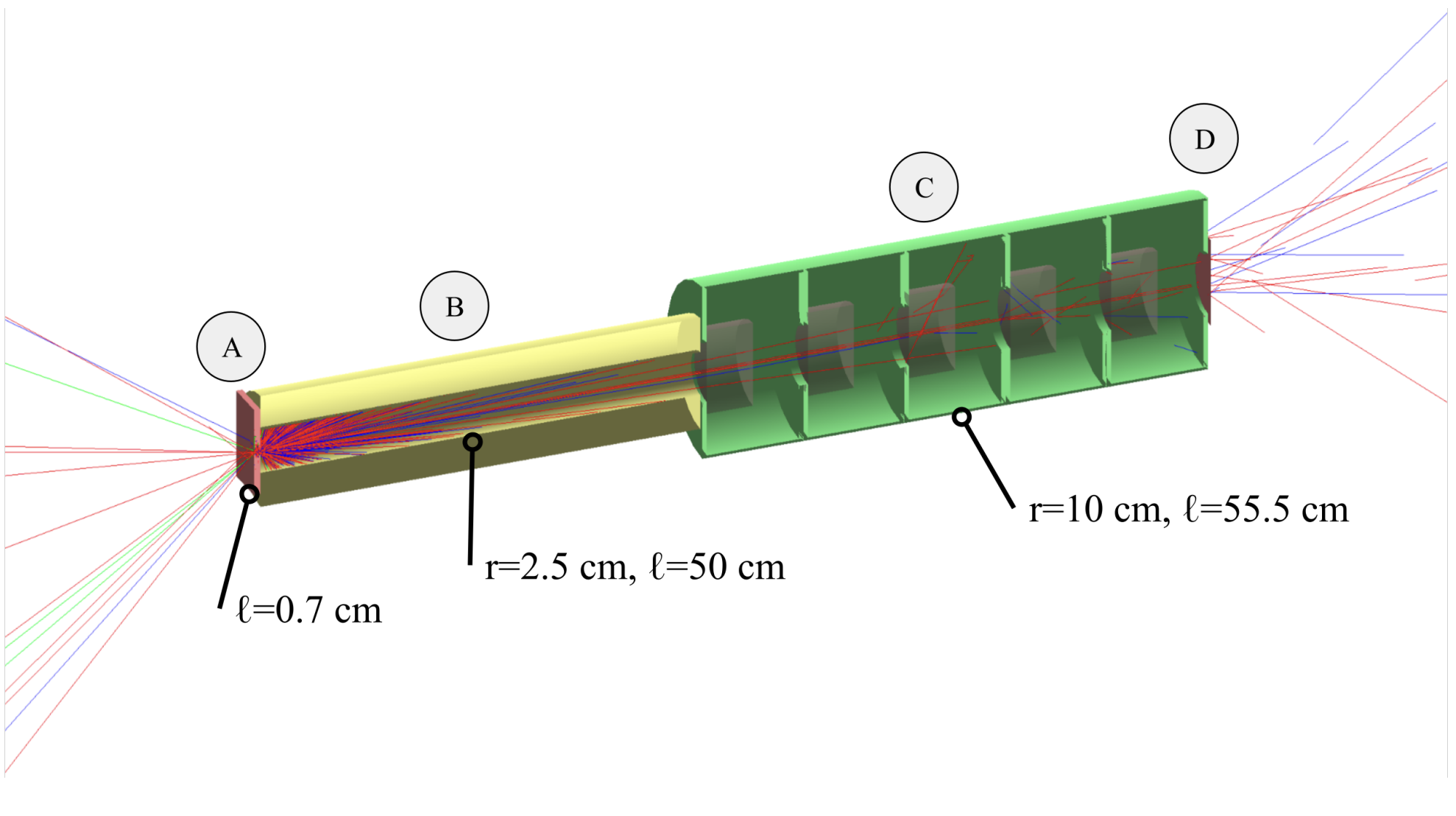
The research focuses on improving the efficiency of a positron source, a crucial component in applications ranging from materials science to fundamental physics and medical imaging. The primary method employed was Monte Carlo simulation using the GEANT4 toolkit and the G4beamline package, allowing them to model the complex interactions of electrons, photons, and positrons within the source. Several moderator designs were investigated, including a simple polycrystalline tungsten foil, a foil combined with an adiabatic matching device and a radiofrequency cavity, a mesh of tungsten foils, and a solid tungsten cylinder. By comparing the efficiency of each design, the researchers identified key factors influencing positron production.
Adding the adiabatic matching device and radiofrequency cavity significantly improved the positron yield for all moderator designs tested. The single-crystal moderator demonstrated the highest efficiency, achieving a 39. 3-fold improvement over the simple foil moderator. The grid moderator also showed substantial improvement, yielding 20 times more positrons than the simple foil. The superior performance of the single-crystal moderator is attributed to its larger diffusion length, allowing more positrons to be emitted.
The single-crystal tungsten moderator, combined with an adiabatic matching device and RF cavity, is the most promising design for a high-efficiency positron source. The research demonstrates the importance of careful moderator design and optimization to maximize positron yield. The simulations provide valuable insights for the development of future positron sources for various applications.
Record Positron Yields with Radiofrequency Cavity
Researchers have achieved a significant breakthrough in positron moderation, a crucial process for creating slow positrons used in various scientific applications. This substantial gain represents a major step forward in positron source technology. The team meticulously optimized each component of the system, beginning with the target material. Calculations revealed optimal thicknesses of 4. 5-8.
5 mm for tungsten and 5. 5-10. 0 mm for tantalum, with tungsten ultimately selected due to its higher melting point and lower cost. Positrons generated from 100 MeV electron collisions with the 7 mm tungsten target initially exhibit a broad energy distribution, peaking at approximately 3 MeV. To focus the beam, an adiabatic matching device was employed, reducing the angular divergence of nearly all particles to under 300 milliradians, enabling efficient transmission through the subsequent stages.
Further refinement involved a five-cell L-band radiofrequency cavity, tuned using a simulated annealing algorithm. This optimization process maximized the number of positrons decelerated to energies below 200 keV, a critical range for effective moderation. The cavity successfully increased the number of low-energy positrons by a factor of 15, significantly enhancing the overall yield. These combined advancements promise to unlock new possibilities in positron-based research, including materials science, fundamental physics, and medical imaging.
Optimized Moderation Boosts Positron Yield Thirtyfold
The research demonstrates a significant improvement in the efficiency of positron moderation, a crucial step in producing slow positrons for various applications. This novel calculation accounts for edge effects, providing a more accurate representation of positron behaviour. The authors acknowledge that the simulations rely on approximations within the G4beamline software and that further experimental validation is needed to confirm the predicted performance gains. Future work could focus on building and testing a prototype positron source based on these optimised designs, potentially leading to more efficient and compact sources for materials science, medical imaging, and fundamental physics research.
🗞 Moderator Simulation for the Compact Positron Source at NLCTA
🧠 ArXiv: https://arxiv.org/abs/2508.15975


See today’s quantum computing news on Quantum Zeitgeist for the latest breakthroughs in qubits, hardware, algorithms, and industry deals.