Quantum algorithms promise to revolutionise computation, but realising this potential requires overcoming challenges in optimising complex quantum circuits, and researchers are continually seeking ways to improve their efficiency. Théo Lisart-Liebermann and Arcesio Castanadena Medina, both from Fraunhofer ITWM, alongside their colleagues, demonstrate a significant advance by combining techniques that pre-optimise circuit parameters with a dynamic reconfiguration algorithm. Their work reveals that initialising quantum circuits using specifically chosen, efficient “Clifford Points” not only improves the speed at which solutions are found, but also allows for a fully classical approach to selecting the most effective circuit configurations. Importantly, the team’s findings suggest that many quantum circuit designs contain unnecessary complexity, opening the door to aggressive simplification and optimisation strategies that could accelerate the development of practical quantum computers.
Clifford Initialization Boosts Quantum Optimization Performance
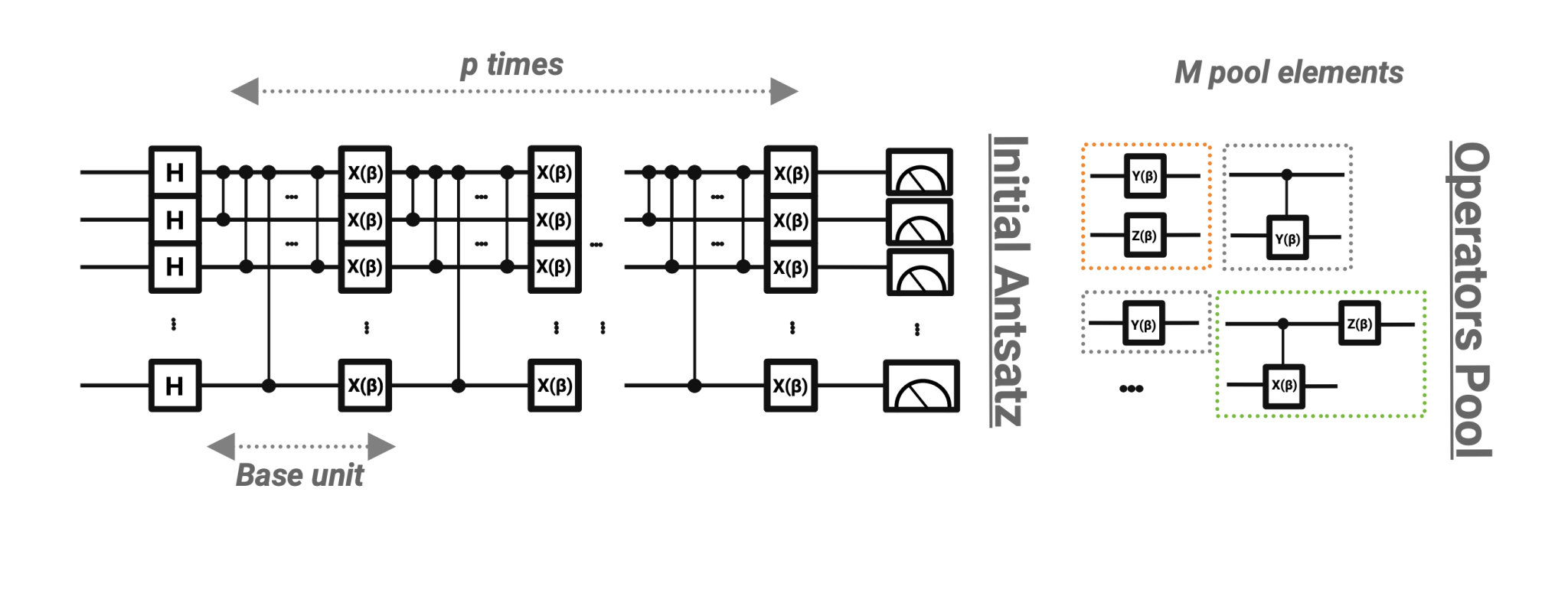
Providing better initial conditions represents a key area of improvement in quantum optimization algorithms. Simultaneously, dynamical circuit reconfiguration algorithms, such as ADAPT-QAOA, enhance performance by adjusting gate configurations during optimization. This article demonstrates that Clifford circuit approximations, at multiple levels within ADAPT, allow for several improvements while increasing opportunities for integrating classical and quantum computation. Initial results show that Clifford circuit pre-optimization offers beneficial gate selection behavior in ADAPT, with potential for accelerating convergence.
Clifford Initialization Boosts Quantum Algorithm Performance
Researchers have significantly enhanced the performance of Variational Quantum Eigensolver (VQE) and Quantum Approximate Optimization Algorithm (QAOA) algorithms through a novel approach called Clifford Circuit Initialization. This method leverages the efficiency of quantum circuits constructed from Clifford Group gates to pre-optimize the parameter space, leading to improved initial guesses for circuit parameters. By exploring the solution space using a reduced set of “Clifford Points,” the team achieved better initialization and, consequently, enhanced optimization performance. The core of this advancement lies in integrating Clifford approximations at multiple levels within the ADAPT-QAOA algorithm, a technique that dynamically reconfigures circuits during optimization.
Experiments demonstrate that Clifford Point pre-optimization introduces beneficial gate selection behavior within ADAPT, potentially accelerating convergence. Furthermore, the researchers developed a fully parallel and fully classical ADAPT operator selection routine applicable to both the MaxCut problem and the Transverse Field Ising Model (TFIM), streamlining the optimization process. A key finding reveals that applying error approximations of 10 to 30 percent on T-gates, using a low-rank stabilizer decomposition, can substantially improve convergence quality for MaxCut and TFIM problems. This suggests that many existing circuit designs over-represent T-gates, opening opportunities for aggressive circuit compilation optimizations and reducing quantum resource requirements. The team’s results confirm that this approach allows for significant quantum-classical integration, reducing the need for extensive calls to the Quantum Processing Unit (QPU) when they do not contribute to computation speed or cost. This work represents a substantial step towards more efficient and scalable quantum algorithms for complex optimization problems.
Clifford Initialization Improves ADAPT-QAOA Performance
This research explores methods to improve the performance of the ADAPT-QAOA algorithm, a technique used to solve complex optimization problems. The team investigated the benefits of initializing the algorithm with parameters derived from Clifford circuits, which are relatively easy to simulate classically, and of approximating certain quantum gates with lower-rank alternatives. Results demonstrate that selecting operators based on Clifford points enhances the ADAPT process, leading to a preference for RZZ gates and a reduction in the need for single-qubit RY gates. Importantly, this approach allows for complete classical simulation of the Clifford portions of the circuit, opening opportunities for integrating classical and quantum computation.
The team also found that introducing a small degree of error, around 10 to 30 percent, when approximating T-gates using low-rank decomposition can significantly improve convergence rates for both the MaxCut and TFIM problems, suggesting that current circuit designs may over-represent these gates. The authors acknowledge that the observed improvements are problem-dependent, with the benefits of Clifford pre-optimization varying between MaxCut and TFIM. Future work could focus on exploring these methods with different problem structures and larger system sizes, and on developing strategies to automatically identify and reduce the over-representation of T-gates in quantum circuits.
See today’s quantum computing news on Quantum Zeitgeist for the latest breakthroughs in qubits, hardware, algorithms, and industry deals.