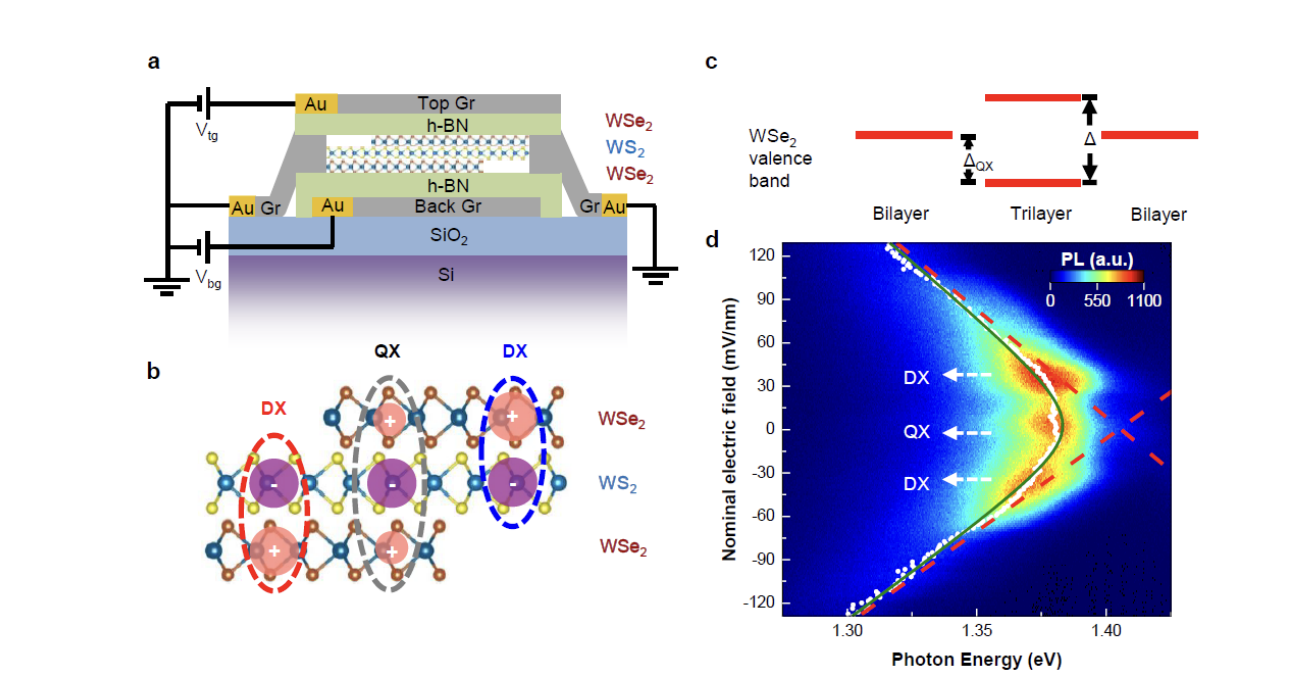
Trilayer moiré superlattices, formed from stacked sheets of materials, present a fascinating frontier in materials science, allowing the emergence of unusual excitonic states with potential for novel electronic behaviour. Yuze, along with colleagues at institutions including [Institution names not provided in source], now demonstrates a remarkable ability to control transitions between these states, specifically between quadrupolar and dipolar excitons. The team reveals that strong interactions between excitons and electrons, driven by inherent electronic correlations within the material, provide a pathway to manipulate these transitions by adjusting either the density of excitons or applying an electrostatic charge. This discovery significantly advances fundamental understanding of quadrupolar excitons and, crucially, opens exciting possibilities for engineering correlated excitonic phenomena in these advanced semiconducting structures.
Trilayer TMDs Exhibit Quadrupolar Excitons
Researchers have uncovered evidence of unusual quasiparticles called quadrupolar excitons within carefully constructed trilayer materials, expanding our understanding of how electrons and holes interact in layered structures. These materials, created by stacking layers of transition metal dichalcogenides, exhibit a unique arrangement known as a moiré superlattice, which hosts these distinct excitons alongside more common dipolar excitons. The team demonstrated that the properties of both types of excitons can be tuned by applying an external electric field, offering a new avenue for controlling these quantum phenomena. This research builds upon previous work exploring correlated electronic states in similar layered materials, suggesting the possibility of creating entirely new electronic phases.
The team fabricated these trilayer structures using a precise layering technique, combining different transition metal dichalcogenides and hexagonal boron nitride. They then used a specialized microscope to observe the material’s optical properties, specifically focusing on the light emitted when excited by a laser. By analyzing this light, they identified the energies of the excitons and how they respond to changes in the electric field. This detailed analysis confirmed the existence of quadrupolar excitons and their sensitivity to external control, opening up possibilities for future device applications.
Quadrupolar to Dipolar Exciton Transitions Demonstrated
Researchers have achieved unprecedented control over quadrupolar excitons within a specially designed trilayer material, paving the way for exploring advanced quantum phenomena. The team constructed a device from alternating layers of tungsten diselenide and tungsten disulfide, creating a moiré superlattice that hosts these unique excitons. This innovative structure allows for the manipulation of exciton interactions and the observation of transitions between different excitonic states. By tuning either the density of excitons or the electrical doping of the material, researchers can drive transitions between quadrupolar and dipolar excitons.
Increasing optical excitation initially induces a transition from quadrupolar to dipolar excitons, and subsequently a reverse transition back to quadrupolar excitons at higher excitation intensities. This behavior arises from the interplay between exciton-exciton repulsion and the confining potential of the moiré structure, effectively freeing excitons from confinement at higher densities. Detailed analysis of the material’s photoluminescence revealed distinct resonances, confirming the ability to manipulate these states with both excitation intensity and electrical doping. This work establishes a powerful platform for exploring and controlling correlated excitons and promises to advance the development of novel quantum technologies.
Exciton Control via Density and Charge Tuning
This research demonstrates the ability to control transitions between two distinct types of excitons, quadrupolar and dipolar, within a trilayer material created from stacked transition metal dichalcogenides. By tuning either the density of excitons or applying an electrostatic charge, researchers were able to switch between these exciton states, leveraging strong interactions between excitons and electrons arising from the material’s unique electronic properties. This control stems from a deeper understanding of how electron correlations and the moiré potential influence quadrupolar excitons. The ability to manipulate these interactions opens up new possibilities for exploring fundamental physics and developing advanced materials. The findings advance fundamental knowledge of these exotic exciton states and open new possibilities for engineering correlated excitons in multilayer materials. This ability to manipulate exciton interactions could pave the way for exploring novel quantum phenomena and developing new technologies based on these materials.
🗞 Strong Correlation Driven Quadrupolar to Dipolar Exciton Transitions in a Trilayer Moiré Superlattice
🧠 ArXiv: https://arxiv.org/abs/2508.16009
See today’s quantum computing news on Quantum Zeitgeist for the latest breakthroughs in qubits, hardware, algorithms, and industry deals.