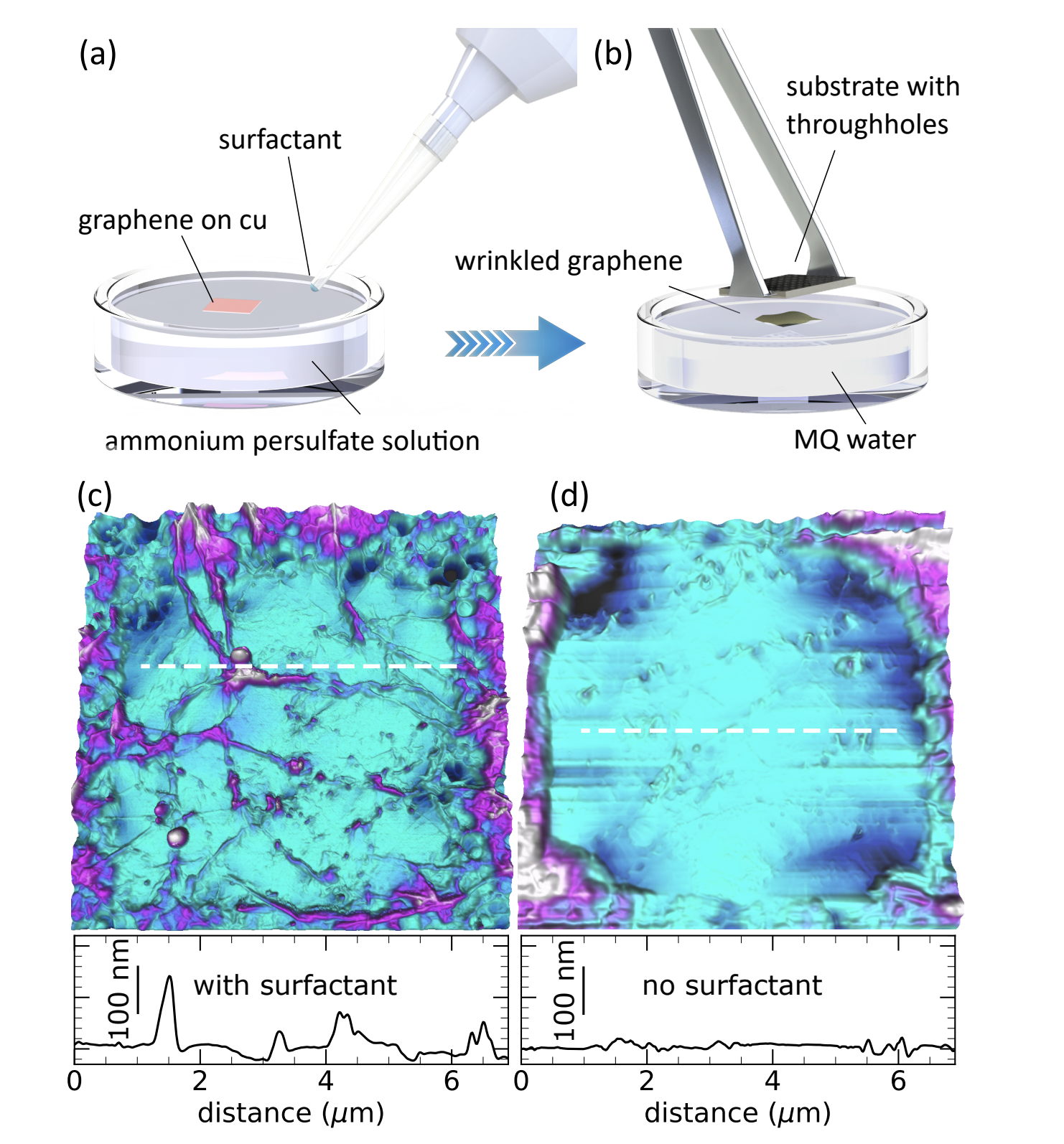
The pursuit of increasingly sensitive nanomechanical devices faces a fundamental challenge: achieving stability with materials of extremely low bending rigidity. Hadi Arjmandi-Tash, Roshan Prasad, and Hanqing Liu, all from Delft University of Technology, alongside colleagues including Dominic Vella from the University of Oxford, present a novel approach to overcome this limitation by intentionally introducing wrinkles into single-layer graphene membranes. This research demonstrates that carefully sculpting these wrinkles dramatically increases the material’s bending rigidity, boosting it by several orders of magnitude and enabling the creation of robust, nanoscale cantilevers with femtogram-scale mass. The team’s findings reveal a shift in mechanical behaviour, moving from tension-dominated properties to a regime where bending dominates, and pave the way for advancements in nanomechanical sensing and cantilever-based technologies.
Graphene Tension and Resonant Frequency Measurements
Researchers investigated the mechanical properties of monolayer graphene, focusing on its tension and resonant frequency. They developed theoretical models to understand how these properties relate to the material’s behavior under stress and vibration, estimating the areal mass density to be approximately 10 -5 kg/m 2 and an effective pre-tension of around 0. 1 N/m through indentation experiments. These values served as key parameters in their models, revealing that surfactant-mediated samples exhibited a factor of two increase in measured stiffness compared to standard samples. The theoretical work analyzed the relationship between indentation stiffness, indenter size, and material properties like tension and bending stiffness.
Researchers used dimensionless variables to simplify the problem and explored the material’s response at different bending stiffness levels, finding that when bending stiffness is low, the indentation stiffness is largely determined by the indenter size. As bending stiffness increases, it begins to dominate, with boundary conditions at the center of the graphene membrane introducing an effective indenter radius related to the bendocapillary length. To predict the resonant frequency of graphene membranes, the researchers developed a model incorporating the membrane’s inertia, tension, and bending stiffness. Solving an eigenvalue problem with dimensionless variables, they found that in the limit of low bending stiffness, the resonant frequency is largely determined by tension. As bending stiffness increases, the frequency becomes more strongly influenced by this property, eventually scaling with its square root. A composite approximation combining these two limits provides a more accurate prediction of the resonant frequency.
Wrinkling Graphene Boosts Cantilever Rigidity
Researchers have developed a technique to dramatically increase the bending rigidity of graphene cantilevers by intentionally introducing wrinkles into the material. This innovation overcomes a fundamental challenge in creating stable, highly sensitive nanomechanical devices, enabling the fabrication of robust cantilevers capable of precise measurements. The team fabricated graphene cantilevers ranging from 5 to 7 μm in length and 2 to 3 μm in width using a focused ion beam. They then analyzed the bending rigidity of these cantilevers using atomic force microscopy (AFM) nanoindentation, a technique that measures the force required to deform the material.
Unlike fully clamped membranes, the cantilever geometry allows for direct probing of bending rigidity, providing a more accurate assessment of this crucial property. Detailed mapping using AFM revealed an up-curvature in most samples, with one sample curling up by approximately 1. 8 μm over a length of 4 μm. Analyzing the force-displacement curves obtained from nanoindentation allowed researchers to infer the height and slope profiles of the cantilevers, providing insights into their mechanical behavior. Modeling the system as a series of springs, combining the spring constant of the AFM probe with that of the graphene cantilever, allowed them to estimate the bending rigidity, which ranged from 10 6 to 10 7 eV, representing a significant increase compared to pristine graphene.
Wrinkling Graphene Dramatically Increases Membrane Stiffness
Researchers have achieved a breakthrough in nanomechanical systems by demonstrating a method to dramatically enhance the stiffness of monolayer graphene. By inducing wrinkles, the team created membranes with bending rigidity increased by several orders of magnitude, enabling the fabrication of mechanically robust cantilevers capable of operating at the atomic limit. This wrinkle-induced stiffening overcomes a fundamental challenge in nanotechnology, where low bending rigidity often compromises stability. Experiments revealed that these wrinkled membranes exhibit substantial increases in both in-plane and out-of-plane stiffness, as confirmed by nanoindentation and resonance measurements.
Notably, the enhanced bending rigidity strongly influences the vibrational response of the structures, marking a transition from tension-dominated mechanics to a regime where bending effects become prominent, even within a single atomic layer. The team sculpted these structures into cantilevers with measured bending rigidities ranging between 10 5 and 10 6 eV, while maintaining remarkably low masses on the scale of femtograms. Resonance frequency measurements across drums of varying diameters showed frequencies ranging from 6. 7 MHz (for a diameter of 9 μm) to 37 MHz (for a diameter of 3 μm), revealing a scaling trend intermediate between ideal membrane and plate limits.
Data analysis, incorporating a theoretical model accounting for finite bending rigidity, suggests that the observed frequencies are best explained by bending rigidity values in the range of 10 5 -10 6 eV, closely matching values obtained from nanoindentation. Further analysis involved fabricating nine cantilevers with lengths ranging from 5 to 7 μm and widths from 2 to 3 μm, and analyzing their bending rigidity with AFM nanoindentation, revealing linear dependencies between force and displacement. These findings open new directions in nanomechanical sensing and cantilever-based technologies, promising more robust and sensitive nanoscale devices.
Wrinkled Graphene Exhibits Enhanced Bending Rigidity
This study demonstrates that introducing wrinkles into graphene significantly enhances its bending rigidity, enabling the fabrication of stable, low-mass cantilevers. Researchers successfully created graphene cantilevers with femtogram-scale mass and measured bending rigidities ranging between 10 5 and 10 6 eV, a substantial increase compared to pristine graphene. These findings reveal a transition from tension-dominated mechanics to a regime where bending effects become prominent, even in a single atomic layer, and are confirmed through both nanoindentation and resonant measurements. The enhanced mechanical performance of wrinkled graphene opens possibilities for ultrasensitive nanomechanical systems (NEMS) devices.
🗞 Mechanical Reinforcement of Graphene via Wrinkling
🧠 ArXiv: https://arxiv.org/abs/2508.16340



See today’s quantum computing news on Quantum Zeitgeist for the latest breakthroughs in qubits, hardware, algorithms, and industry deals.