The behaviour of systems constantly gaining and losing energy, known as driven-dissipative systems, often leads to complex and stable states far from equilibrium, and understanding these states is a major challenge in modern physics. Kilian Seibold, Greta Villa, and colleagues at the University of Konstanz, along with Javier del Pino from the Universidad Autónoma de Madrid, now demonstrate that the underlying ‘flow’ of the system within its energy landscape powerfully dictates the stability and characteristics of these states. Their research reveals that these quantum systems retain key features of their classical counterparts, offering a new way to identify and control robust phases, and potentially advancing fields such as error correction. By examining a driven-dissipative Kerr oscillator, the team predicts previously unobserved phases, expanding the criteria used to detect transitions between different states of matter and highlighting the importance of phase-space flow topology as a fundamental organising principle.
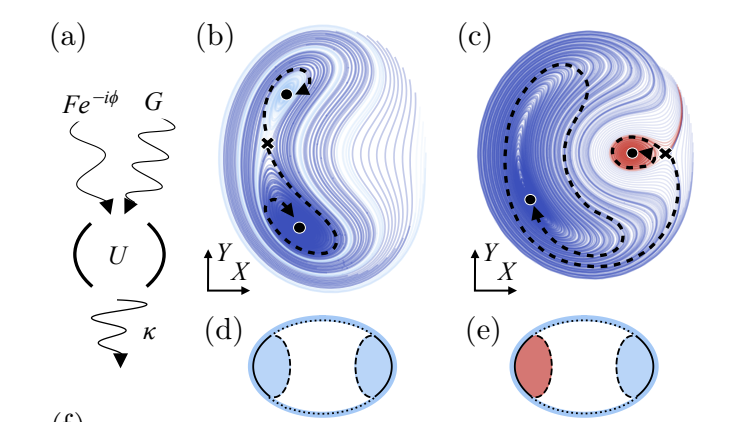
These systems, characterized by coherent driving, interactions, and dissipation, exhibit a rich variety of dynamic behaviors, and the team discovered that the arrangement of these states in phase space dictates their overall stability and structure. Experiments reveal that topological transitions, changes in the number, chirality, or connectivity of these states, correspond to fundamental reorganizations within the system’s dynamic landscape. This correspondence is significant because it provides accessible diagnostics, measurable through state tomography and linear response techniques, to probe the system’s internal organization.
Results demonstrate the prediction of new phases not previously identified by conventional methods that rely on detecting the closing of Liouvillian gaps, thereby expanding the toolkit for characterizing phase transitions. This breakthrough delivers a powerful new approach to identifying and controlling robust phases in these complex systems, with potential applications in error correction and quantum technologies. The findings show that the proposed diagnostics are directly accessible through heterodyne detection, offering a practical route for probing flow topology in current superconducting and photonic platforms. Looking ahead, researchers are exploring extensions to multimode systems, investigating the link between flow topology and photon blockade, and developing bosonic codes tailored for fault-tolerant quantum computation. More broadly, this work establishes a spectral framework for characterizing non-equilibrium transitions, moving beyond the limitations of traditional Liouvillian gap analysis and opening new avenues for research in diverse physical systems.
Classical Topology Reveals Quantum Phase Transitions
This research demonstrates that the topology of classical flow patterns leaves discernible signatures in the steady states of driven-dissipative quantum systems, specifically a Kerr resonator with single- and two-photon drives. The team revealed that features of classical phase-space flow, such as the number, arrangement, and stability of fixed points, are reflected in the quantum system’s Wigner function. Importantly, these topological features remain robust even in the deep quantum regime, where quantum fluctuations would typically obscure classical behaviour. By analysing frequency-resolved chirality spectra, researchers can extract local winding signatures from fluctuation modes, providing a practical diagnostic accessible through standard heterodyne detection techniques.
Driven Dissipative Nonlinear Quantum Systems
This body of work represents a comprehensive investigation of open quantum systems, with a particular focus on nonlinear optics, driven-dissipative systems, and their potential applications in quantum information science. The research explores how quantum systems interact with their environment, leading to dissipation and decoherence, and how external driving forces can be used to create novel quantum states and phenomena. A key theme is the exploration of nonlinearities, which allow for the creation of complex quantum states like cat states, and their use in enhancing quantum information processing. The research encompasses a wide range of theoretical and experimental studies, with a strong emphasis on circuit QED, a superconducting circuit platform ideal for realizing and controlling quantum systems.
Researchers investigate the dynamics of these systems, focusing on the stability and robustness of non-equilibrium states, and develop new techniques for characterizing and manipulating quantum states. A significant goal is to improve quantum error correction, a crucial step towards building fault-tolerant quantum computers. The work also explores quantum measurement and state estimation, developing methods for accurately characterizing the properties of quantum systems. The research builds upon foundational theories of open quantum systems and quantum optics, while also pushing the boundaries of current knowledge.
Researchers are particularly interested in exploiting higher-order nonlinearities and utilizing cat states as a key resource for squeezing, error correction, and exploring non-classical behaviour. The frequent collaboration between different research groups suggests a strong synergy and a shared focus on advancing the field. The work demonstrates a clear emphasis on building practical quantum technologies, with a focus on developing robust and scalable quantum systems.
🗞 Manifestations of flow topology in a quantum driven-dissipative system
🧠 ArXiv: https://arxiv.org/abs/2508.16486