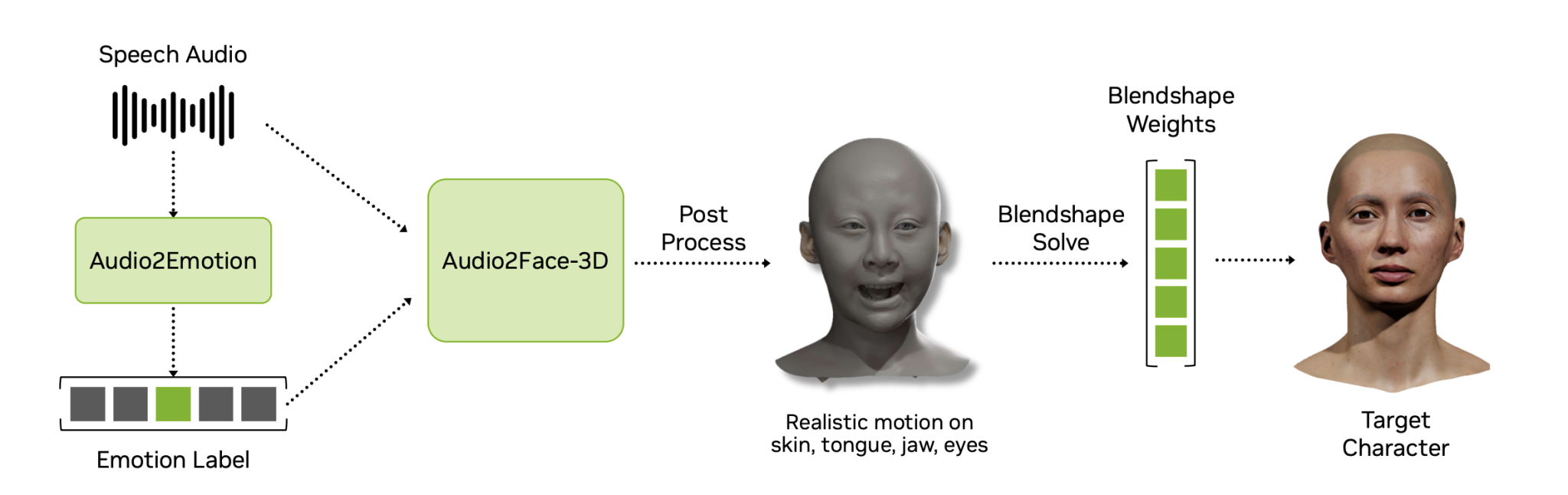
Creating realistic facial animation for digital avatars remains a significant challenge in interactive media, but researchers now present Audio2Face-3D, a system that drives animation directly from audio input. This innovative approach enables real-time interaction between people and their digital representations, offering a powerful tool for creating believable characters in games and virtual environments. The system allows for the automatic generation of facial movements synchronised with speech, removing the need for laborious manual keyframing and opening up new possibilities for dynamic, responsive avatars. By open-sourcing the underlying networks, software development kit, training framework, and a sample dataset, the team aims to empower digital content creators and accelerate the development of more immersive and engaging experiences.
Achieving lifelike avatars requires high-quality facial animation, traditionally involving extensive manual work and video-based motion capture systems. These limitations motivate the development of methods that can generate realistic facial animation directly from audio, offering a more flexible and accessible solution for a wider range of applications. This research addresses the need for automated facial animation techniques, aiming to provide a streamlined process for creating believable and expressive digital characters.
Audio-Driven 3D Facial Animation Generation
This document details the research behind Audio2Face-3D, a system for generating realistic talking head animations from audio. The core idea is to map features within audio to corresponding 3D facial movements, creating natural and expressive animations. This work builds upon extensive prior research in speech animation and lip synchronisation, which have evolved from dynamic programming and rule-based systems to learning mappings from audio to visual speech units. Researchers have also explored various techniques for 3D facial modeling and animation, such as blendshapes, mesh deformation, and inverse rigging.
A crucial element of this field is the use of generative models, particularly diffusion models, which have become dominant in image and video generation. Several recent papers demonstrate the effectiveness of diffusion models for talking head animation, while earlier generative models like GANs remain relevant. Techniques like CLIP, which aligns text and images, can be used to control stylistic elements, and Neural Radiance Fields (NeRFs) are leveraged for rendering realistic talking heads. Current trends emphasize style control, one-shot generation, and accurate audio-visual alignment. In essence, this document provides a comprehensive overview of the state-of-the-art in talking head animation, with a particular focus on the techniques driving progress in this field.
Realistic Facial Animation from Raw Audio
Researchers have developed Audio2Face-3D, a system that generates realistic facial animation directly from audio input, enabling more natural interactions between users and digital avatars. The core of the system lies in its ability to translate nuances in speech into corresponding facial movements, creating expressive and detailed animations in real time. To broaden the applicability of this technology, the team has open-sourced the Audio2Face-3D networks, a software development kit, a training framework, and an example dataset, fostering further innovation in the field. The system generates animation by directly manipulating vertex positions on a facial mesh, adapting to different avatar designs through a blendshape solver that fits a blendshape model to the generated motion.
This solver operates by minimizing the difference between the target expression and the synthesized geometry, focusing on visually salient regions like the lips, eyelids, and nasolabial folds. To ensure stability and realism, the solver incorporates regularization terms, discouraging excessively large weight magnitudes and promoting sparse activation patterns. A temporal regularization term encourages consistency between frames, smoothing facial motion and reducing jitter, while constraints limit weights and enforce mutual exclusion between incompatible poses. The team adopted the ARKit blendshape schema, personalizing these targets to better match the expressions of individual subjects, balancing generality with subject-specific accuracy. The resulting system delivers a powerful and versatile solution for creating realistic and engaging facial animations, with significant implications for gaming, virtual reality, and other interactive applications.
Realistic Facial Animation from Speech and Emotion
This work presents Audio2Face-3D, a system designed to generate realistic facial animations for digital avatars driven by audio input. The researchers trained both regression and diffusion-based networks using a high-quality dataset of 4D facial capture, enabling the system to produce lip-synchronisation and broader facial movements from any speech input, regardless of language or speaker. The resulting animations function in real-time, supporting both interactive applications and offline authoring of facial performances. Notably, the system extends beyond simple lip-sync by incorporating Audio2Emotion, a network that infers emotional state from speech and translates it into corresponding facial expressions, reducing the need for manual adjustment. The team has released the networks, software development kit, training framework, and dataset as open-weight and open-source resources, aiming to broaden access to digital human technology.
🗞 Audio2Face-3D: Audio-driven Realistic Facial Animation For Digital Avatars
🧠 ArXiv: https://arxiv.org/abs/2508.16401