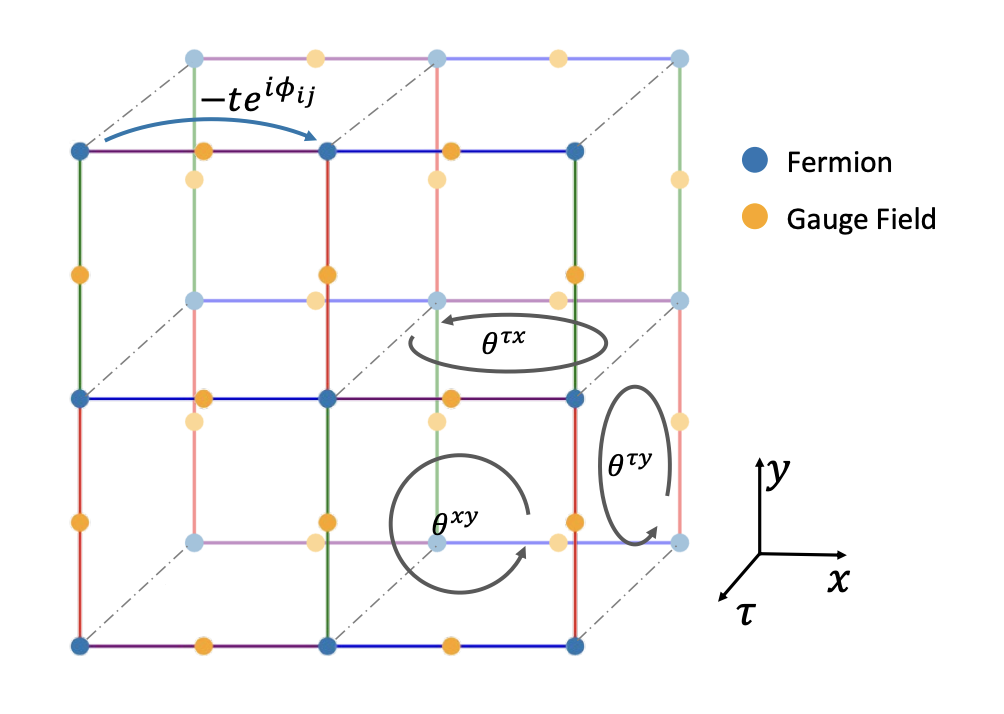
Understanding the behaviour of fundamental particles requires solving incredibly complex calculations, and a long-standing challenge in physics involves accurately simulating interactions between gauge fields and fermions. Kexin Feng, alongside collaborators at the University of Science and Technology of China and the University of California, Irvine, now presents a new computational method that dramatically accelerates these simulations. Their work introduces a hybrid quantum Monte Carlo algorithm, optimised for modern graphics processing units, which achieves a significantly improved scaling efficiency compared to existing techniques. This advancement allows researchers to model the exotic Dirac spin liquid state with unprecedented precision and at much larger system sizes, revealing crucial details about its fundamental properties and providing strong evidence for its predicted conformal behaviour, ultimately paving the way for deeper investigations into this and other complex quantum phenomena.
The simulations are performed within the framework of (2+1)-dimensional quantum electrodynamics, known as QED3. The algorithm achieves a high acceptance rate and exhibits nearly linear scaling of computational complexity with system size, expressed as O(NτVs), where Nτ represents the imaginary time dimension and Vs denotes the spatial volume. This represents a substantial improvement in efficiency compared to traditional methods, which typically scale as O(NτV3s). This acceleration is achieved through innovations in problem-specific preconditioning, customized code for matrix calculations, and the implementation of CUDA graphs, allowing for simulations of unprecedentedly large system sizes.
Detailed Calculations Confirm Spin Liquid Phase
This document provides a detailed technical supplement to a research paper investigating a potential U(1) spin liquid phase in a lattice model. It offers a comprehensive explanation of the methods and results, ensuring transparency and facilitating reproducibility. The supplement details the mathematical derivations essential for understanding the calculations, while avoiding unnecessary complexity in the main paper. It allows other researchers to verify the findings and potentially extend the work, providing a complete understanding of the underlying physics. The document details the derivation of fermionic correlation functions, used to characterise the spin liquid phase.
The researchers define the spin operator in terms of fermionic creation and annihilation operators, and then define the bond operator, representing fermion hopping between neighbouring sites, incorporating the phase of the gauge field. They then derive expressions for the spin and bond correlation functions, relating them to the Green’s function of the fermions and the gauge field using Wick’s theorem. The calculations explicitly account for the effects of the fluctuating gauge field on the correlation functions, simplifying the expressions to obtain final forms that can be measured in numerical simulations. Key concepts underpinning this work include the U(1) spin liquid, a quantum state characterised by fractionalized excitations and a gapless spectrum, and the process of fractionalization, where electrons break down into independent excitations.
The fluctuating gauge field is crucial for mediating interactions between these excitations and enforcing the constraints of the U(1) spin liquid. The Green’s function describes the propagation of fermions in the system and is a fundamental quantity in many-body physics. Wick’s theorem is a powerful tool for calculating correlation functions, and hybrid quantum Monte Carlo (HQMC) is a numerical method used to simulate quantum systems with fermionic degrees of freedom. Correlation functions provide information about spatial correlations between operators, revealing long-range order or disorder. This supplement is important because it provides a rigorous validation of the methods used in the research, enabling reproducibility and facilitating extensions of the work. The detailed explanations deepen our understanding of the physics of U(1) spin liquids, providing a crucial foundation for future investigations. In summary, this document is an essential companion to the research paper, offering the technical details and mathematical derivations necessary for a complete understanding of the methods, results, and underlying physics.
Efficiently Simulating the Dirac Spin Liquid State
This research presents a new computational method for studying the Dirac spin liquid state, a complex quantum phenomenon relevant to both condensed matter and high-energy physics. The team developed a hybrid Monte Carlo algorithm, accelerated using graphics processing units (GPUs), to simulate this state with significantly improved efficiency compared to existing techniques. This advancement stems from innovations in problem-specific preconditioning, customized code for matrix calculations, and the implementation of CUDA graphs, allowing for simulations of unprecedentedly large system sizes.
The results demonstrate the algorithm’s ability to accurately calculate key properties of the Dirac spin liquid, including the scaling dimensions of various operators, and confirm theoretical predictions about its conformal nature. This provides valuable supporting evidence for understanding the behaviour of this quantum state and its potential connection to materials exhibiting similar properties. While the current work focuses on the fundamental properties of the Dirac spin liquid, the authors acknowledge limitations related to extrapolating results to the absolute thermodynamic limit. Future research will likely focus on exploring transitions to other phases and applying this improved computational method to study more complex systems and materials, potentially bridging the gap between theoretical models and experimental observations.
🗞 Scalable Hybrid quantum Monte Carlo simulation of U(1) gauge field coupled to fermions on GPU
🧠 ArXiv: https://arxiv.org/abs/2508.16298
See today’s quantum computing news on Quantum Zeitgeist for the latest breakthroughs in qubits, hardware, algorithms, and industry deals.